This is a mystery flower, one of three that I've never been successful in identifying. Can anyone tell me what it is?
UPDATE: Apparently it's Starwort, an invasive weed native to Ireland.

Cats, charts, and politics

This is a mystery flower, one of three that I've never been successful in identifying. Can anyone tell me what it is?
UPDATE: Apparently it's Starwort, an invasive weed native to Ireland.
Criminologist John Pfaff brings this chart to our attention today:

There are a couple of things to notice. First, people always think that crime is worse overall than it is in their own neighborhood. Second, in 2020 perceptions of local crime went down while perceptions of overall crime went up.
It's not hard to figure out what happened in 2020. Basically, perceptions of neighborhood crime—i.e., crime that people know about firsthand—didn't change much. But an endless Fox News focus on the crime associated with George Floyd protests convinced a lot of people that America's cities were aflame. It was never really true, but on TV it sure looked true.
This is all part of a continuing perception that you take your life in your hands if you visit an American city. I've gotten this reaction a surprising number of times from friends who are sort of startled if I tell them I'm going up to LA. "Isn't that dangerous?" And this is LA in the middle of the day. It's not special pleading to say that it's not even remotely dangerous. But a surprising number of people don't know this.
I blame TV in general, Fox News in particular, and long memories that go back to an era when big cities actually were dangerous in certain areas. Obviously you shouldn't be an idiot, and there are certainly sketchy places that anyone with sense would avoid at night. But downtown areas in general in the daytime? Mostly they're no more dangerous than your local shopping mall.
I wrote about a pet peeve yesterday, so why not tackle another one today? Here is Alexandra DeSanctis at National Review arguing that opposition to abortion isn't really based on religious beliefs:
One need not be religious to acknowledge biological reality: The unborn child is a distinct, living human being. Abortion therefore is an act of violence. It is a procedure that, when successful, kills that distinct, living human being. It should be obvious that attempting to restrict or abolish such a procedure does not require imposing God or religion on other citizens; it doesn’t even require belief in God.
This is so tiresome. For the past several decades the anti-abortion movement has been driven by the idea that "life begins at conception." That is, at the moment of conception the embryo becomes a human being who deserves the full protection of the law. But there's no special secular reason to choose conception as the dividing line. It could just as well be based on heartbeat or brain development or viability outside the womb or anything else. It's a gray area. The only reason to insist on conception is if you also believe this is the moment that the embryo acquires a soul from God.
But you hardly even need to bother with philosophical arguments, which will only lead you down a rabbit hole anyway. Just look at what real-life people actually think. According to a Pew survey, virtually everyone who opposes abortion believes strongly in God. And there's this:

Hardly any atheists believe abortion should be illegal. It's almost exclusively a belief held by religious folks, and the more religious they are the more they believe it. In real life, full-on opposition to abortion is very obviously a religious conviction.
DeSanctis is annoyed at people who think that striking down Roe v. Wade puts us on a path to theocracy. Fine. I understand. But at the same time, opposition to abortion from conception onward is very clearly a religious belief. Denying this leads conservative writers to tie themselves in knots, desperately trying to find secular arguments that just happen to produce exactly the conclusions that their particular religion teaches. You are treating your readers like idiots when you do this.
I am genuinely puzzled by this:

A third of the country thinks 9/11 changed America for the better? That seems crazy to me. Off the top of my head, 9/11 produced the following changes:
I suppose you might think that the general increase in security is a good thing because we were too complacent about terrorism before 9/11. But that's all I can come up with.
I feel like I must be missing something really obvious here. But what?
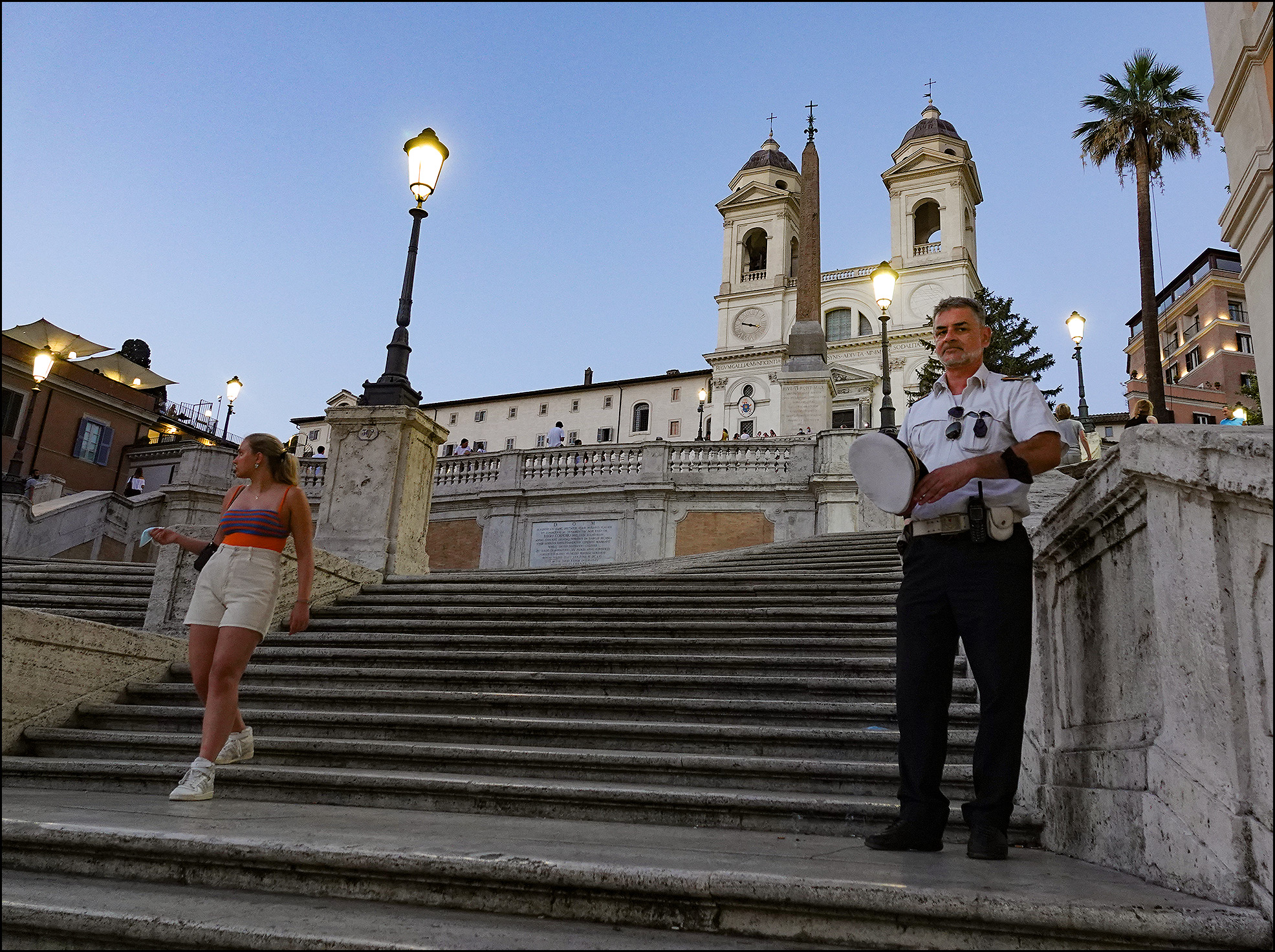
A couple of years ago the municipal government of Rome decided to make it illegal to sit on the Spanish Steps. Why? I'm still not entirely sure. The New York Times reported at the time that "Rome has tried for years to get ill-mannered tourists to behave. In 2012, Mayor Gianni Alemanno’s government passed regulations to stop tourists from snacking on monuments. But sitting was mostly O.K." But that wasn't enough, and eventually they decided that Rome's monuments needed to be treated more respectfully. Part of that included an end to sitting on the steps.
Today's picture is a view of the Spanish Steps at dusk with a Roman police officer making sure that no one sits on the steps. It sounds like a bit of a thankless job, but I guess someone has to do it.
Chad Orzel comments on one of my pet peeves today:
The way journalists are trained to select and construct stories drives the media toward promoting the very worst stuff, all the time. Put that together with the increasing nationalization of the news, and you’ve got a huge sample from which to draw Bad Things. If some guy lost his shit on a plane in Salt Lake City in 1991, that was a local story that you likely wouldn’t hear about in New York. In 2021, it’s a viral video, and every NYC-based writer is rushing to the keyboard to either QT-dunk on it or embed it in a thinkpiece about the age of rage.
I call this the "big country problem": in a nation of 300 million people, there's always someone doing something stupid every single day of the year. If you want to scare people into thinking that liberals are going to take their guns away, it's easy to find dozens of examples of some local nitwit doing or saying something about taking people's guns away. If you want to scare people into thinking that fascism is overtaking America, it's easy to find dozens of examples of some local nitwit doing or saying something about gunning down protesters in the streets.
The first time this really hit me was about a decade ago. I don't remember the details, but there was some student at Harvard, maybe, who wrote a private email to a friend that contained some sketchy thoughts about race and genetics. For some reason the friend got mad a few months later and made the email public.
It's hard to think of anything more trivial. A private email! From a college student! And not even racist per se, but just poorly thought out. Thirty years ago it would have sparked controversy on campus—at most—and that's it. But in 2010 it became viral news, and the student became a national poster child for intolerance.
This kind of thing happens constantly these days: local stories that somehow get picked up and go national. Nothing has really changed much on the ground, but the constant coverage of this stuff makes it look like it's way more widespread than it used to be. And by "stuff" I mean whatever happens to be your hobbyhorse. If you want to scare people about anything, we live in a golden era. Internet culture has evolved to the point that it's easy to do, but hasn't yet evolved to the point where we're all savvy enough to realize that it's mostly meaningless.
So we all run around thinking the world is going to hell, even though practically every actual indicator of wellbeing suggests quite the opposite. Somebody must be laughing their ass off about this. I'm just not quite sure who. Rupert Murdoch?
Via Lauren Bauer at the Brookings Institution, here are the numbers for food insecurity in the United States, now including 2020:
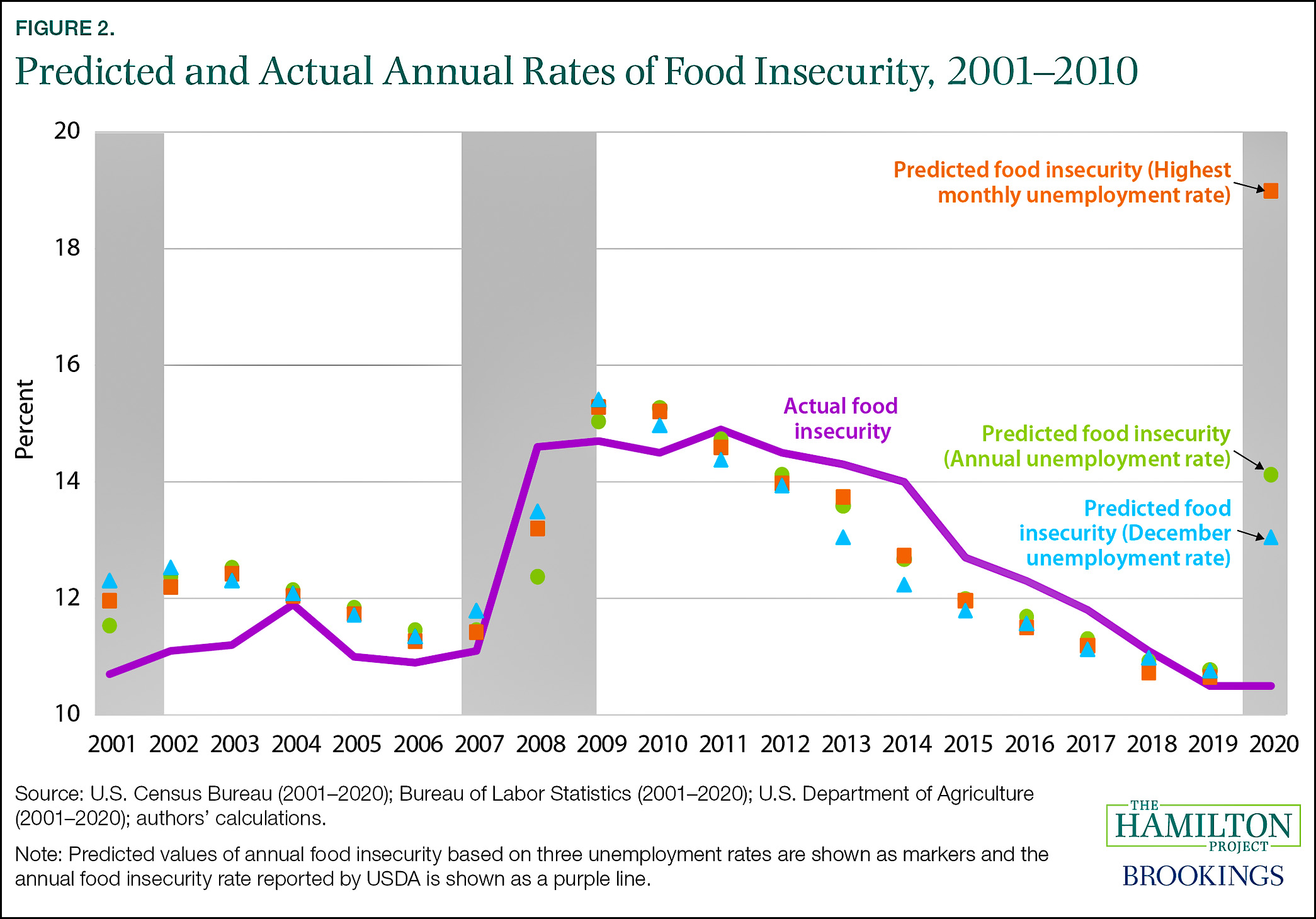
As you can see, food insecurity is fairly easy to predict based on the unemployment rate. In 2020, however, food insecurity remained low even though the unemployment rate skyrocketed. This is due to the COVID-19 rescue bills that were passed earlier in the year.
You can take whatever lesson you want from this. One obvious one is that hunger is an easily solvable problem: just give people money. Or food stamps. Or food.
Another obvious one is that, on a purely economic basis, we did pretty well during the pandemic. There are exceptions—there always are—but generally speaking both the poor and the working class made it through with their personal finances intact or even improved.
On a similar note, in a month or so we'll get figures for evictions and general inability to pay rent following the end of the eviction moratorium, and I'm willing to bet that it will show little change. Why? Because I doubt that housing insecurity actually increased much in the first place.
After only eight months, it's all over:
Better luck next time, Democrats.
We're not out of the woods yet, but the vet says her tail appears to be healing nicely. The prognosis is that no amputation will be necessary.
We'll know for sure on Saturday. Cross your fingers.
Did I capture this picture of a hooded Oriole deep in the rainforest of Costa Rica, or was he perched on a palm tree in my neighbor's yard? Guess correctly and you win a pat on the back!