Most polls on abortion break up responses into three categories:
- Should always be illegal.
- Should always be legal.
- Should sometimes be legal.
The first two are obviously clear enough, but the third encompasses a very wide range of views. For example:
- Should be illegal except in cases of rape and incest.
- Should be legal early in a pregnancy but illegal after 13 weeks.
- Should be generally legal but not in the third trimester.
These are very different things, and it doesn't help much to mush them all together into the broad category of "sometimes." For example, here are the figures from Gallup presented in the traditional way:
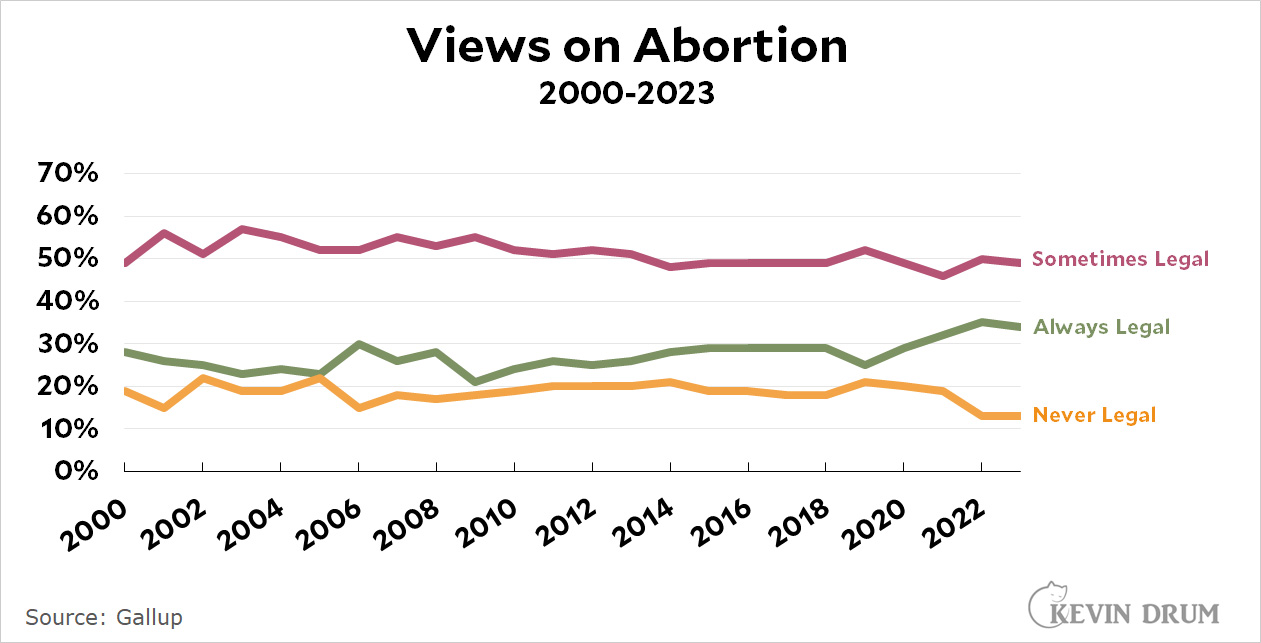 The "sometimes legal" category is the biggest by far, but this presentation gives you no idea of whether these people are mostly for or mostly against abortion. The answer, it turns out, is that by a wide margin they're mostly opposed to abortion. Here's the same chart, but with the middle category broken into "legal under most circumstances" and "legal only in a few circumstances":
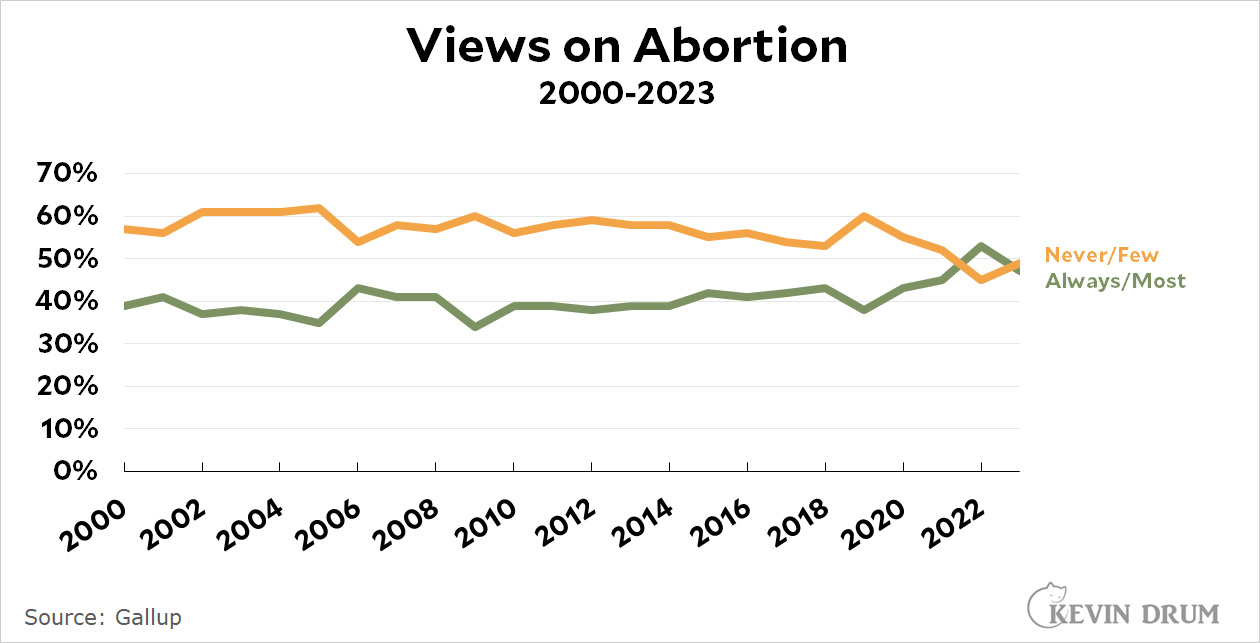 This provides a better picture in at least three ways. First, it tells us that conservative abortion sentiment has generally been ascendant over the past two decades. Second, it tells us that abortion views truly started trending more liberal after 2019. Third, it tells us that abortion views got more conservative in 2023, the first poll taken after the Dobbs decision was handed down. This is very much not the conventional wisdom, and it should give us pause about the notion that Dobbs prompted a backlash against abortion restrictions.
I'm not thrilled with this since I liked the conventional wisdom—and in truth there's still some scattered evidence that national opinion became a little more pro-choice in the wake of Dobbs. However, most of the responses to abortion polling showed the opposite, and I'd rather know that than continue kidding myself that my side has made big gains over the past year.
POSTSCRIPT: It's worth noting that the Dobbs decision certainly prompted stronger feelings about abortion on both sides. How much stronger? I don't think anyone knows for sure. But if it prompted more change in intensity on the pro-choice side it might still be true that, in practice, views on abortion have pushed reproductive politics in a more liberal direction over the past year.
It's also the case that, thanks to the early leak of the Dobbs decision at about the time Gallup was in the field in 2022, we should compare 2023 to 2021 to get a clean presentation. If you do that, the liberal position gained a couple of points and the conservative position lost a couple.
In any case, it's clear that Dobbs either helped the conservative position or, at most, helped the liberal position very slightly. There was certainly no big backlash.