Here is the full text of the ill-fated Equal Rights Amendment:
Resolved by the Senate and House of Representatives of the United States of America in Congress assembled (two-thirds of each House concurring therein), That the following article is proposed as an amendment to the Constitution of the United States, which shall be valid to all intents and purposes as part of the Constitution when ratified by the legislatures of three-fourths of the several States within seven ten years from the date of its submission by the Congress:
"ARTICLE —
"Section 1. Equality of rights under the law shall not be denied or abridged by the United States or by any State on account of sex.
"Section 2. The Congress shall have the power to enforce, by appropriate legislation, the provisions of this article.
"Section 3. This amendment shall take effect two years after the date of ratification."
The ERA was passed in 1972 and needed ratification from 38 states before its 10-year deadline expired. It got only 35. However, Senator Kirsten Gillibrand of New York and Representative Cori Bush of Missouri have proposed a three-step strategy to declare that the ERA has, in fact, passed already and only needs to be recognized. It goes like this:
- The 10-year deadline is part of the preamble, not the actual text of the Amendment, so it doesn't count.
- During the Trump administration three more states ratified the ERA: Illinois, Nevada, and Virginia. That brings the tally to 38.
- Six states have repealed their ratification, but there's no constitutional mechanism for doing that. Once ratified, always ratified.
This means that the required 38 states have legally ratified the ERA and the national archivist merely needs to announce it. Done and done.
But can it work? Gillibrand plans to introduce a joint resolution that codifies her theory, but Republicans will never support it:
Ms. Gillibrand conceded that she did not think Republicans would ever support the amendment, “largely because the pro-life movement has co-opted this argument,” she said. She said her hope was to compel Mr. Biden to call on the archivist to take action, or to change the filibuster rules in the Senate so that civil rights measures like the amendment would need only a simple majority — not 60 votes — to move forward.
This is doomed. Biden won't act unilaterally; the Senate won't pass an enabling resolution; and no court would back Gillibrand's plan.
“This is a political rather than a legal struggle,” said Laurence Tribe, the constitutional scholar and professor emeritus at Harvard Law School. “It would succeed only in a different environment than we have. It’s not going to pass. The real question is what political message is being sent. In a political environment like this, you throw at the wall whatever you can.”
If Gillibrand were a Republican making a weird new legal argument for something like, say, overturning the 25th Amendment as a Deep State coup, there's a tolerable chance the Supreme Court would stroke its collective chin, make up some shiny new doctrine, and rule in favor. But a Democrat with a weird new legal theory for a liberal cause? Fuhgeddaboudit.

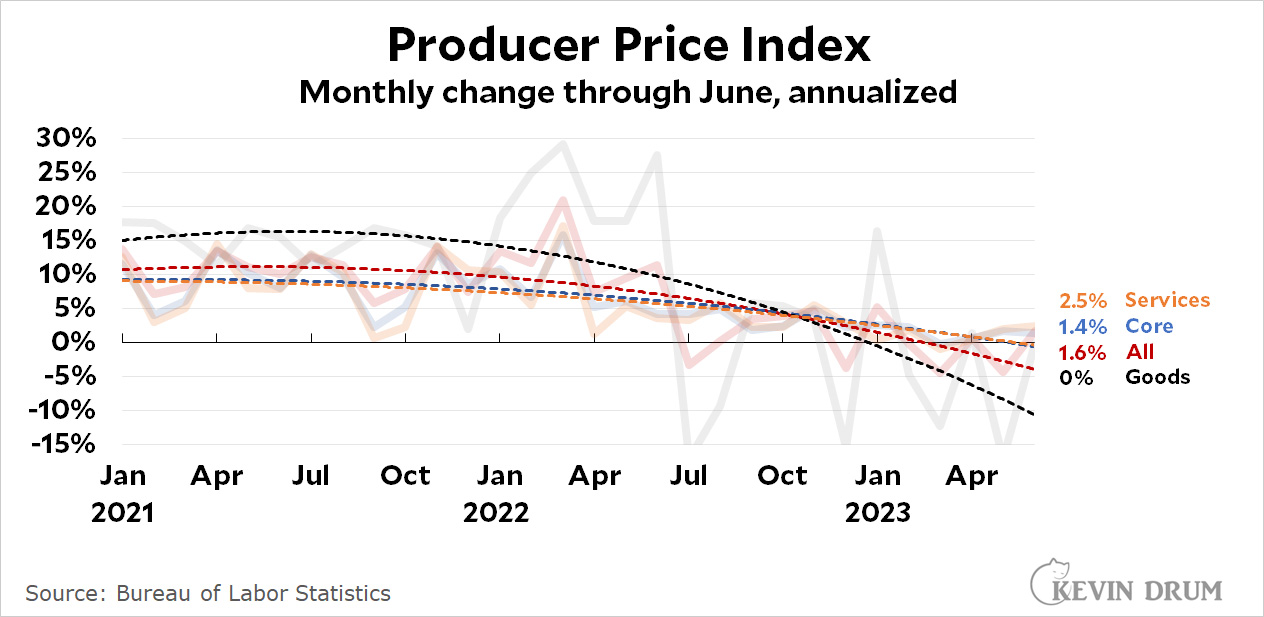 Although the overall PPI jumped a bit in June, it has been absolutely flat over the past year. It shows zero inflation in producer prices since last June. (Goods are down 4.4% over the past year. Services are up 2.3%.)


