Skip to content

I have bad news today. Hopper has been losing weight lately, and we intended to let a vet take a look at her after her tail had healed. We did that on Monday and it turned out that she was much sicker than we knew. Her kidneys were essentially gone, and although IV fluids would make her feel better for a few days, our vet said that her chances of permanently recovering were close to zero.

So we did the necessaries and had her put to sleep. She was only eight years old. The picture below is the last one I took of her, just before my Louisiana vacation.

The COP26 climate conference in Glasgow has been a failure. There have been a few agreements here and there, but nothing very impressive for a conference that was supposedly "make or break" for humanity.

This shouldn't surprise anyone. COP26 merely confirms what we've known for a long time: nations won't agree to cut back on profitable fossil fuel extraction and politicians don't dare promise to do anything that will annoy their constituents. This has been true for decades and it's still true.

If I were your benevolent dictator, here's what I would do:

  1. Aggressively roll out wind, solar, and nuclear power. This would probably get us about halfway toward our goal of net zero carbon emissions.
  2. Pour trillions of dollars into R&D looking for new technologies to reduce atmospheric CO2. This would include things like cement production and chemical manufacturing that don't benefit from green electricity, and carbon capture, which is a necessary part of meeting our goals.
  3. Begin seeding the atmosphere with aerosols. If we start now, it could be done very slowly while we test for larger effects on the planet. If, instead, we wait until 2040 or 2050 to do this, it will be an emergency operation with unknown impacts.

I understand this is not a popular proposal. Hell, I don't like it much myself. But all the evidence in the world suggests that nothing else has any real chance of success. It's time to face up to that.

According to Politico, corporate executives are up in arms about inflation and worried that President Biden just doesn't get it:

Craig Doescher, a Michigan-based consultant who works in a chief financial officer-type capacity for multiple businesses, said inflation is disrupting nearly every sector and that there’s little confidence that anyone in Washington has a short-term plan to deal with it.

"It didn't take long to completely break down the economy in 2020 but it's going to take a long time to put it all back together," Doescher said. "I've got clients who haven't given significant raises to unskilled workers in decades and now they are raising wages by 50 percent and still having trouble finding people. There is a lot to ride out here."

Where does this crap come from? I have in my hands a fresh, crisp ten-dollar bill that I will give to anyone who can point to an actual firm that is raising wages by 50% and still can't find workers. I'm serious. I realize that boring charts and BLS numbers are no longer of any use to journalists, but here's another crack at average pay over the past year:

You can see a couple of things here. First, overall inflation speeds up between September and October. That's the 6.2% headline number we've all seen. Second, the cost of labor slows down. Since January, labor costs have gone up far less than the overall inflation rate.

There has been an increase in the price of goods, and of course supply chain disruptions have made lots of things hard to get. That's a genuine problem, and it's one the White House ought to be focused on.

But labor costs? Give me a break. There are a dozen ways I can present this data, and they all tell the same story: wages haven't gone up substantially in 2021. There are a few narrow categories with high wage increases, but even those are nowhere near 50%:

The leisure industry (which includes restaurants) is the obvious outlier here, with every other industry at about 4% or less—lower than the overall rate of inflation.

Bottom line: There isn't any big surge in the cost of hiring new employees. There just isn't. Stop saying there is.


Pictures of egrets are a dime a dozen. I have hundreds of them.

What I don't have is a good picture of an egret in flight. Egrets are remarkably shy birds that fly away at the slightest movement, and I've never been able to get anything better than a decent picture of one flying.

But perhaps you remember the egret in Monday's picture? Just outside the frame there's a tour boat. This was my chance! I zoomed in, got a good focus, and just waited for the tourists on the boat to eventually scare the egret into flying away. They did, and burst mode did the rest.

This is the best picture I took on the entire trip. It's pin sharp, the lighting is superb, the background is perfect, and the motion is stopped. I finally have a great picture of an egret in flight.

November 4, 2021 — Lake Martin, St. Martin Parish, Louisiana

In the New York Times today, Claire Bond Potter blames Ronald Reagan for the unraveling of the American social safety net:

Under Mr. Reagan, conservatives were finally able to begin dismantling the New Deal state and Lyndon B. Johnson’s Great Society. In 1981 and 1982, Mr. Reagan made more than $22 billion in cuts to social welfare programs.... Democrats were complicit. In 1992, although he would try (but fail) to pass national health care, Bill Clinton promised to “end welfare as we know it.”...By 1999, single mothers on “workfare” had sunk deeper into poverty.

Progressive Democrats did only marginally better. In 2012, Republicans accused President Barack Obama of unwinding decades of welfare-to-work provisions, with a new system of waivers, work requirements and block grants that states had to follow. And while his Affordable Care Act passed narrowly, under pressure from both parties, he abandoned universal health care.

Today the poverty rate hovers around 11 percent, about where it was in 1973, and economic insecurity now envelops the working poor and middle class.

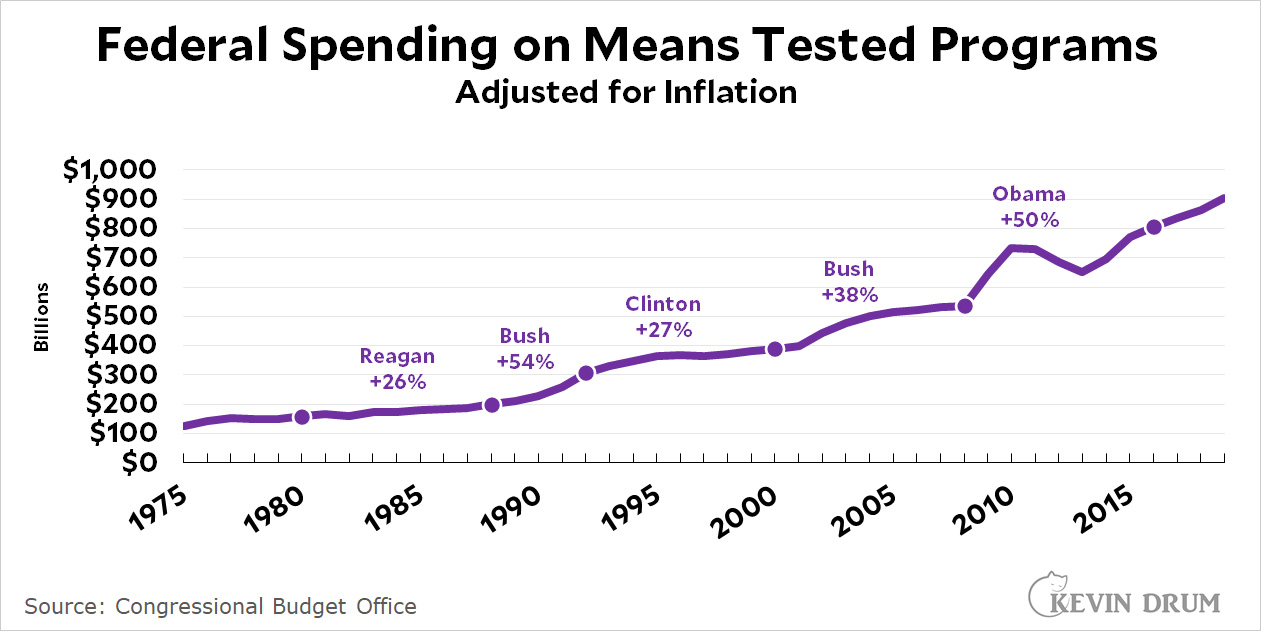
This is wildly misleading. There's no question that Ronald Reagan was rhetorically opposed to social welfare programs, just as there's no question that conservatives say they want to pare back the safety net. But they haven't:

As for poverty, the only honest way to measure it is to look at earnings after accounting for social welfare benefits. After all, the whole point of those benefits is to reduce poverty.

Using that measure, in 1973 about 20% of the country lived in poverty. Today, that number is about 9%.

In other words, social welfare spending is up nearly 500% since Reagan took office and poverty has been cut in half. Is that still too little? Does it compare badly to our peer countries in Europe? Is it shameful that we still don't have a national healthcare system?

I'm inclined to answer yes to all those questions. You might differ. But for God's sake, can we at least agree to use real numbers when we talk about this? It's the minimal honesty we should expect from our public intellectuals.

As we all know, Larry Summers has been warning for some time about the risk of high inflation. Given the enormous federal spending of the past 18 months this is a perfectly defensible concern, and yesterday's inflation numbers suggest he may have been right.

But if you're a fan of Summers, you need to pay attention to everything he says:

Summers attributes the persistent inflation to Biden’s COVID relief package, but said he supports the infrastructure and social spending bills. “Together, they are smaller over 10 years than this past year’s stimulus was over a single year, and in addition they are substantially paid for,” Summers said.

The social spending bill, in its current form, amounts to about $200 billion per year and doesn't affect the federal deficit at all. In other words, it will have no effect on inflation. Capiche?

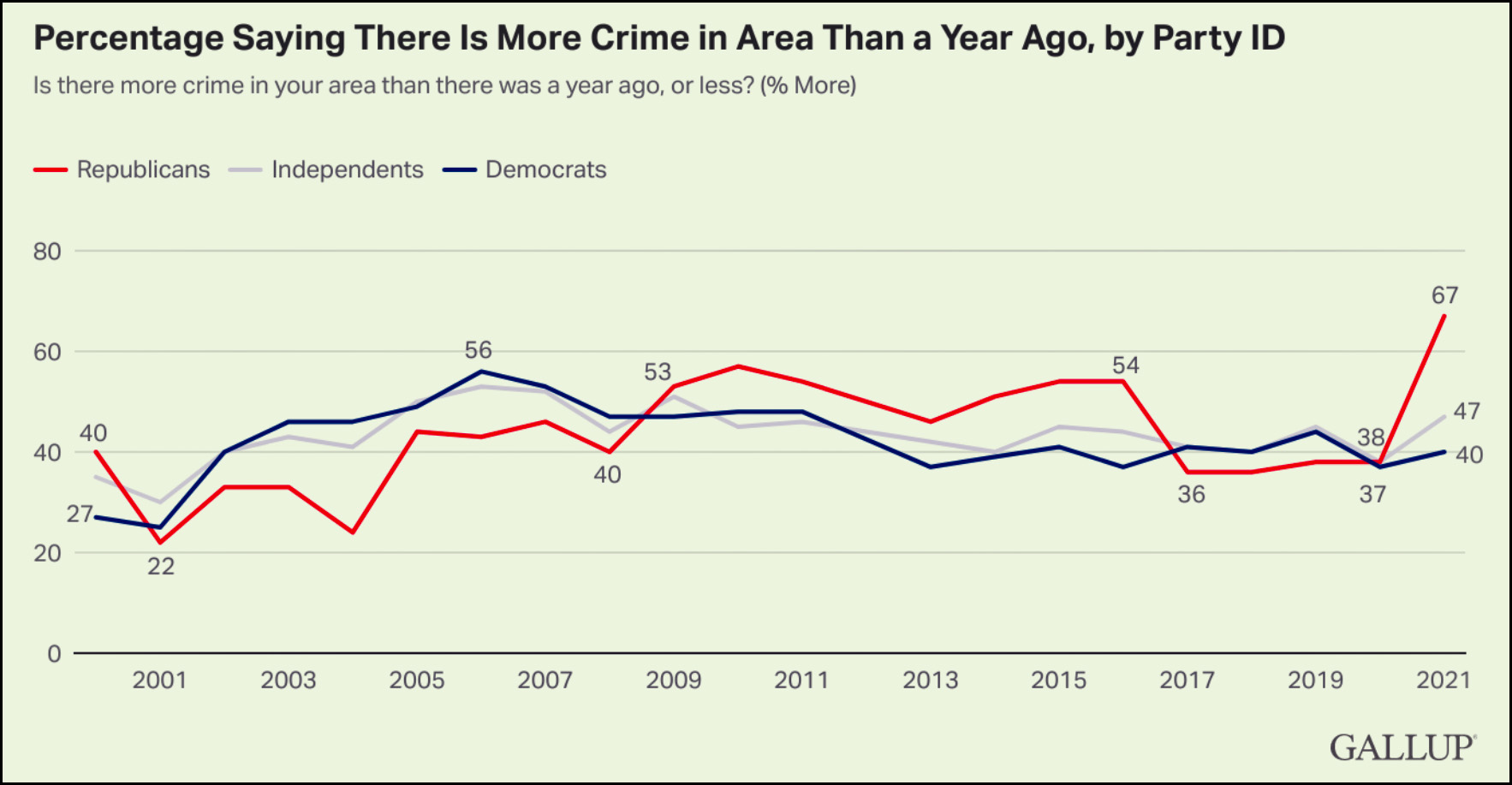
Has crime gotten worse in your neighborhood? That depends on which party you belong to:

Among both parties, fear of crime rose after 9/11. After that, fear of crime among Democrats steadily declined over the next 15 years.

But Republicans showed an entirely different response. When Barack Obama was elected president, fear of crime spiked 13 points. When Donald Trump was elected, fear of crime plummeted 18 points. Finally, when Joe Biden was elected, fear of crime once again spiked, this time by 29 points.

Needless to say, the actual amount of crime doesn't change much over the course of a single year. So why are Republicans convinced that it does?

Do I have to say it? Or is the answer obvious by now? This has nothing to do with actual levels of crime. It has nothing to do with crime policy, which is mostly local anyway. It has nothing to do with protest marches or Ferguson or anything else in far distant cities.

It's because of Fox News, which pushes the crime button whenever a Democrat is president and releases it whenever a Republican is president. That's it. That's all there is to it.

As long as we're on the subject of the economy, it's worth noting that the third-quarter GDP number released a couple of weeks ago shows that the economy is running very close to its potential:

This shows GDP as a percentage of potential GDP. As you can see, the economy never surpasses its potential for long without sliding into recession (gray bars). Sometimes it happens quickly, sometime it takes a while, but it always happens.¹

In February of 2020 we were already running above potential and ready to drop into recession when the pandemic hit. We've now nearly regained that level, running at 99.7% of potential.

This doesn't mean that we're ready to fall into a recession, but it does mean that the economy is running about as hot as it can. There's a little bit of headroom left, but not a lot.

¹The CBO revises its estimate of potential GDP frequently. These figures are based on its near-term estimates.

Treasury yields were up today:

This suggests that today's inflation news has caused inflationary expectations to go up a bit, but not a lot. That's the good news.

The bad news is that I imagine that mainstream news is going to be all inflation all the time. I'm OK with that, I guess, as long as they get their numbers right and put it all into long-term context. Unfortunately, the odds of that are not good.