Skip to content

Consumers are splurging, says the Wall Street Journal. Retail sales were up 0.7% in September, an annualized rate of 8.9%. Shazam!

But you might recall that inflation was high in September. If you adjust for that the annualized increase is only 3.9%. And if you compare retail sales to a year ago, the annual increase is a whopping 0.1%:

Some splurge, eh? After a year of declines retail sales have only barely climbed back to where they were last September. Hell, the Journal even has a chart showing that real retail sales have been flat for two years. Let's not get ahead of ourselves here.¹

¹And always adjust for inflation! When will people learn?

Paul Krugman has an odd column today. He says that America is as powerful economically as ever and that Joe Biden has conducted a strong foreign policy. Nevertheless:

Serious students of international affairs are noting that the world seems to be becoming more dangerous, with many local cold wars turning hot, and suggesting that we may be witnessing the end of the Pax Americana, the long era in which U.S. economic and military dominance limited the potential for wars of conquest.

....It seems safe to say that the world no longer trusts U.S. promises, and perhaps no longer fears U.S. threats, the way it used to.

Krugman places the blame for this on the chaotic Republican Party, but I think it would be better to ask first if it's even true.

American power was at its peak in the '50s and '60s, when the US accounted for nearly half the world's economy and the Cold War made us the world's uncontested military leader as well.

But did that scare off the Soviet Union? It did not. They seized control of Eastern Europe after World War II. They blockaded Berlin. They invaded Hungary in the '50s and Czechoslovakia in the '60s. They fought proxy wars against the US in Korea, Vietnam, Congo, and Nicaragua. As bad as Vladimir Putin is, his record of military intervention pales in comparison to the Cold War USSR.

Hamas's attack on Israel, needless to say, is also nothing new. Israel has literally been at war since its founding, and terrorist groups have never been intimidated by American power.

In terms of leadership, the US has been pretty effective at gathering support for Ukraine and opposition to China—every bit as effective as it was during the Cuban Missile Crisis.

This leaves China's recent behavior, which has unquestionably become more anti-American over the past decade. At the same time, China was hardly America's good buddy during the heyday of US power.

So color me unconvinced. America has long had plenty of enemies as well as plenty of obstreperous allies. I'm skeptical of the idea that the world is becoming more dangerous, which strikes me as decidedly ahistorical. I'm equally skeptical of a decline in Pax Americana, which I think never existed in the first place. Can anyone point me toward a good argument for either of these?
In good news this weekend, Poland voted to dump the anti-democratic Law and Justice Party, one of Europe's most dangerous. Like Donald Trump, Poland's current strongarm prime minister immediately announced that the election had been rigged and he was the real winner. This probably won't stand up even though virtually every branch of government has been stuffed with Law and Justice appointees over the past eight years, and in the end the opposition will take over and begin the long and laborious of fixing Poland's government:

The big question now, however, is not only whether the opposition can form a government but, if it does manage to take power, can it actually wield it in a system where public broadcasting, the constitutional court, the judiciary in general, the central bank, the national prosecutor’s office and other branches of state have been packed with Law and Justice loyalists who, in many cases, cannot be easily dislodged?

....Lech Walesa, the leader in the 1980s of Solidarity, the trade union movement that opened the way to the 1989 election that toppled communism, warned in an interview with Gazeta Wyborcza, a liberal newspaper, that Mr. Kaczynski, a former ally turned bitter enemy, “has definitely come up with something, he has definitely prepared something. He will not want — and will not be able — to give up power.”

Even with all this standing in the way, it remains the case that Poland's voters turned decisively against the right-wing populist Law and Justice agenda. This is yet another sign that the world is not turning steadily toward authoritarian rule. Rather, politics, as usual, continues to swing like a pendulum between liberal and conservative parties. Lately, it's been swinging considerably more in the liberal than the conservative direction.

The Washington Post writes today about Carlos Hoyt:

The 63-year-old educational consultant and psychotherapist is part of a small but increasingly vocal group of people who favor phasing out racial categories.

....Hoyt read aloud the Census Bureau’s caveats, that “the racial categories included in the Census Questionnaire generally reflect a social definition of race recognized in this country, and not an attempt to define race biologically, anthropologically, or genetically.”

To recognize that race … is a false concept but to keep doing it anyway, there’s something intellectually problematic about it.”

I'm sure Hoyt and others like him are arguing in good faith, but they're deeply misguided for three reasons:

  1. "Race" may or may not be the the most useful word here, but humans are divided into population groups that can be identified genetically. A recent study identified nine groups, and for our purposes the key finding is that two of the groups are Northern European and East and West African. In other words, what we colloquially call white and black.
  2. The Post article starts out by noting that humans share 99.9% of their DNA. This finding of the Human Genome Project, it says, "gave waste to the notion of 'race' among the vast majority of scientists." But humans share about 99% of their DNA with bonobos and chimpanzees, which obviously produces a gigantic difference. That 0.1% difference among humans amounts to about 5,000 SNPs (a measure of genetic variation). That's not trivial
  3. Everyone agrees that "race is a social construct," so to say that race doesn't exist is to imply that social constructs are somehow less real than biological constructs. But nothing could be farther from the truth. Social constructs are tremendously powerful and dominate all of human existence. So even if it were true that race has no biological basis, it would still be very real indeed.

In summary: (a) there are population groups that correspond fairly closely to ordinary notions of race, (b) there are genetic differences between these groups, and (c) even if this weren't the case, race would still be socially very real. We're stuck with race or something very like it, I'm afraid.

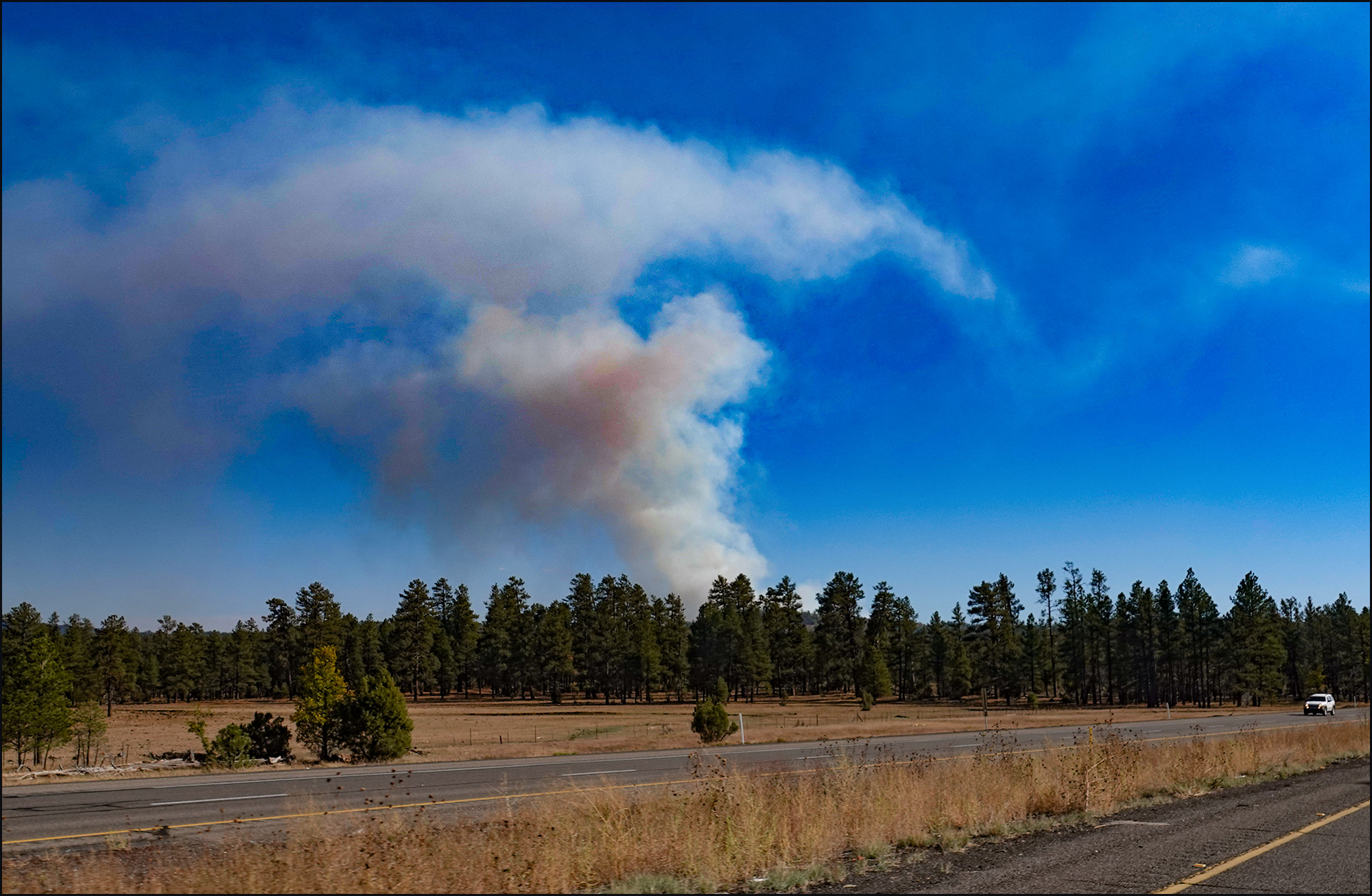
I know you rely on me for the latest breaking news, so here it is: there is a prescribed burn being conducted in the Coconino National Forest south of Flagstaff. Do not report this fire. Repeat: DO NOT REPORT THIS FIRE. The US Forest Service thanks you for your cooperation.

Can Jim Jordan, the lunatic conservative endorsed by Donald Trump, become Speaker of the House after all?

Jim Jordan rolled out several key endorsements in his bid for speaker on Monday, a surprising turn that has some in his party privately believing the Ohio Republican has a shot after all.

....On Friday, Jordan’s fight for the gavel seemed treacherous, with 55 House Republicans stating on a secret ballot that they will oppose him on the House floor. That included many angry Scalise backers.

But Jordan’s allies kicked off a pressure campaign, posting the office phone numbers of holdouts online — directing the rage of the base and conservative media personalities. And it appears to have had success.

If this happens—which is still iffy—it will be a victory for Matt Gaetz and the MAGA wing of the party. They've developed a well-earned reputation for refusing to compromise even if the world burns, and that forces moderates to cave in because they do care if the world burns.

Of course, the "moderates" could negotiate with Democrats over a compromise choice, but they consider that worse than settling for an ultracon like Jordan. So maybe they aren't really moderates after all. They're just wimps.

Saturday was eclipse day, so today is eclipse photos day. I've got a whole series for you, in chronological order.

The first picture was taken on Friday while I was scouting sites. This is Chimney Rock, a classic western rock formation about 15 miles south of Cortez, Colorado.¹ This picture was taken at 10:30 am, and as you can see, the sun is directly above the chimney.

¹Well, it's a Chimney Rock. It's a popular name for rock formations that look like this.

October 13, 2023 — Montezuma County, Colorado

Moving on to eclipse day, Chimney Rock drew a large crowd. Check out the line of cars on the left.

An annular eclipse doesn't blot out the sky like a total eclipse. The moon covers 95% of the sun, but it turns out that even 5% of the sun is quite a bit. However, as totality approaches it does get a little dim.

A few minutes before totality, the sun is once again directly above the chimney. This is a composite photo, with top and bottom shot with different exposures.

Here's the sun just before totality. Admittedly, there isn't a lot to see here. The disk of the sun is still bright even though I shot at minimum ISO, minimum shutter speed, minimum f/stop, and a 10x neutral density filter.

And here it is at totality. It isn't perfectly centered because, although I was well within the zone of totality, I was a few miles away from the precise line of totality.

After totality, we all started to leave. But a few people stuck around for a while.

October 14, 2023 — Montezuma County, Colorado

Donald Trump has been gagged by yet another judge:

A judge imposed a limited gag order on former President Donald J. Trump on Monday, restricting Mr. Trump from making public statements attacking the witnesses, prosecutors or court staff involved in the federal criminal case in which he stands accused of conspiring to overturn the 2020 election.

....Trump can still attack the Biden administration or the Justice Department and say that he thinks the prosecution is politically motivated. But he cannot attack Jack Smith, the special counsel, or his staff or family, nor can he attack court staff or witnesses. He can attack Pence, except he can’t talk about Pence’s role in the events that involve this case. She did not say she was barring Trump from attacking her personally.

Needless to say, Trump called this the worst attack on democracy ever in history and said he would appeal. It won't do him any good, though. This was a fairly routine and narrowly tailored order and I doubt any appeals court would overturn it. Trump still doesn't get that the criminal court system simply works differently from the all-vengeance-all-the-time world he's used to.

Up until 2010 merchants weren't allowed to charge extra for purchases made by credit card even though they had to pay swipe fees every time one was used. But that year the Department of Justice settled a lawsuit against the big credit card companies which put an end to this prohibition. Since then, subject to state laws, merchants have been allowed to offer cash discounts. Alternatively, they can pretend to raise all their prices by 3-4% and then rebate the extra to cash customers. This is the equivalent of charging more to credit card customers.

I was all in favor of this—but not because I objected to swipe fees. It costs money to run a credit card network, and swipe fees are a reasonable way of recouping those costs. My problem was that, thanks to the near-monopoly they enjoyed, credit card companies could keep their fees invisible and almost certainly too high. After all, credit card companies charge swipe fees and then rebate much of it in the form of reward programs for affluent customers. This makes no sense.

So why not let merchants charge the fees openly and let consumers choose? If merchants decide to charge more for credit card purchases, it's a sign they think swipe fees aren't worth it and would prefer cash. If they don't, it's a sign they think they're getting their money's worth.

Since then I haven't noticed many merchants charging for credit card use, but that's largely because I live in California, where it was still illegal until a few years ago. Today, though, the Wall Street Journal tells us how things are going:

Overall, about 3% of merchants offer cash discounts. This is up from 2% before the pandemic, but it's still a pretty low number. The evidence isn't entirely in yet, but I'd say I turned out to be wrong. Even in the face of ever-rising swipe fees, barely any merchants feel slighted enough to bother trying to get their customers to pay cash. Inertia and habit are a big part of this, but it's nevertheless the case that changing the rules made little difference. Apparently the vast majority of merchants are OK with funding bank reward programs. Go figure.

A recent article in the Journal of Pediatrics concludes that increasing mental health problems in teens and young adults have been caused by a decline in the amount of unsupervised play time they were allowed as kids.

I really want to believe this. It makes perfect sense to me that being constantly under the protection of adults leads to anxiety and worse as you grow up and are forced to live more independently. Unfortunately, this article fails to make the case at a critical juncture. Here's how it goes:

  1. Mental health has been declining for decades among children. The article presents fairly solid evidence for this.
  2. Free play has been declining for decades. Again, the evidence is solid.
  3. Free play makes kids happy. Also solid.
  4. Free play has long-term effects on mental well-being. This is the key step, and suddenly the evidence disappears:

Beyond promoting immediate mental well-being, children’s independent activity also may help build mental capacities and attitudes that foster future well-being. One way of thinking about this involves the concept of internal [good] vs external [bad] locus of control (LOC)....Many research studies, mostly cross-sectional but some longitudinal, have shown that a low internal LOC, assessed by a standard questionnaire, is highly predictive of anxiety and/or depression in both children and adults....Twenge and her colleagues also documented a dramatic decline in internal LOC among them over that same period. Logically, it seems likely that a decline in internal LOC was a mediating cause of the decline in mental well-being.

....And so, we have a cause–effect sequence that plausibly contributes to the relationship between children’s independent activity and their mental well-being: Experiences of having control ⇒ internal LOC ⇒ mental well-being.

In this final step, the wording changes dramatically. Things are "likely" or "plausible" or "logically likely." There's only one piece of research cited, a weak lab-based study showing only that children with controlling mothers have low internal LOC. There's nothing more on the crucial claim that lack of free play leads to low internal LOC.

So I'm unconvinced. I agree about the logical, plausible likelihood of all this, but that's all the more reason to be cautious about accepting weak confirming evidence. And I'm afraid that in this case the evidence is in fact pretty thin.