This is a rare archival photograph of Hilbert and Charlie back in Charlie's younger days. Such a cute couple.

Cats, charts, and politics

This is a rare archival photograph of Hilbert and Charlie back in Charlie's younger days. Such a cute couple.
I'm catching up on the news, and I see that Steve Scalise has dropped out of the race to replace Kevin McCarthy as Speaker of the House.
I think this is wise, but not for political reasons. As someone who's been through chemotherapy for multiple myeloma, I know that it gets worse as it progresses. Scalise was diagnosed with multiple myeloma a few weeks ago, and while he may feel OK now, in a few more weeks he's likely to start feeling pretty awful. Everyone responds to chemo differently, but I sure wouldn't recommend taking on a stressful new job in the middle of it.
Politically, it's a different story. After winning the Republican nomination for speaker—by a bare 113-99 vote—Scalise eventually concluded that he had no chance of winning the 217 votes necessary to actually become speaker. The problem is that no one else does either. It takes only five votes to torpedo a candidate, and no Republican can come close to winning all but five votes.
So now what? Even Republicans are starting to admit their party is so muddled that they have no choice: they have to ask for help from Democrats. As long as Democrats cast all their votes for their own leader—which is traditional—Republican candidates need 217 votes to win. But if Ds vote present, a Republican can win with only a majority of Republican votes—which Scalise already has. Alternatively, a "Gang of 217" Ds and Rs could get together and agree on a compromise candidate.
Until something like this happens the House is paralyzed. Without a speaker they can't vote on anything—not budgets, not aid to Israel, not so much as a post office renaming. And as long as the House is paralyzed, America is paralyzed. Something has to give.
Yes, I'm traveling this week. Here's where I stopped for the night. Can you identify the city?
UPDATE: leszekmp got it right: it's Flagstaff, Arizona, taken from an overlook on the road up to Lowell Observatory. We stopped in Flagstaff on our way to Durango, Colorado, where (a) we have friends, and (b) I will be a few minutes drive from Saturday's annular eclipse. There will be photos, of course.


After last month's big spike—mostly due to gasoline prices—inflation settled down a bit in September:
 But the news was mixed: CPI was down but core CPI edged up. That's both surprising and unwelcome.
Alex Tabarrok agrees that the "deaths of despair" narrative has been oversold. But he's not ready to give it up completely:
I wouldn’t, however, throw out despair as an organizing principle. The evidence on “despair” goes beyond death to include a host of co-morbidities such as mental stress, marriage rates, labor force participation rates and other measures of well being. Regardless of the precise population to which these problems attach they are co-morbidities and I suspect not by accident.
I'm sympathetic to this notion. The mental image it brings to mind is a poverty-stricken Appalachian community with no jobs and half the people strung out on Oxy or worse. But this probably just shows that I'm as vulnerable to media hysterics as anyone. So let's look at the evidence for the three things Alex mentions.
Remember that we're trying to account for a slowdown in life expectancies that began around 1998 among high school dropouts. But here are marriage rates:
 As you can see, marriage rates have been falling since the '60s. Among high school dropouts they actually stabilized in the late '90s.
Next up is labor force participation:
 Among men, labor force participation has been falling forever with one exception: high school dropouts. Their labor participation has been increasing recently:
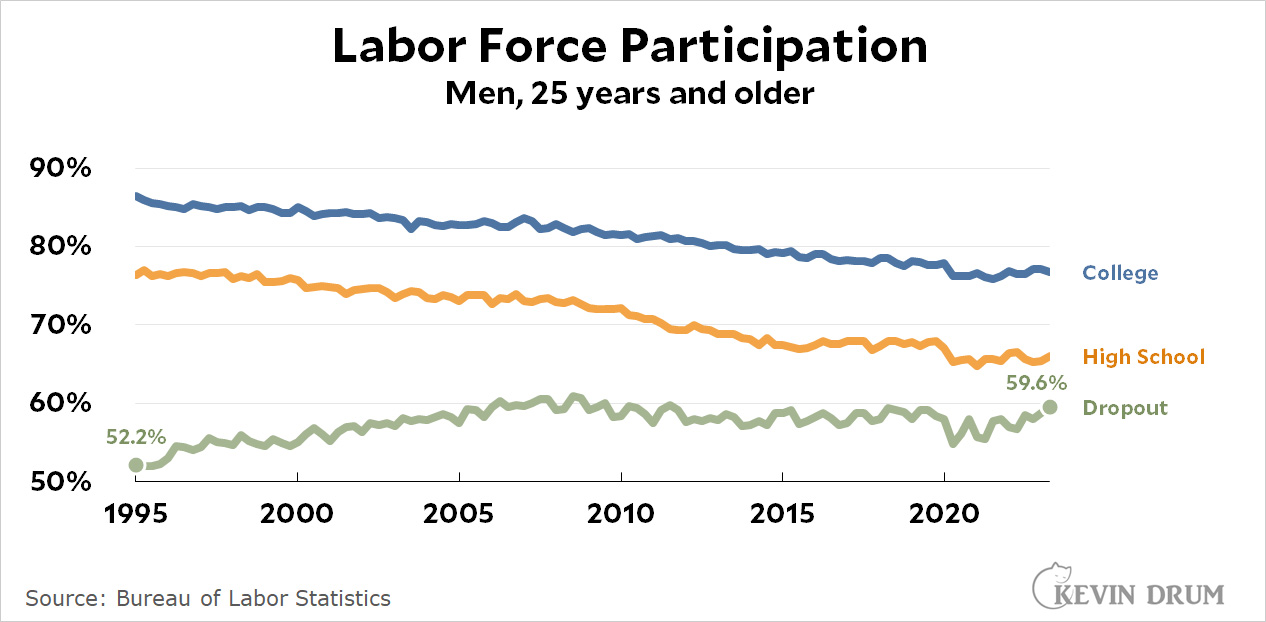 There's certainly no indication here that anything negative happened around 1998. Among women, labor force participation declined after the Great Recession but then turned back up. Today it's only about 2% below its peak.
Finally we have mental stress, and here the evidence is conflicting. Evidence from disability claims suggests mental health in general got worse until the early 2000s, when it flattened and then improved:
 The annual APA survey says that stress hasn't increased lately:
 But then again, there's this:
 The increase here isn't huge, but it's been steady since 1999 for all age groups. In addition, there's considerable evidence of increasing teen stress, though only since about 2012 or so.
Altogether, of the three co-morbidities Alex mentions, marriage has been stable since 1998 among high school dropouts; labor force participation has improved; and mental health is equivocal. Over the same period material conditions have improved:
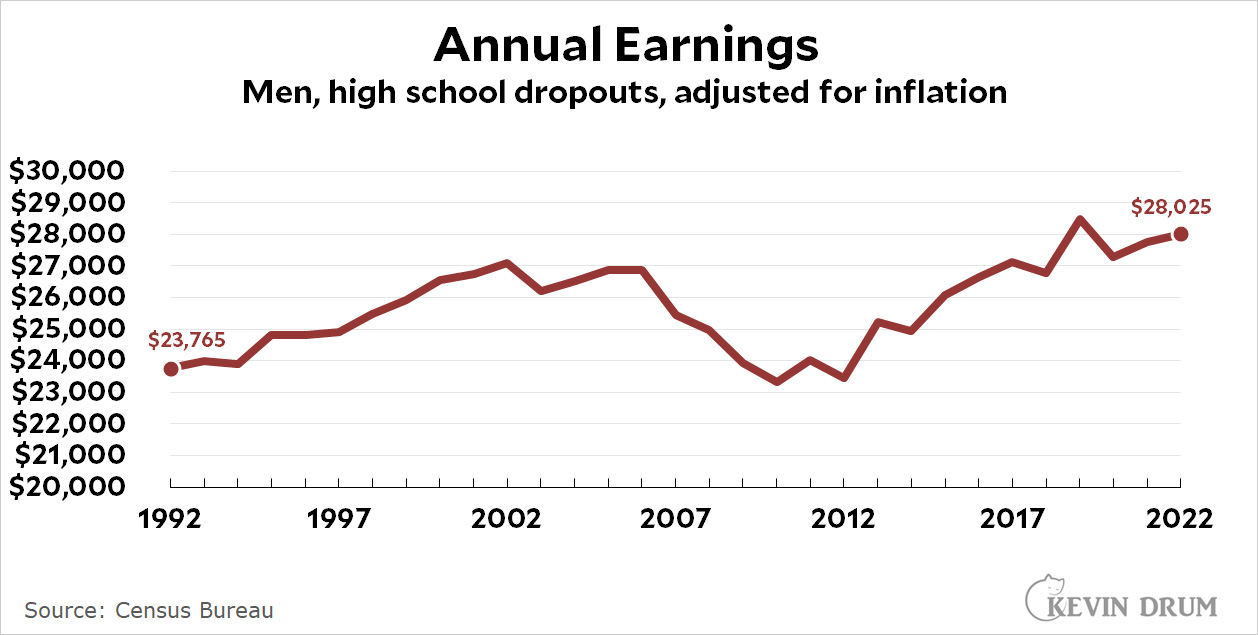 Overall, the notion that despair has increased among Americans in general, and among high school dropouts in particular, is an attractive theory but it really doesn't seem to be supported by the evidence. Americans have gotten angrier over the past 20 years, but probably not gloomier.
This is an LBB, a little brown bird. There's nothing special about him except for excellent lighting and exceptional sharpness. So he is your bird of the day.

Travel day today. I'm calling a lid.
Prosecutors in the case of Donald Trump's effort to overturn the 2020 election want to know if he plans to blame poor advice from his attorneys. But why do they care? The New York Times explains:
Defendants who pursue advice of counsel arguments waive the shield of attorney-client privilege that would normally protect their dealings with their lawyers. And, as prosecutors reminded Judge Chutkan, if Mr. Trump heads in this direction, he would have to give them not only all of the “communications or evidence” concerning the lawyers he plans to use as part of his defense, but also any “otherwise-privileged communications” that might be used to undermine his claims.
This strikes me as a pretty iffy defense in the first place, since there's mountains of evidence that Trump got plenty of good advice from the non-lunatic attorneys in the White House and elsewhere. He just chose to ignore any of the attorneys who didn't tell him what he wanted to hear.
But maybe it's the best chance he has. After all, blaming others is what Trump is best at.
Matt Yglesias takes on the "Deaths of Despair" meme today. It originates with Anne Case and Angus Deaton, who wrote about it a few years ago, and, as Matt points out, it's somehow survived despite a series of statistical examinations that have left it in tatters. If you adjust for age, it becomes less dramatic. If you adjust for geography, it's limited largely to the South. If you break it down by education, it's largely a phenomenon of high school dropouts. Matt continues:
The rise in deaths of despair turns out to overwhelmingly be a rise in opioid overdoses. This increase is not happening in European countries that have not only been buffeted by the same broad economic trends as the United States, but are also seeing the rise of right-populist backlash politics.
The obvious explanation is that the US and Europe have very different laws governing pharmaceutical marketing....This is all actually pretty clear cut and has been said before, but critics must not be saying it clearly (or rudely) enough because the narrative just keeps trundling forward.
I agree with Matt's larger point: the deaths of despair narrative doesn't really seem to hold water, and it's worth saying this bluntly. But is it really just about opioid overdoses? Let's revisit a recent chart from Case and Deaton:
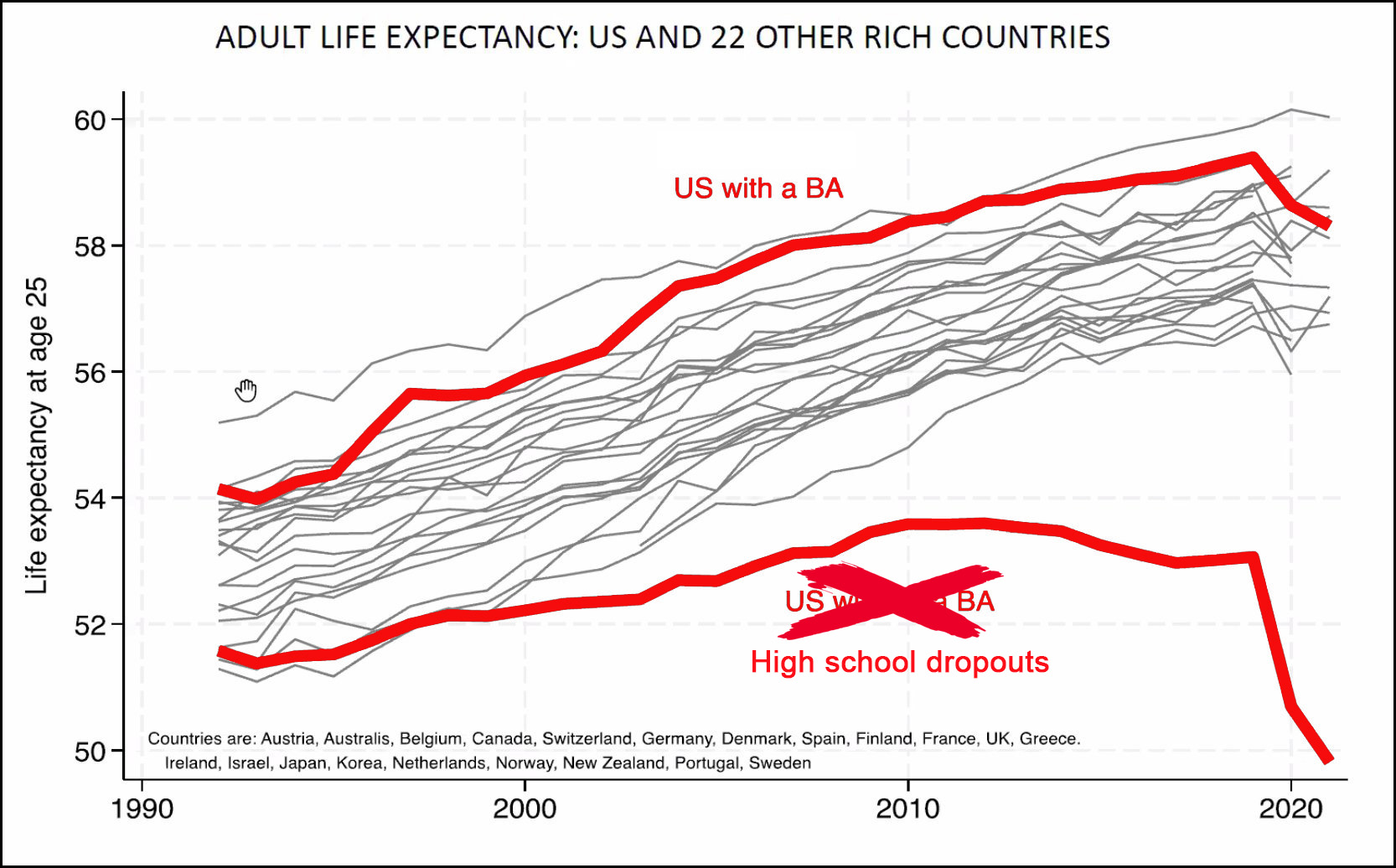 US life expectancy has taken a big hit compared to other rich countries, but it turns out this is largely due to reduced growth rates among high school dropouts. The slowdown started around 1998 or so, which means it has to be related to something that changed in 1998 or earlier. Something that changed more for high school dropouts than for college grads.
Now let's take a look at drug overdoses from a recent RAND study:
 There's a huge difference in the rise of opioid overdoses between college grads and high school dropouts. And the OxyContin revolution started in 1996, which makes it a natural candidate for a trend that began in 1998.
But the difference is fairly modest until around 2015, when fentanyl hits the scene. Between 2000 and 2015 the difference rose by about 30 per 100,000. Then, in just the few years from 2015 to 2021, it rose by about 45 per 100,000. Thus we'd expect life expectancy growth for high school dropouts to slow down between 2000 and 2015, and then to really slow down from 2015 to 2021.
And this is roughly what happened—until COVID hit and the bottom fell out of everything. So the only remaining question is this: Is the increase in overdose deaths among dropouts (bottom chart) enough to account for their stagnant life expectancy (top chart)? This is something that only an expert can answer. Any volunteers?
The Atlanta Fed's GDPNow forecast continues to suggest that the economy was red hot in Q3:
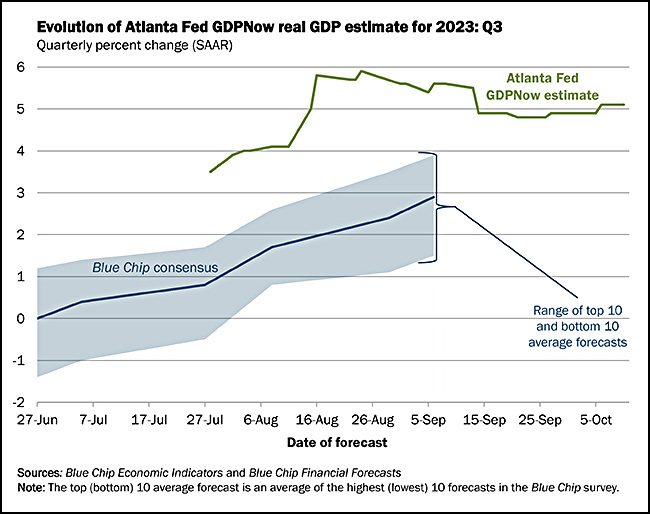 Their forecast of 5.1% growth is largely based on increases in consumer spending (2.5%) and net exports (1%). Those subcomponents are indeed looking good so far:

 The trade deficit is on track to be $20+ billion better than in Q2, while PCE jumped in July and has stayed on a higher track since then. That 5.1% growth forecast is still a little hard to believe, though, and the New York Fed agrees:
 Both of these forecasts have reasonably good track records, so it's odd that they're in such sharp disagreement. The New York Fed doesn't put the Atlanta Fed's forecast even within the outer bounds of probability.
The BEA's first official estimate of third quarter GDP will be released in a couple of weeks, on October 26. We'll find out then who's right.