Skip to content

In my post yesterday about the past 20 years of horrific Israeli behavior I noted that "There are reasons things have turned out this way, many of them the responsibility of Arab nations and the Palestinians themselves."

Unsurprisingly, many people asked just exactly what part of the historical record could explain or justify Israeli conduct. It's a fair enough question, because although this history is both contentious and well-known, it's also peculiarly unknown to a lot of people these days.

So here's a nickel summary. First off, this is the original 1947 UN map showing the partition of the old British Mandate in Palestine into two new states, one Jewish and one Arab. There are several things to notice:
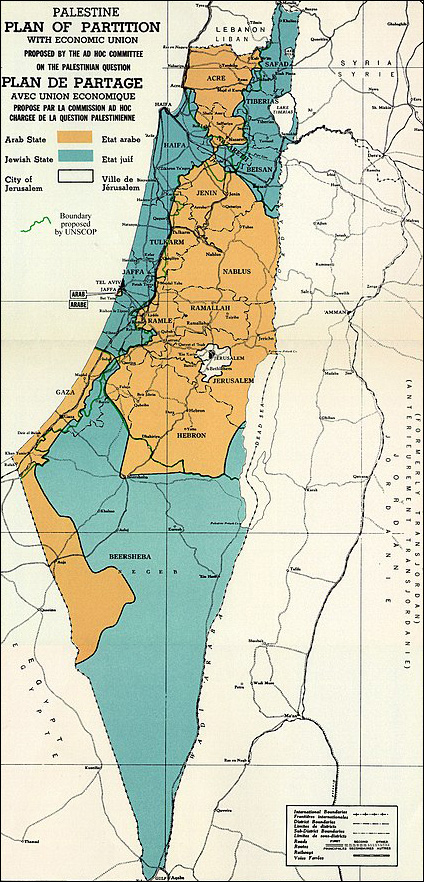
  • Gaza is much larger than it is today and almost touches the West Bank.
  • Jerusalem is solidly within the West Bank and is designated as an international enclave.
  • The city of Jaffa on the Mediterranean coast is an Arab enclave.
  • Arab lands extend north to the border with Lebanon.
  • All of these areas were to be connected by extraterritorial roads, guaranteeing free passage within each state and free passage of all to Jerusalem.

So what happened? Zionist leaders weren't thrilled with the partition but reluctantly accepted it. Arab leaders rejected it completely. Partly this was on the grounds that Israel had been given the best land, but mostly it was because they flatly refused to accept the establishment of a Jewish state. They declared war on Israel as soon as the partition was announced, with the stated intent of destroying it.

They lost, and by the time the war ended a lot of territory had changed hands. Israel took Jaffa, the northern Arab region, most of Gaza, and much of the West Bank—and forcibly expelled nearly a million Palestinians from Israeli territory in the process. Jordan seized the rest of the West Bank. Egypt took the remaining piece of Gaza. The extraterritorial roads, needless to say, were consigned to the dustbin of history.

From that point on the Arab states enforced a total air and land blockade against Israel while Egypt blocked its use of the Suez Canal. In 1956, Egypt's president, Gamal Abdel Nasser, blockaded the Gulf of Aqaba, preventing Israel from developing an alternate route to the Red Sea and Asia. At the same time he nationalized the Suez Canal, prompting an invasion from Britain, France, and Israel. They pulled back due to international pressure and Nasser reopened Aqaba.

During the rest of the 50's Palestinian fedayeen trained in Eqypt mounted repeated attacks across the border into Israel. In 1964 Nasser created the Palestine Liberation Organization. In 1967 he blockaded Aqaba again and planned an imminent war against Israel, joined by other Arab states.

They lost. During the war Israel seized the West Bank, Gaza, and the Golan Heights on the border with Syria. Israel then began building settlements on the West Bank in order to protect itself from further attacks.

In 1973 the Arab States attacked again. This was a close run thing, but again, they lost. The 1973 war shook Israel badly, and after it ended they ramped up the settlement program.

In 1988 Palestinians launched the First Intifada, a civil uprising against Israelis. This happened against a background, over the previous two decades, of hijackings, terrorist attacks, missiles launched into Israeli territory, PLO attacks across the Lebanese border, and the establishment of Hezbollah after the Lebanon War.

The Palestinians lost that intifada. Then, at the Camp David Summit in 2000, peace terms between Israel and the Palestinians seemed to be finally in sight, but the PLO pulled out and the talks collapsed. Shortly afterward, the Second Intifada started, marked by gunfights, suicide bombings, stone-throwing, and rocket attacks. The suicide bombings in particular produced an understandable panic among the Israeli population.

Nonetheless the Palestinians lost. In 2005 Israel withdrew from Gaza but Hamas won elections to run the territory. They declared their unconditional desire to destroy Israel, which was met by an Israeli/Egyptian blockade of Gaza. Since then Hamas has kept up a steady but intermittent barrage of missiles fired into Israel. In 2023 they launched a brutal cross-border attack against Israel.

To summarize:

1948: Arabs launch a war of destruction against Israel.

1956: Egypt blockades the Gulf of Aqaba and nationalizes the Suez Canal, touching off a war.

1967: Arab states plan a war of destruction against Israel but are stopped before it can begin.

1973: Arab states launch yet another war of destruction against Israel.

1982: PLO attacks from Lebanon incite a border war with Israel.

1988: Palestinians launch the First Intifada.

2000: Palestinians launch the Second Intifada.

2007: Hamas takes over Gaza and promises the destruction of Israel.

2023: Hamas launches a brutal attack on Israeli civilians, torturing and killing over a thousand people while taking 200 hostage.

History is contingent. It's not right to say that Palestinians today "deserve" ill treatment because of something that happened in 1948. But at repeated points since then, Arab wars have provoked reactions that eventually metastasized into what we have today. Each of these reactions was a response to an attack in recent memory, and only over time have the beginnings fallen away into mist.

Given this history—even if you take a different view of who started what—it's all but inevitable that Israel would take harsher and harsher measures to protect itself. This doesn't justify the past two decades of Israeli callousness and cruelty, especially against Palestinians in the West Bank, but it does make it understandable.
The Wall Street Journal reprises yet again Jerome Powell's great dilemma:

Inflation has fallen faster this year than many Fed officials anticipated after a hair-raising series of rate increases that none of them envisioned two years ago.

The big questions now are about when the Fed can start cutting rates and by how much. The answers will matter greatly to households, markets and possibly the 2024 presidential election.

One danger is that Powell and his colleagues—blamed for reacting too slowly to address surging inflation two years ago—will wait too long to lower rates as they ensure inflation is fully extinguished. That mistake could curb economic growth too much, causing a recession.

The hubris here is remarkable. Powell and his buddies on the Fed just can't bring themselves to admit that they aren't the ones responsible for inflation coming down. Their model of the economy is implicitly this:

Rate hikes → a miracle occurs → inflation comes down

Rate hikes don't directly affect inflation. How could they? There's an intermediate step, and everyone knows what it is:

Rate hikes → demand slows → inflation comes down

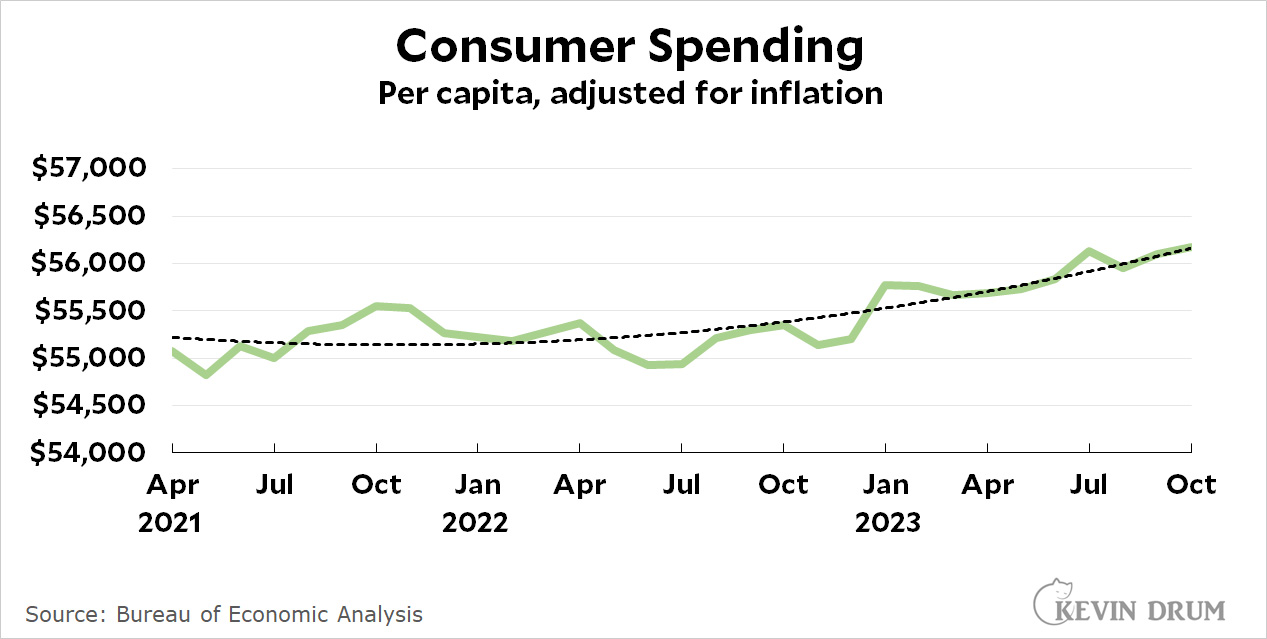
Until we see a slowdown in demand, the Fed's rate hikes haven't yet had an effect. So far, though, we haven't seen even a hint of a demand slowdown:

In addition, GDP was up 5.2% last quarter. Unemployment is running at 3.7%. Nonresidential investment is up. Wages are up.

This isn't a "soft landing." Just look at the numbers. The jet is still in the air cruising at 600 knots. We haven't even started our descent.

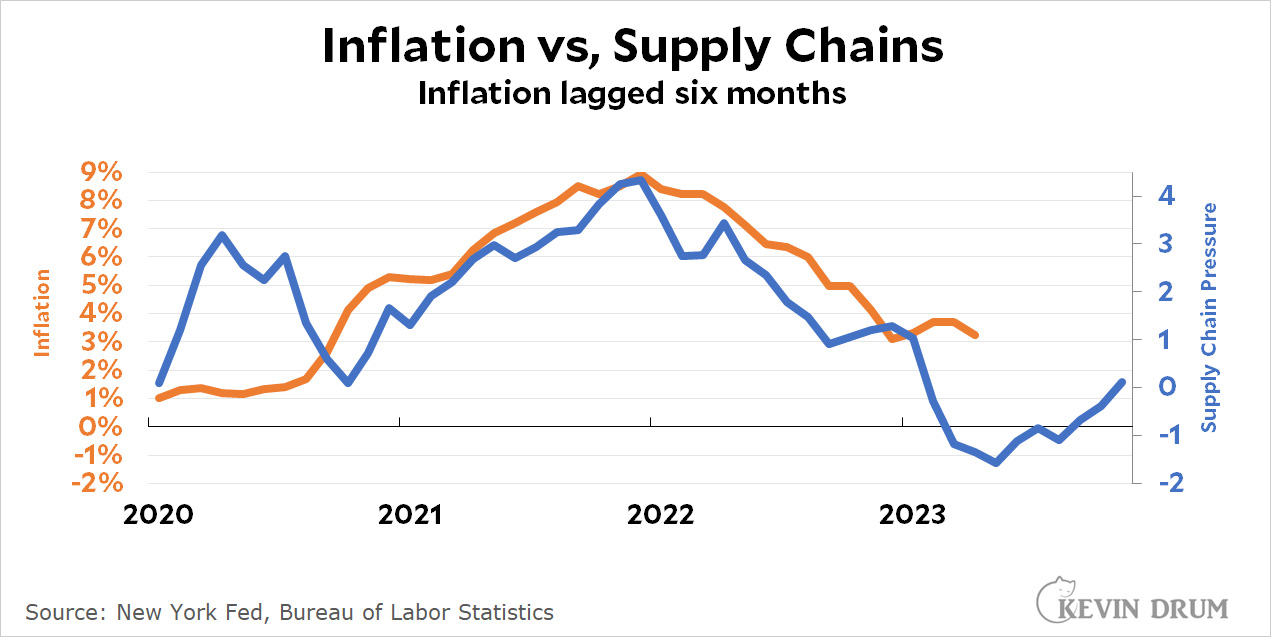
So one of two things is true. Either the Fed has reduced inflation through pure magic, or the Fed hasn't had any effect yet and inflation is down because supply chains have returned to normal.

The evidence is overwhelmingly in favor of the latter.

Coincidence? I think not.

To a lot of oldsters like me, the depth and extremity of campus support for the Palestinian cause—and its attendant hatred of Israel—can be inexplicable. But it's not that hard to understand. If you were born after 1990 or so, your experience of Israel and the Palestinians is not 75 years old, with everything that implies. Rather, it's been molded exclusively over the past two decades—a period that's seen very little Palestinian aggression. That means young people have experienced what, from their view, looks like a fathomless, unprompted, and wanton persecution of Palestinians by a powerful and ruthless Israeli state that is allowed by the US to treat an oppressed minority however it wants.

Here's what they see:

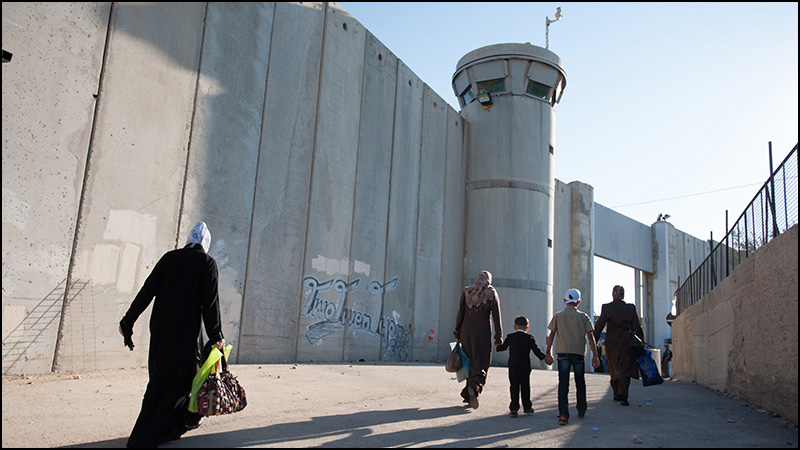
A West Bank under rigid military rule that administers one justice system for Israelis and a different, far harsher one, for Palestinians. Roadblocks, travel restrictions, segregation, checkpoints, Israeli-only roads, and countless other indignities of daily life. Censorship and long lists of banned books. Restrictions on visitors. Military tribunals that imprison thousands of Palestinians on specious grounds, including hundreds held in "administrative detention" without even the charade of a trial. Construction of a 400-mile prison wall manned by military guards who shoot anyone (on the Palestinian side) who gets too close.

Steady carving up of the West Bank that splinters Palestinian territory into Swiss cheese and makes a mockery of any future Palestinian state. Military raids against Palestinian towns. Extremist outposts that are tacitly supported even though they're illegal even under Israeli law. Settler violence against Palestinians that's rarely punished. Routine land seizures from Palestinian enclaves.

Demolition of homes and eviction of Arabs living in East Jerusalem. A blockade of Gaza that restricts water, fuel, food, and medicine from its residents. Deliberate policies that keep Palestinians in grinding poverty.

And in Benjamin Netanyahu, a leader who treated Barack Obama with open contempt and is actively opposed to any kind of two-state solution. Then, following October 7, prosecution of a ruthless war that has indiscriminately killed at least ten times more Gazans than Israelis. And a barbarous squeezing of the Gaza blockade to make life all but impossible for the survivors.

This is very far from comprehensive, and it's unconscionable even if you have a good understanding of the decades of history that prompted it. If you don't, it's unconscionable and gratuitous, a case of a country tormenting its powerless occupied subjects just because it can. Even the modest amount of Palestinian violence during this era is easy to interpret as nothing more than the righteous flailing of a brutally oppressed people.

This view, in my opinion, is ahistorical. There are reasons things have turned out this way, many of them the responsibility of Arab nations and the Palestinians themselves. But even that doesn't justify Israel's actions over the past two decades—and if you're familiar only with those two decades it merely looks like brutality for its own sake. Is it any wonder that young people feel the way they do about Israel and Palestine?

Ten paragraphs into yet another story about struggling boys these days, we get this:

Girls have been surpassing boys in school since at least the 1950s, says Richard Reeves, president of the American Institute for Boys and Men, a nonpartisan, nonprofit research organization. Colleges in the past were more willing to accept male applicants in need of improvement. That has changed, and women now outnumber men on college campuses.

My guess is that "since at least the 1950s" means "basically forever." We have a remarkable ability to forget just how ill-behaved men have been since the start of time. It's only more obvious now because, like colleges, we're no longer willing to indulge it.

The Washington Post reports today about a brewing controversy over bank safety. The Fed wants to increase capital requirements for risky mortgage loans, with riskier loans requiring more capital. This sounds sensible, but banks, of course, are fighting it.

The only thing that makes this a live controversy is that the banks have an odd partner: organizations that advocate for more Black homeownership. Because of their lower income and smaller wealth (for down payments), Black homebuyers are generally riskier than white ones. Increasing capital requirements for their loans will probably lead to higher interest rates and push the Black homeownership rate even lower than it already is.

In one sense, this is yet another example of a truism: low incomes make everything harder. We would most likely be better off if we stopped piecemeal resistance to every regulation that might hurt the poor and simply gave them more money. This would accomplish the same thing but still allow sensible regulation and rulemaking.

In the case of Black homebuyers, the problem goes beyond income anyway. I did a very rough horseback calculation of how much homeownership you'd expect among Black families just based on their lower average incomes and then compared it to reality:

Take these numbers with a grain of salt. But only a grain: they're probably not too far off. What they show is that you'd expect the Black homeownership rate to be about ten points lower than white homeownership just by virtue of their lower incomes. But in reality, Black homeownership is about ten points lower still. This difference might be due to a lot of things, but plain old racism is almost certainly part of it.

So sure, we could give money to low-income families. That would help. But it wouldn't solve the whole problem.

Check out Casey DeSantis on Fox News asking supporters to swarm into Iowa and commit election fraud:

This is not a "gaffe." It was obviously planned and rehearsed. "You do not have to be a resident of Iowa to be able to participate in the caucus," she said. That isn't a case of sloppy wording in a live interview. It's an explicit call to break the law.

Today DeSantis is saying that "participate" just means, you know, participate. Not vote. How silly that anyone would think otherwise!

What revolting behavior.

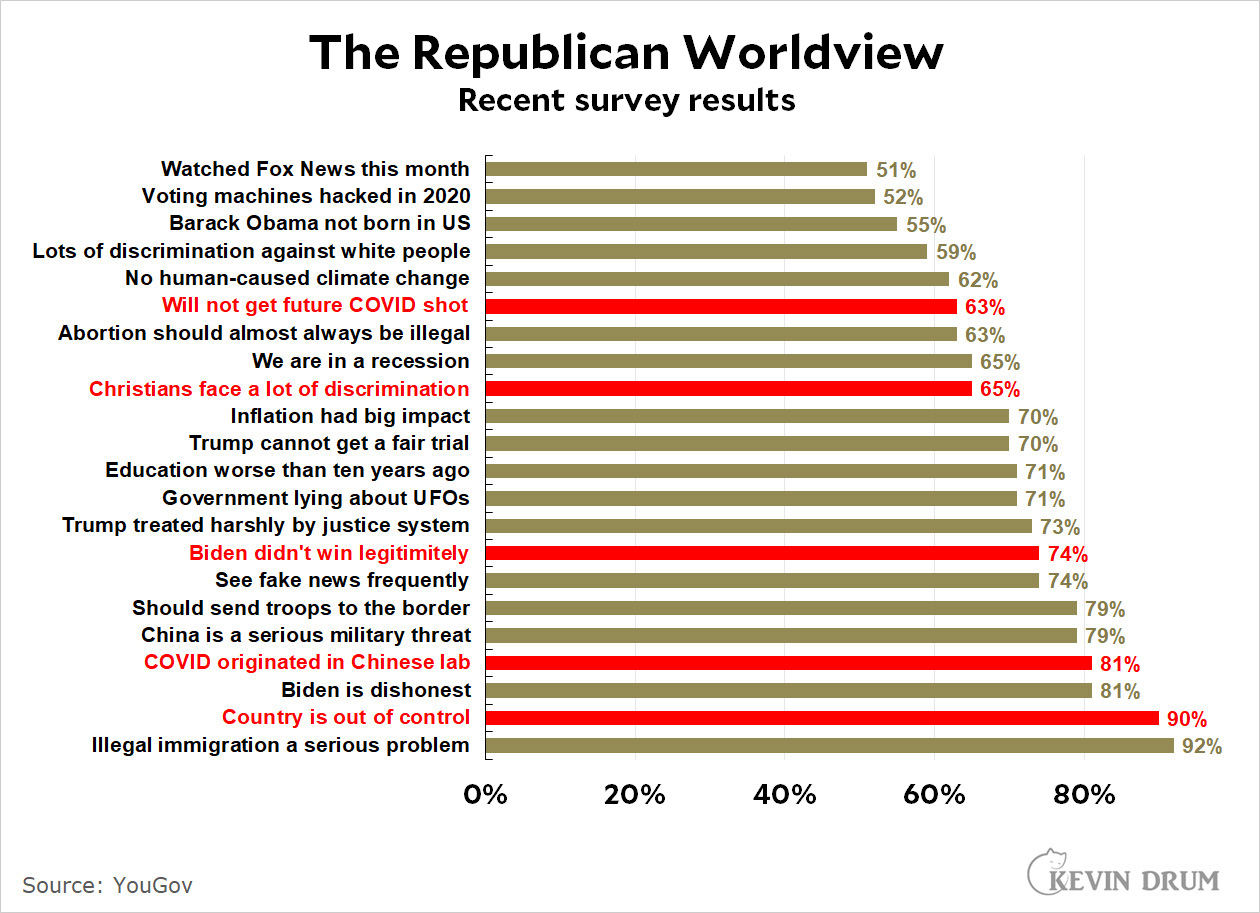
Apropos of nothing, I was browsing through a bunch of YouGov polls and thought I'd put together a summary of Republican views of the world. YouGov is handy for this because they ask lots of different questions and always provide crosstabs. Here it is:

You may think this is my way of saying "Republican are idiots." But not really.¹ My point is more that, thanks to Fox News and Donald Trump and the rest of the conservative ecosphere, this is what Republicans think of the world. They believe Christians are widely discriminated against. They believe Biden stole the election. They believe COVID came from a Chinese lab. They believe we're in a recession. Virtually all them believe the country is "out of control."

If you believed this stuff, you'd act like a Republican too. We are all far more susceptible to what the media tells us than we like to think. The problem with Republicans is just that their media is so much worse than ours.

If someone else wants to create a chart like this for Democrats, feel free to dive in.

¹Well, maybe a little bit.

You really have to watch this short clip of Jake Tapper's interview with Rep. James Comer today. It's about David Weiss's indictment of Hunter Biden on tax charges, and Tapper is literally laughing in Comer's face. But Comer is such an idiot that he's completely oblivious. Classic TV.

I see a meme going around suggesting that only Democratic presidents create jobs, but it's pretty misleading. As much as I prefer not to give Trump credit for anything, job creation was fine on his watch. It's not fair to charge him with the pandemic collapse, nor to give Biden credit for all the gains since then. You really need to acknowledge a pandemic "time-out," which ends Trump's record in March 2020 and starts Biden's two years later. Here's what that looks like:

This isn't "official," but it's a more reasonable look at what really happened to the economy after adjusting for the pandemic. Basically, everyone is about the same except for Clinton, the employment GOAT among recent presidents, and George W. Bush, the goat among recent presidents.

This is getting tiresome. The New York Times tells us today that Claudine Gay, the president of Harvard, has apologized for her congressional testimony earlier this week. Here's their summary:

Asked during Tuesday’s hearing whether urging the genocide of the Jewish people amounted to defying Harvard policies against bullying and harassment, Dr. Gay replied, “It can be, depending on the context.”

Yes, she said that. But she immediately added that it was harassment if it was "targeted at an individual":

Anti-semitic rhetoric, when it crosses into conduct that amounts to bullying, harassment, intimidation, that is actionable conduct and we do take action.

Politically speaking, Gay and the other presidents should have had the presence of mind to say that calling for genocide was vile and disgusting and had no place on their campuses. That's especially the case since they were dealing with a grandstanding jackass like Rep. Elise Stefanik. Then they could have added that although this is hard to accept, even vile anti-semitism is protected free speech unless etc. etc.

Apologizing for not doing that is the right thing to do. Nonetheless, it remains the case that Gay's answer was, in fact, the right one. Free speech is meaningless unless it applies to the most revolting and offensive speech too.