The decline of the US—or even of the West more generally—has been a persistent topic for years, and for some reason it's enjoying a mini-Renaissance right now. There is much talk, for example, that the dollar is losing its spot as the world's reserve currency. But it sure doesn't look like it:
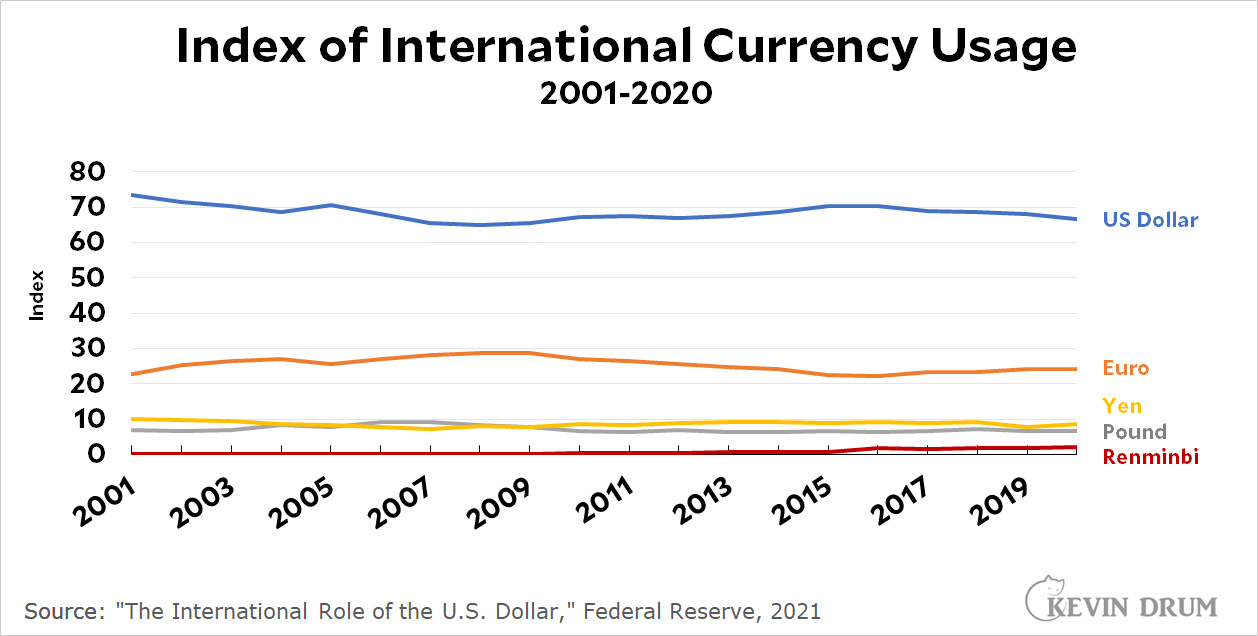 The dollar lost a bit of influence during the Iraq War years, but that came to a hard stop in 2007, when the economy collapsed. There's nothing like a world crisis to remind people why they liked dollars in the first place, is there?
The value of the dollar is fundamentally backed by our economic performance. Let's take a look at both the level and growth of GDP in the best-performing countries:
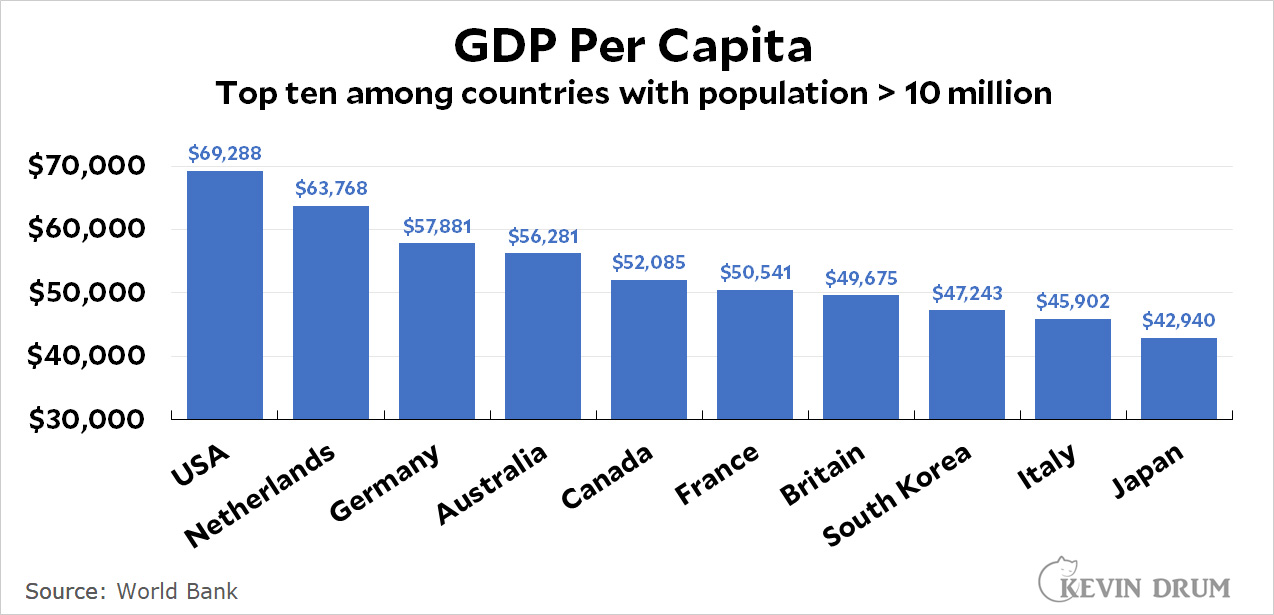
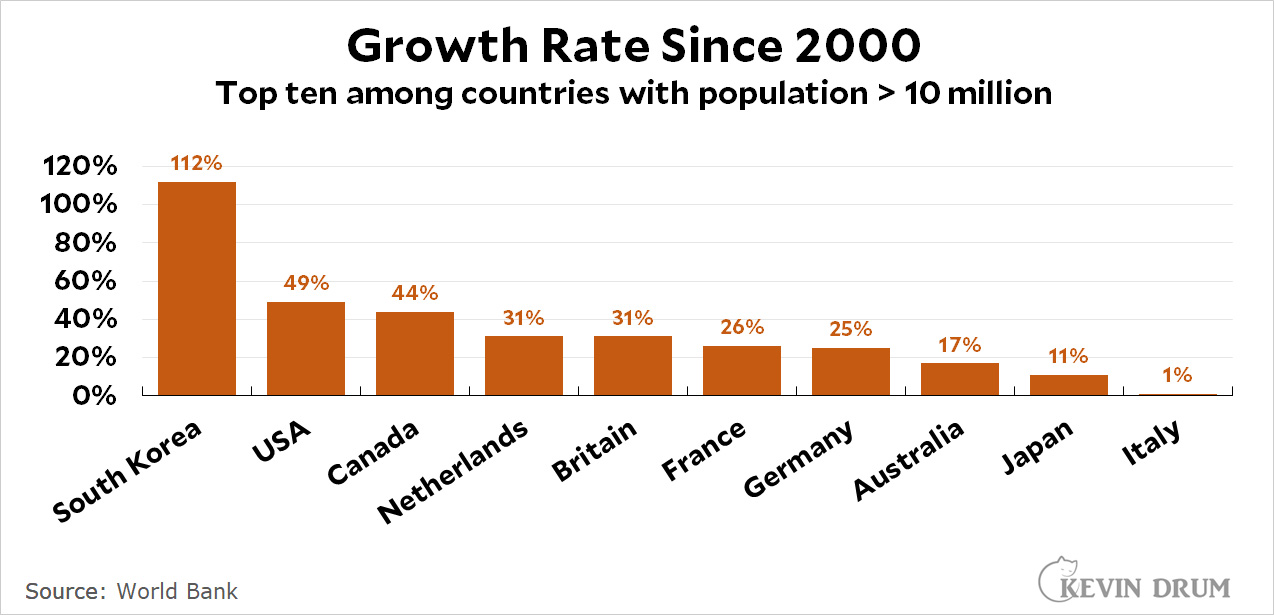 The US has the highest GDP per capita in the world among large-ish countries¹ and the fastest growth rate aside from South Korea, which started from a very low base.² You really ought to sit back for a minute and contemplate just how remarkable this is.
So our economy is not just big, it's also growing fast. And I hardly need to point out the well-known fact that we have a huge military to protect this economy:
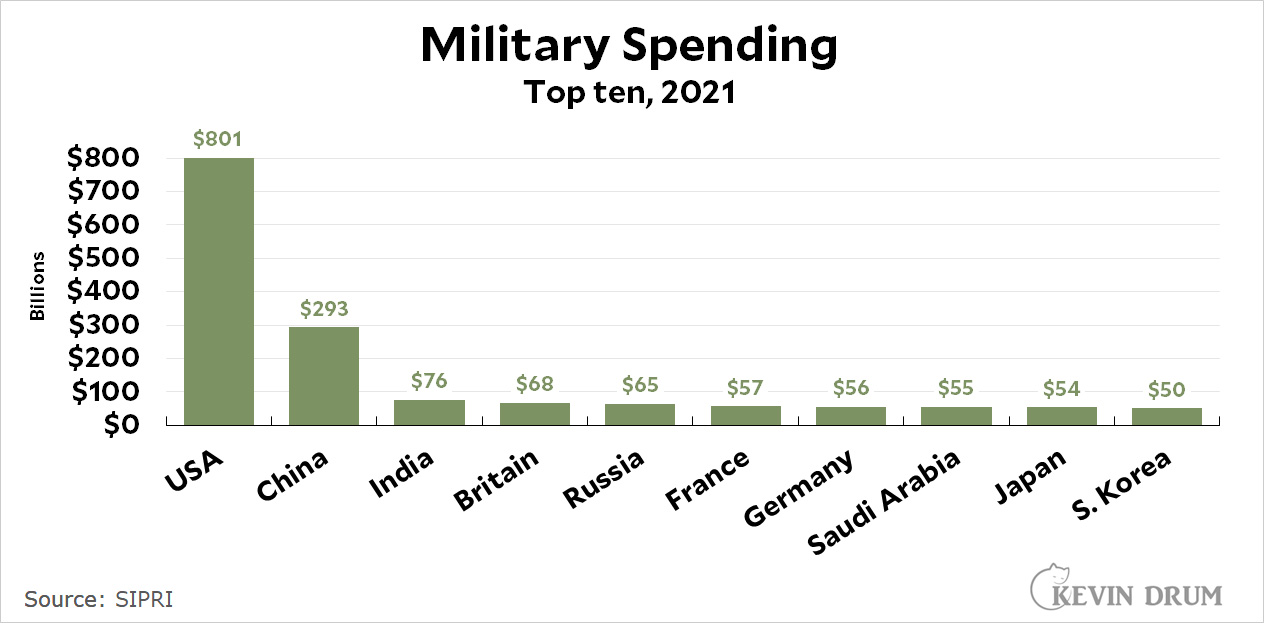 In fairness, despite the vast chasm between the US and China in military spending, it's an open question just how much it means. On the one hand, purchasing power parities and a cheap conscript-style army means China can field a lot more boots on the ground than we can. On the other hand, our technology is so far ahead of China's that we might outbulk them by more than 3:1 in real life. On the third hand, our military patrols the entire world while China's only has to patrol China itself and its nearby seas. On the fourth hand, the US potentially has all of NATO to call on in the case of a shooting war. On the fifth hand, it's not clear how vulnerable a classical navy like ours is to cheap, high tech drones and cruise missiles.
All this said, it mostly applies to a shooting war over, say, Taiwan, not a war on American territory. There's not much question that two big oceans and nearly a trillion dollars worth of military spending make us all but impregnable on our own territory. Short of a nuclear war, there's no safer place on earth.
Here's another thing to look at for the world's large economic powers: population growth.
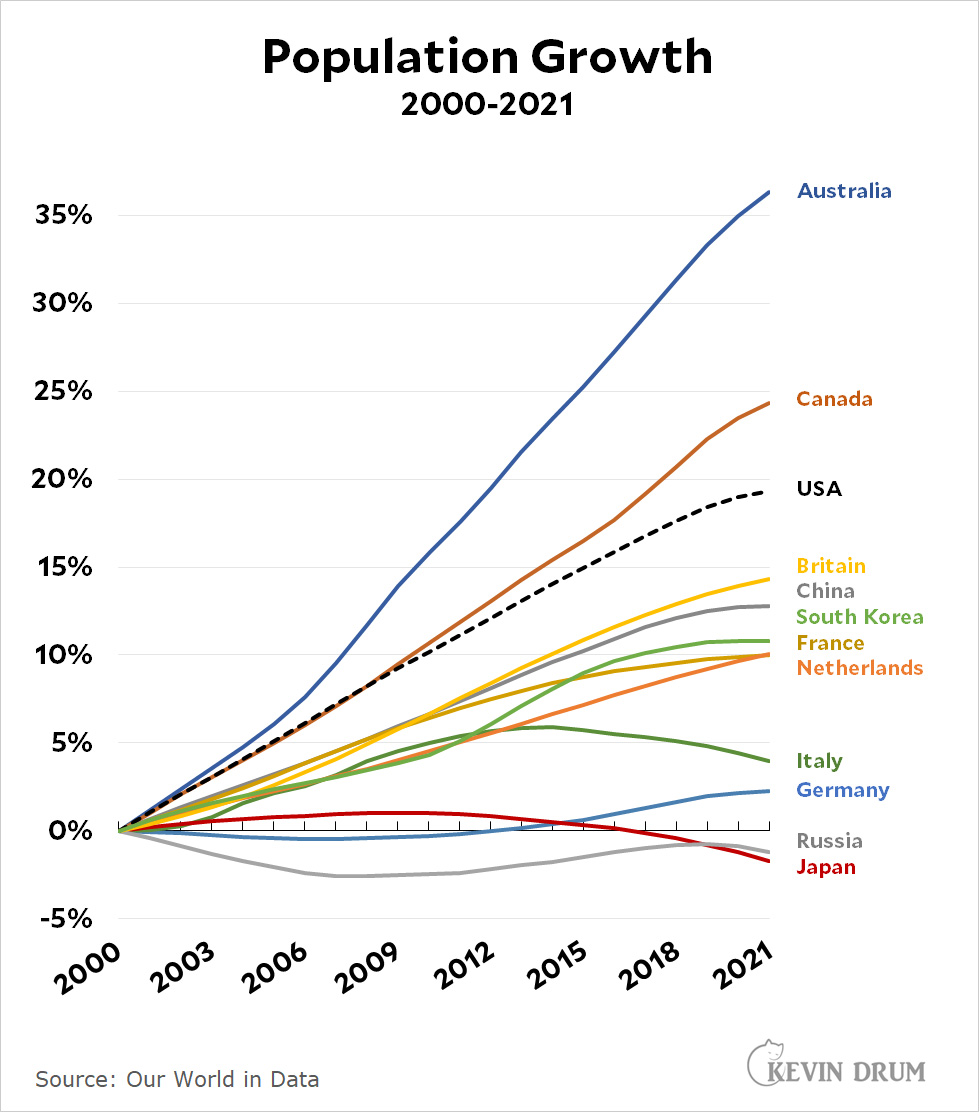 Unlike many rich countries, the US is still growing at a brisk pace. Here's education:
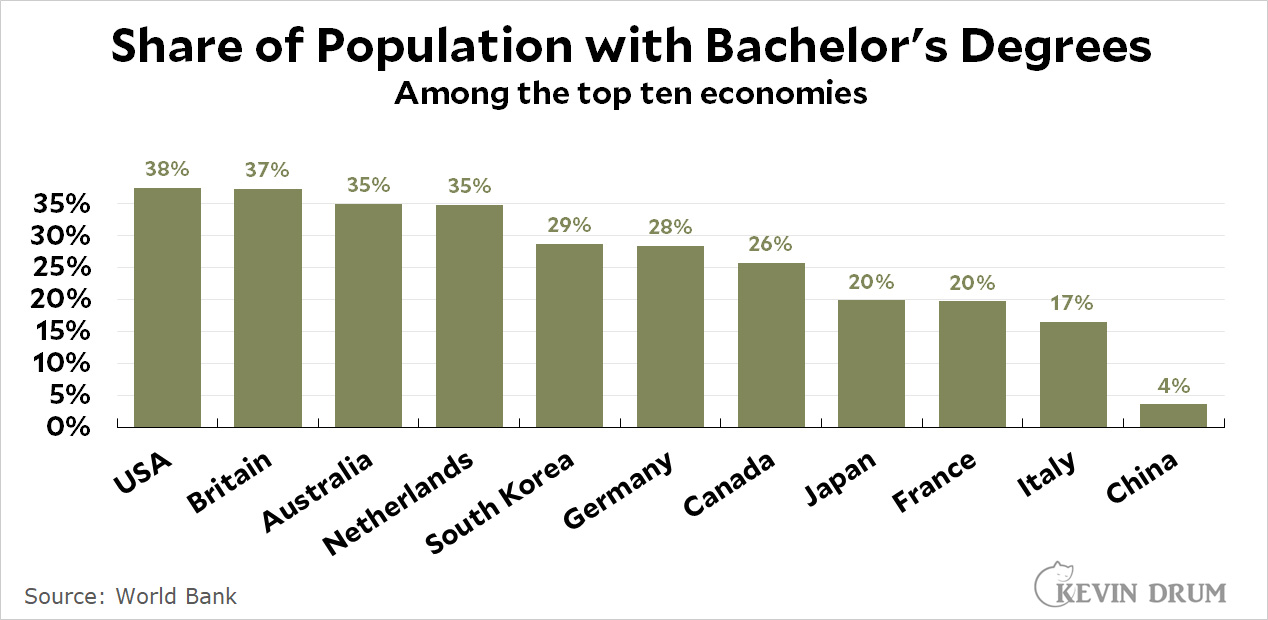
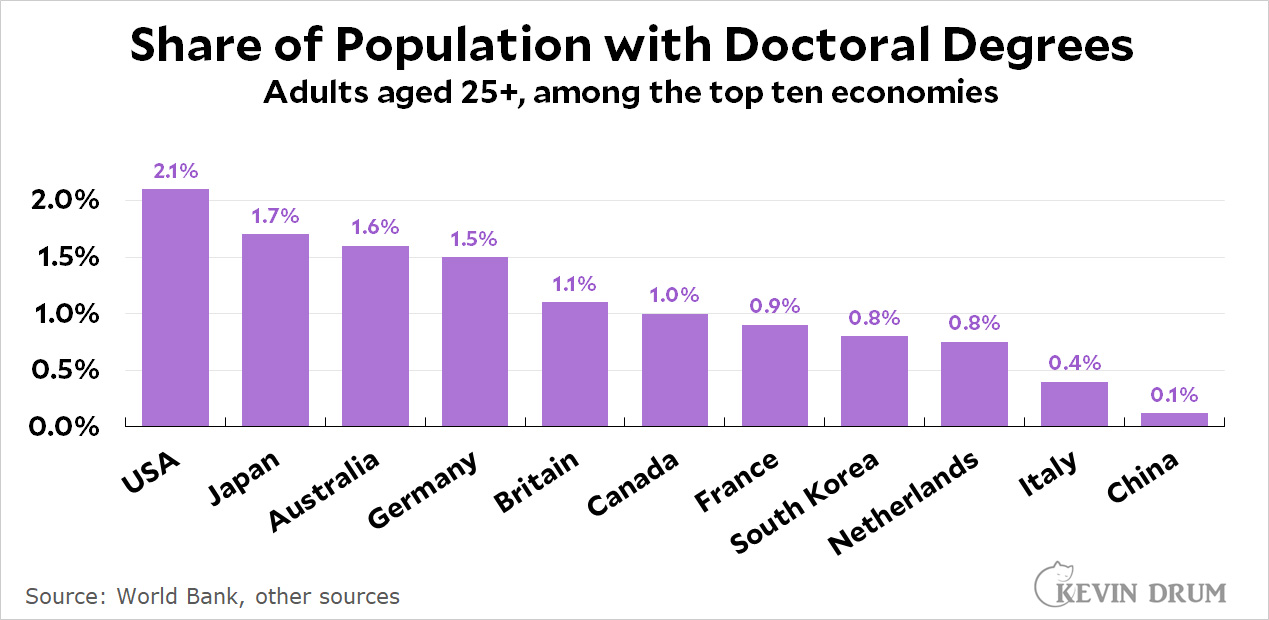 Finally, I was intrigued by this tweet quoting Larry Summers:
This might be true, but it's largely because we've given developing countries so many airports already and it hasn't worked out so well. China is discovering the same thing today with its Belt and Road initiative: eventually there comes a time when your clients can't pay back their loans, and then what? Write off the investment and never go back? Demand repayment and become the bad guy? In terms of influence this is a losing game.
Also, while it might not be politically correct to point this out, Africa and South America combined account for 8% of world GDP. Does it really matter who has more influence in these places?
In summary: The dollar remains the world's reserve currency and shows no signs of that turning around anytime soon. Our GDP is the largest among big countries and our growth rate is second highest. Our military spending is wildly higher than anyone in the world. Our population growth is among the highest among rich nations. We have the most highly and broadly educated workforce. And while we may or may not be losing influence in the global south, does it really matter either way except at the margins?
There are plenty of things you can nitpick here, and plenty of qualitative arguments you can make against American supremacy. It's also clear that China has every intention of trying to match the US as a global superpower. But it has a very long row to hoe before it gets there. And by the time it matters, everything is going to depend on leadership in AI anyway—which is yet another area where the US has a dominant position.
Anyway, this is the case for the US retaining its crown as by far the most powerful nation in the world for a good long time. Aesthetics aside—de gustibus, after all—it's hard to make an argument for any other country being a better place for a young person to live for the rest of their life.
¹I excluded petrostate countries from this list for obvious reasons, though it doesn't change things much anyway.
²South Korea's growth rate has slowed considerably since 2010 and is now only slightly higher than ours.