Yesterday I pondered a question about fentanyl: it first became available on the street in the late 1970s, but it wasn't until 2013 that its use suddenly skyrocketed in the US. Why did it take so long for that to happen, given that it's practically a perfect drug for narcosyndicates?
Via Twitter, Beau Kilmer at RAND referred me to a report he co-authored a few years ago. The single biggest factor, he thinks, was the growing number of easy ways to synthesize fentanyl outside a commercial lab:
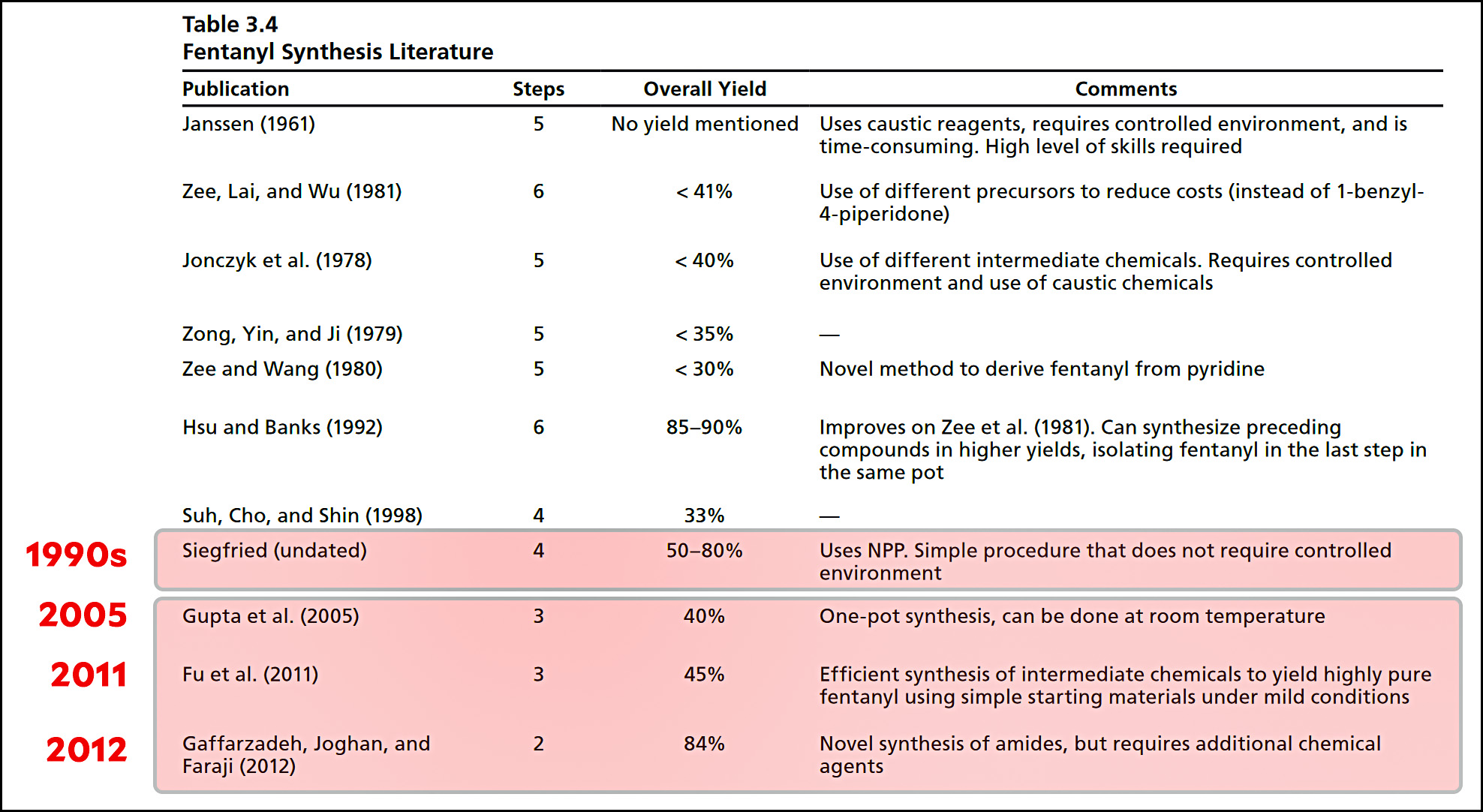 The Siegfried Method came out of Russia and was specifically designed for illicit manufacture of fentanyl. In the aughts, several more simplified methods were discovered that could be made by anyone with even modest training:
The invention and dissemination of easier synthesis methods can render a much broader set of individuals qualified and capable of producing fentanyl....Largely gone are the days of a single highly-trained chemist synthesizing fentanyl in a professional laboratory. The potential scale of chemical and pharmaceutical manufacturing, especially in China, combined with more-accessible synthesis techniques allows for the untrained to manufacture fentanyl virtually anywhere, making supply disruption more challenging.
A second possible explanation lies in the postal service:
Rising e-commerce and the growth of inbound packages from China overlap with fentanyl’s arrival. In 2011, postal services of the United States and China entered into an agreement to streamline mail delivery and reduce shipping costs for merchandise originating in China. This “ePacket” service is designed for shipping consumer goods (under 2 kg) from China directly and rapidly to customers ordering items online.
....Today, shipping costs from China are negligible. A 1-kg parcel can be shipped from China to the United States for as little as $10 through the international postal system or for $100 by private consignment operator. The volume of mail and cargo from China gives adequate cover for smuggling minute quantities of fentanyl or other novel synthetic opioids. Online vendors realize this and often prefer sending packages through USPS, sometimes targeting processing centers that handle large volumes of mail.
Easier methods of synthesis broadened the base of manufacture while fentanyl's concentrated nature made it easy to ship via postal service—which is considerably safer than smuggling hundreds of bricks of heroin or cocaine in boats and planes.
Put together, this offers a plausible explanation for ~2013 as the year that fentanyl finally took off. Before then it was difficult to synthesize; required trained chemists and commercial-quality labs; was tricky to smuggle; and because of all this was probably about as profitable as more conventional drugs. After 2013 it was easy to make; easy to smuggle; required only cooks and makeshift labs; and was highly profitable. What more could an aspiring drug lord ask for?