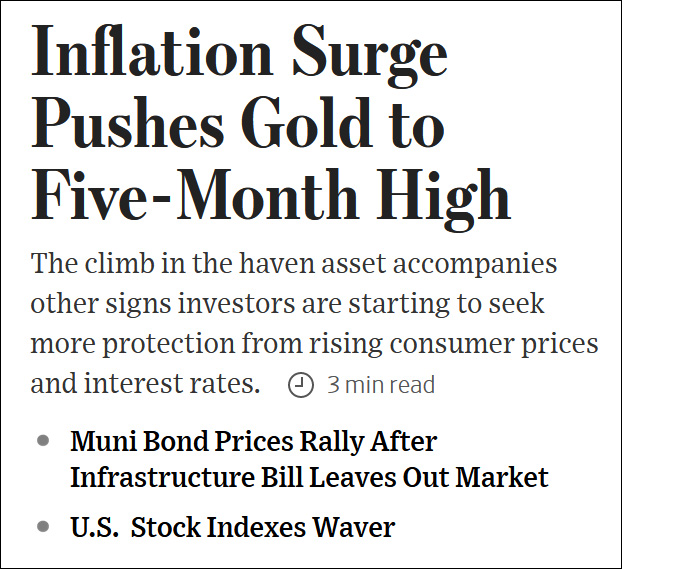
The Wall Street Journal's obsession with inflation marches bravely along:
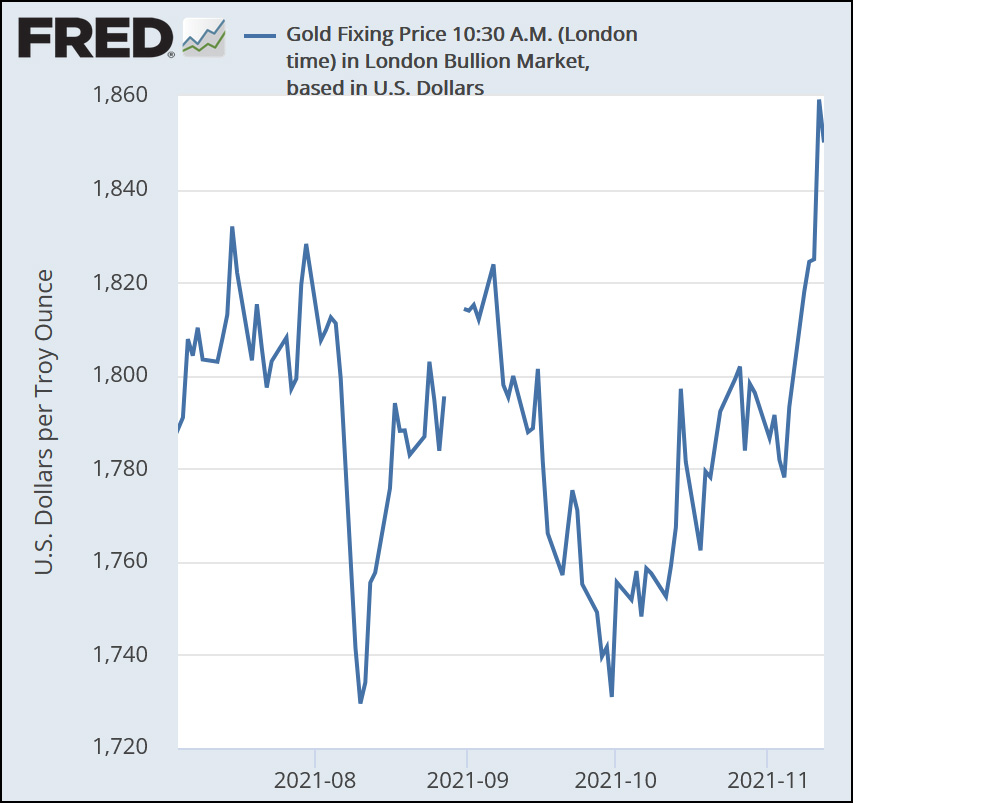
Gold! They can't figure out another angle to keep inflation on the front page, so they haul out the old "inflation hedge" of gold and present a carefully constructed chart that looks like this:
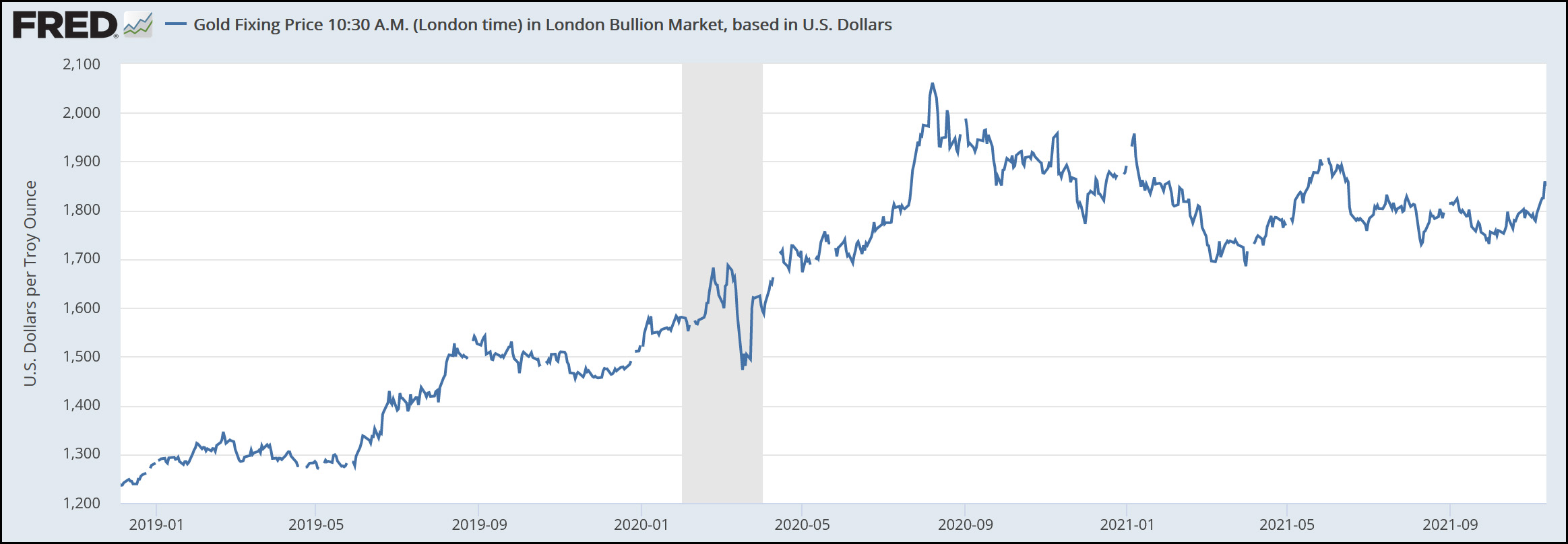
That's a five-month high, all right, thanks to a single day of trading on Friday. Here's what the chart looks like more normally:
Suddenly it doesn't really look like much, does it? And that's assuming anyone is dumb enough to think of gold as an inflation hedge anyway.
But any port in a storm. The Journal is determined to keep its Wall Street readership in a constant state of panic over inflation, and this will have to do. Until they figure out another angle for tomorrow, that is.
How many times have we heard this kind of thing from Republicans? And how many times has it mattered? Has any attempt to make nice with them ever been reciprocated in any way?
Republican mendacity on the subject of congressional investigations is beyond belief. They will hold months and months of investigations over anything, no matter how trivial—remember the Clinton Christmas card list? the IRS nonsense? Solyndra?—but when the shoe is on the other foot they recoil in horror that Democrats would do such a thing to them.
Back in January, all of these folks agreed that the 1/6 insurrection was appalling. Of course Congress should investigate an attack on Congress. But then time went by and they decided that the partisan inconvenience of making Donald Trump look bad far outweighed the national interest in figuring out who was responsible for the attack. Quelle surprise.
I was pretty pleased with the egret photo I showed you on Thursday, so today you get the whole sequence of the egret taking off from its perch. I wish I could have kept it centered longer, but I've never had very steady hands and they're getting unsteadier all the time. So five is all you get.
November 4, 2021 — Lake Martin, St. Martin Parish, Louisiana
On Friday a team of researchers released the results of a survey about racial views among Black, white, Democratic, and Republican respondents. There's a big gap between Democrats and Republicans, which is hardly surprising, so it's more interesting to rejigger the data and show just the difference between Black Democrats and white Democrats. Here it is:
There aren't a lot of Black-white differences in the first five or six issues, but the differences widen for the last four. White respondents were a lot more likely to believe that white people are less likely to be hired and less likely to be admitted to college thanks to affirmative action. And—oddly?—Black respondents are much more likely to think racism will get worse in the future.
The most interesting divergence however, is in the two discrimination questions. Among Black respondents, 73% believe discrimination is common but only 25% say they've been personally discriminated against. Likewise, about 50% of white respondents think hiring and college admission discrimination against white applicants is common, but only 11% think they've been personally discriminated against.
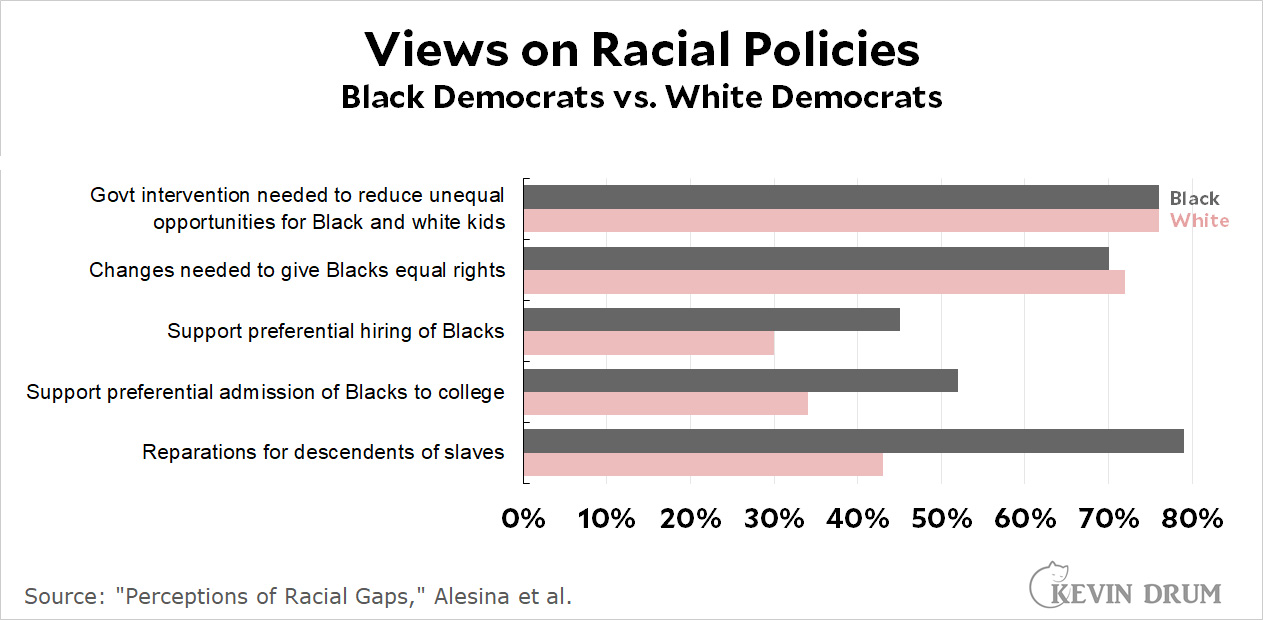
And now for a look at actual policies:
There's nothing much to see in the top two policies. However, when it comes to concrete preferential treatment, there's a difference of 15-18%. And reparations produce a whopping 36% difference.
Nickel summary: white Democrats generally say the same thing as Black Democrats, but when it comes to the concrete questions of whether white people are discriminated against in hiring and college admissions—and whether they should be—there's a pretty sizeable difference. Whites believe that affirmative action has hurt them and they don't support it. Even among Black respondents, about a third believe that affirmative action hurts white people and only about half support it. Affirmative action just doesn't have a lot of support, even among Democrats.
March 16, 2016: President Obama nominates Merrick Garland to an empty seat on the Supreme Court.
March 17 - November 8, 2016: Senate Republicans blockade Garland, vowing to hold "no hearings, no votes, no action whatsoever" on his nomination.
November 3, 2020: Joe Biden is elected president of the United States.
March 11, 2021: Garland is sworn in as Biden's attorney general.
November 12, 2021: Garland's Justice Department indicts Steve Bannon for contempt of Congress following Bannon's refusal to obey a subpoena to testify before the 1/6 committee.
Revenge is indeed a dish best served cold. I wouldn't be surprised if Bannon isn't the last to be indicted.
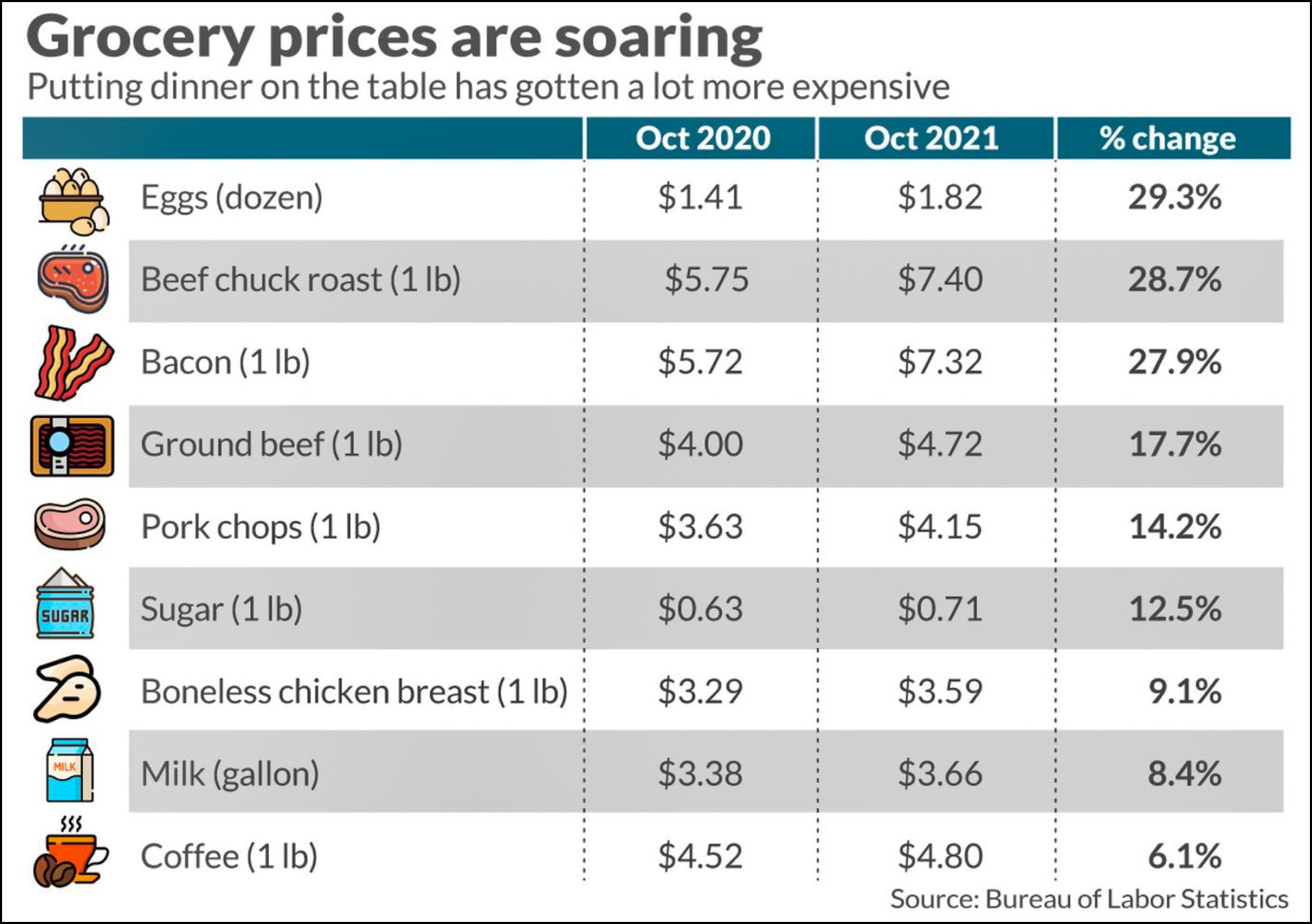
A reader sends me this chart, which was included in an article about "soaring" food prices:
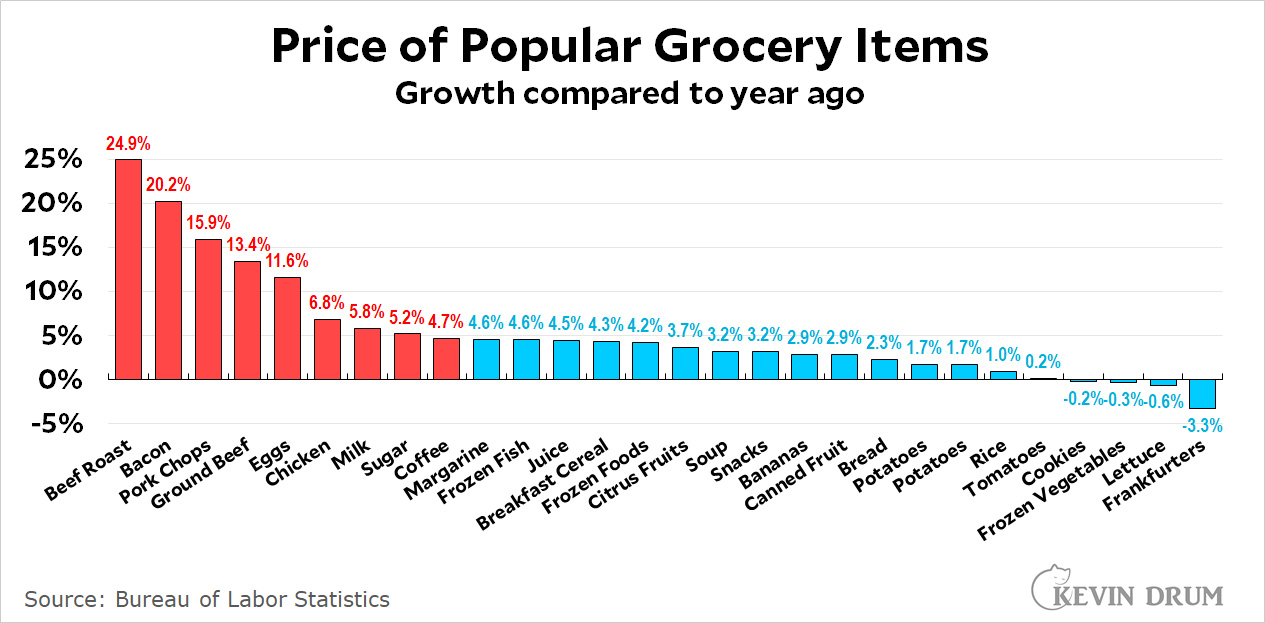
Here's a bigger chart that shows a wider variety of food:
I need to be clear here: I don't object to reporting about high food inflation. At 5.4%, the overall inflation rate of food is high right now. But if you cherry pick your data to show only the items that have gone up the most, then by definition you're playing with loaded dice. It's like presenting a chart showing the prices of BMWs, Porsches, and Cadillacs and pretending that it shows the average price of cars.
In the top chart, if you glance quickly at the middle because that seems like it's probably the average, you'd think overall food prices are up 15% or more. That's wrong. Conversely, if you show your readers the lower chart, they'd probably figure that food prices are about 4-5% higher than last year, which happens to be correct.
Why would a news outlet do this? The top chart is flatly misleading. Is there anyone in the news media interested in doing a contrarian piece showing what's really happening with food prices? Why not?
I have bad news today. Hopper has been losing weight lately, and we intended to let a vet take a look at her after her tail had healed. We did that on Monday and it turned out that she was much sicker than we knew. Her kidneys were essentially gone, and although IV fluids would make her feel better for a few days, our vet said that her chances of permanently recovering were close to zero.
So we did the necessaries and had her put to sleep. She was only eight years old. The picture below is the last one I took of her, just before my Louisiana vacation.
The COP26 climate conference in Glasgow has been a failure. There have been a few agreements here and there, but nothing very impressive for a conference that was supposedly "make or break" for humanity.
This shouldn't surprise anyone. COP26 merely confirms what we've known for a long time: nations won't agree to cut back on profitable fossil fuel extraction and politicians don't dare promise to do anything that will annoy their constituents. This has been true for decades and it's still true.
If I were your benevolent dictator, here's what I would do:
Aggressively roll out wind, solar, and nuclear power. This would probably get us about halfway toward our goal of net zero carbon emissions.
Pour trillions of dollars into R&D looking for new technologies to reduce atmospheric CO2. This would include things like cement production and chemical manufacturing that don't benefit from green electricity, and carbon capture, which is a necessary part of meeting our goals.
Begin seeding the atmosphere with aerosols. If we start now, it could be done very slowly while we test for larger effects on the planet. If, instead, we wait until 2040 or 2050 to do this, it will be an emergency operation with unknown impacts.
I understand this is not a popular proposal. Hell, I don't like it much myself. But all the evidence in the world suggests that nothing else has any real chance of success. It's time to face up to that.
Craig Doescher, a Michigan-based consultant who works in a chief financial officer-type capacity for multiple businesses, said inflation is disrupting nearly every sector and that there’s little confidence that anyone in Washington has a short-term plan to deal with it.
"It didn't take long to completely break down the economy in 2020 but it's going to take a long time to put it all back together," Doescher said. "I've got clients who haven't given significant raises to unskilled workers in decades and now they are raising wages by 50 percent and still having trouble finding people. There is a lot to ride out here."
Where does this crap come from? I have in my hands a fresh, crisp ten-dollar bill that I will give to anyone who can point to an actual firm that is raising wages by 50% and still can't find workers. I'm serious. I realize that boring charts and BLS numbers are no longer of any use to journalists, but here's another crack at average pay over the past year:
You can see a couple of things here. First, overall inflation speeds up between September and October. That's the 6.2% headline number we've all seen. Second, the cost of labor slows down. Since January, labor costs have gone up far less than the overall inflation rate.
There has been an increase in the price of goods, and of course supply chain disruptions have made lots of things hard to get. That's a genuine problem, and it's one the White House ought to be focused on.
But labor costs? Give me a break. There are a dozen ways I can present this data, and they all tell the same story: wages haven't gone up substantially in 2021. There are a few narrow categories with high wage increases, but even those are nowhere near 50%:
The leisure industry (which includes restaurants) is the obvious outlier here, with every other industry at about 4% or less—lower than the overall rate of inflation.
Bottom line: There isn't any big surge in the cost of hiring new employees. There just isn't. Stop saying there is.

 Gold! They can't figure out another angle to keep inflation on the front page, so they haul out the old "inflation hedge" of gold and present a carefully constructed chart that looks like this:
 That's a five-month high, all right, thanks to a single day of trading on Friday. Here's what the chart looks like more normally:
 Suddenly it doesn't really look like much, does it? And that's assuming anyone is dumb enough to think of gold as an inflation hedge anyway.