Skip to content

I was looking up the figures for meat production earlier this evening and I ran across something puzzling:

The volume of beef and pork produced follow each other almost perfectly. I can't think of any reason for them to be tied so closely together. What's going on?

POSTSCRIPT: This chart also shows that the production of beef and pork seems to be pretty steady over the past year. So why do we keep hearing about shortages, and why is the wholesale price of beef and pork so high?

According to the USDA, the farm price of beef is up 16% over the past year while the retail price is up 24%. But why? Is it really just higher feed costs?

Atrios sez:

This is anticipating things a bit, but voters might get a bit annoyed if you trumpet the great things you did but it doesn't come online for years, and is underfunded (so not real) when it does.

Or, I dunno, maybe The Left is to blame.

I don't get this. Big, complex programs almost never come online within a few months. That's just the way it is. Why do people complain about this constantly?

And even when they do come online fast, does it matter? The expanded Child Tax Credit started flowing almost immediately; it was nearly universal; and it was straight-up cash in people's pockets. But as near as I can tell, it elicited a big meh from voters, most of whom never really realized that it was a Biden program anyway.

Donald Trump had the right idea on this stuff: Don't worry about all the fussy details, like whether the program actually works or not. Just boast about it to the skies, and keep doing it every time you open your mouth. Eventually people will believe the story, not the reality.

I order enlargements of my best pictures and display them on an upstairs wall. Every month or two I order a new one and rotate it into the display, and for the past several months I've been rotating in only black and white photos.

That process is complete, and I now have a display of just black and white pictures. It's hard to do black and white well, but it's fun to try and I think I'm getting a little better at it.

In another month or so I'll start rotating new pictures in, and the display will once again be a combination of color and monochrome. Until then, enjoy the grayscale.

November 10, 2021 — Irvine, California

As long as we're on the subject of inflation, a reader emails to ask whether high inflation is a global problem or a purely American one. For starters, here is inflation in the US and Europe:
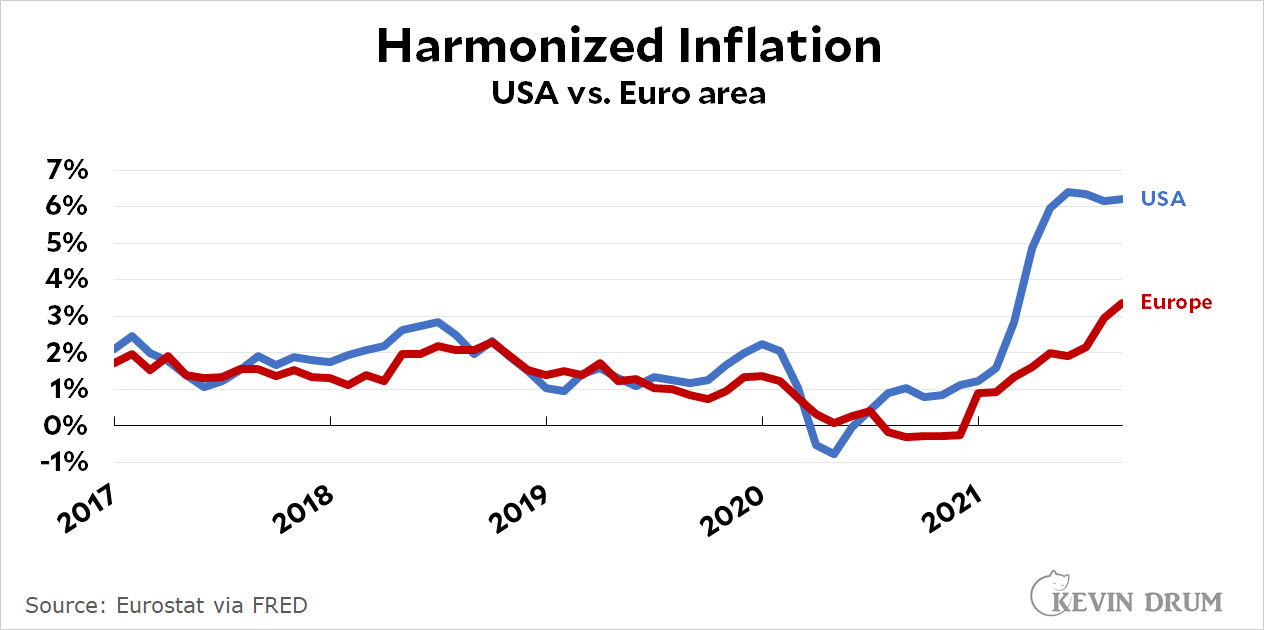
One thing to notice is that this is "harmonized" inflation. Every country has a slightly different way of calculating inflation, so Eurostat performs some statistical magic to bring them all into line and make them comparable. That's why the US figures look a little different than the ones you usually see. Eurostat thinks the US hit a 6% inflation rate back in May and has been pretty steady ever since. Euro-area inflation, by contrast, is still low but appears to be climbing.

Take that for what it's worth. A few months from now things might look very different.

The main takeaway, however, is that in March US inflation started to pull away from Euro-area inflation. Why? Paul Krugman dedicated an entire column to this question and concluded that it was a mystery. And if it's a mystery to Krugman, who am I to have an opinion?

But let's throw caution to the wind and offer up the obvious answer: in the US we passed a $900 billion stimulus bill in December and then followed it up with a $1.9 trillion stimulus bill in March. That's a lot of money to dump into the economy, and seems plenty sufficient to touch off a round of inflation. European countries mostly didn't do this because they already have safety nets that take care of people during things like recessions and pandemics.

So that's my answer, anyway. It's also why I continue not to be too worried about high inflation. We pumped $2.8 trillion into the economy, and it's no surprise that it produced some inflation. However, that was a one-time event. Once that money works its way through the economy, inflation will fade away naturally.

That's just my two cents. Remember, though, I Am Not An Economist.¹

¹Not that economists seem to be doing any better on this question...

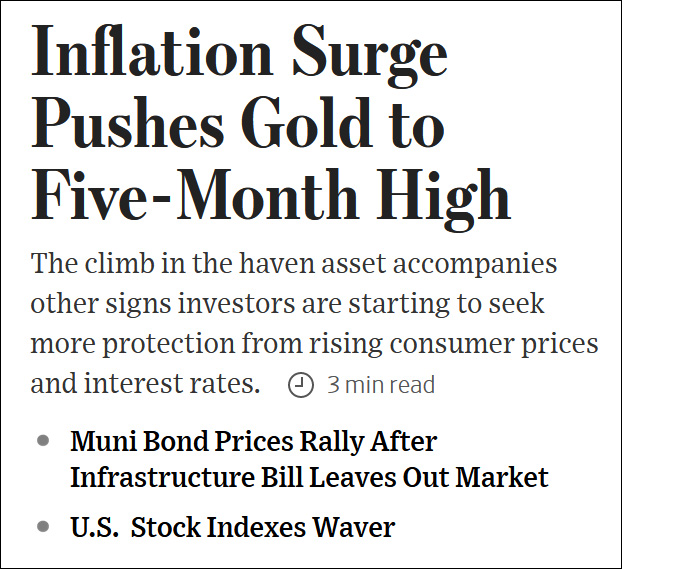
The Wall Street Journal's obsession with inflation marches bravely along:

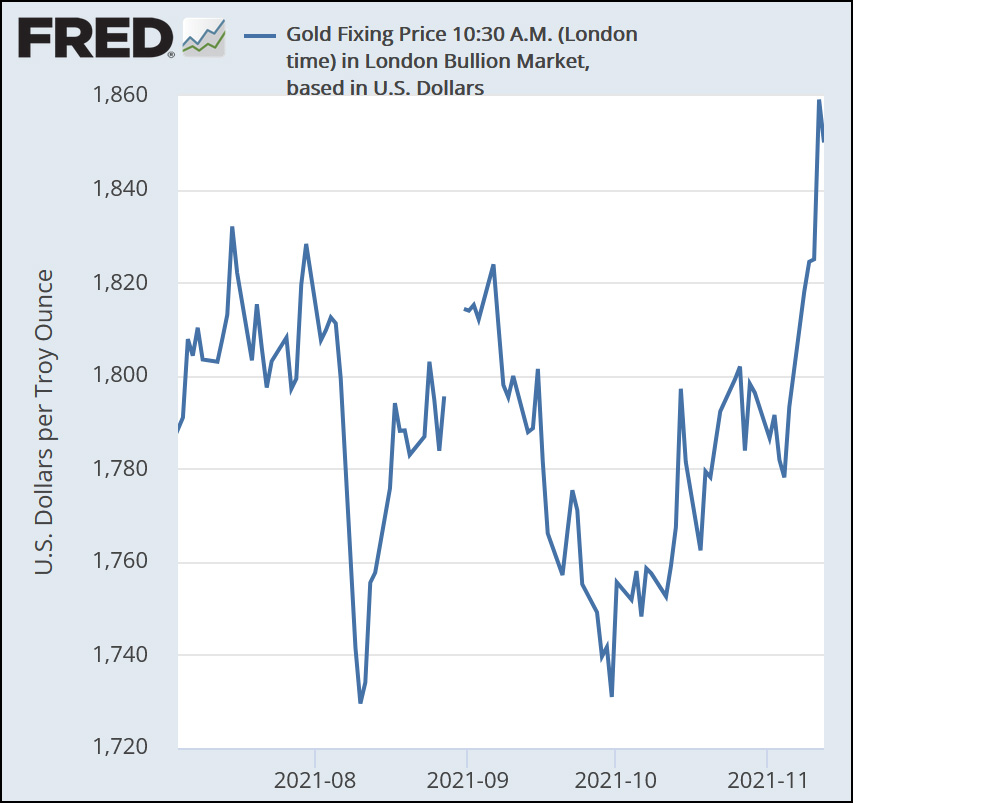
Gold! They can't figure out another angle to keep inflation on the front page, so they haul out the old "inflation hedge" of gold and present a carefully constructed chart that looks like this:

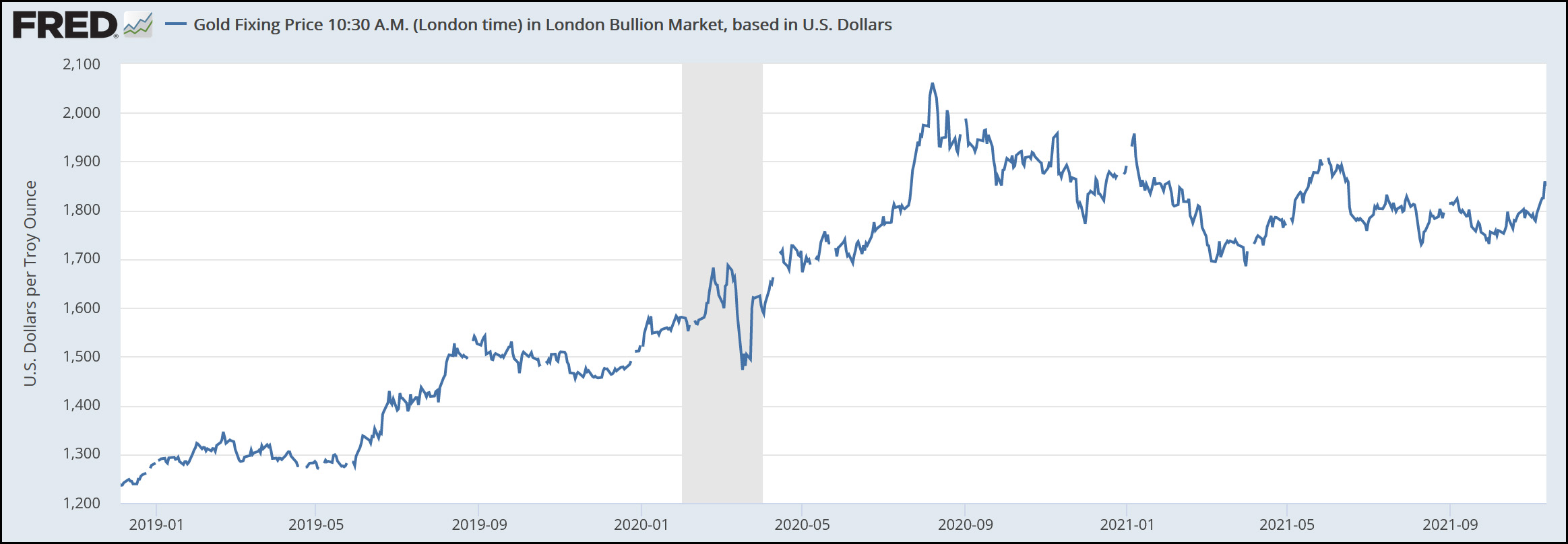
That's a five-month high, all right, thanks to a single day of trading on Friday. Here's what the chart looks like more normally:

Suddenly it doesn't really look like much, does it? And that's assuming anyone is dumb enough to think of gold as an inflation hedge anyway.

But any port in a storm. The Journal is determined to keep its Wall Street readership in a constant state of panic over inflation, and this will have to do. Until they figure out another angle for tomorrow, that is.

Ooh, I'm so scared:

How many times have we heard this kind of thing from Republicans? And how many times has it mattered? Has any attempt to make nice with them ever been reciprocated in any way?

Republican mendacity on the subject of congressional investigations is beyond belief. They will hold months and months of investigations over anything, no matter how trivial—remember the Clinton Christmas card list? the IRS nonsense? Solyndra?—but when the shoe is on the other foot they recoil in horror that Democrats would do such a thing to them.

Back in January, all of these folks agreed that the 1/6 insurrection was appalling. Of course Congress should investigate an attack on Congress. But then time went by and they decided that the partisan inconvenience of making Donald Trump look bad far outweighed the national interest in figuring out who was responsible for the attack. Quelle surprise.

I was pretty pleased with the egret photo I showed you on Thursday, so today you get the whole sequence of the egret taking off from its perch. I wish I could have kept it centered longer, but I've never had very steady hands and they're getting unsteadier all the time. So five is all you get.

November 4, 2021 — Lake Martin, St. Martin Parish, Louisiana

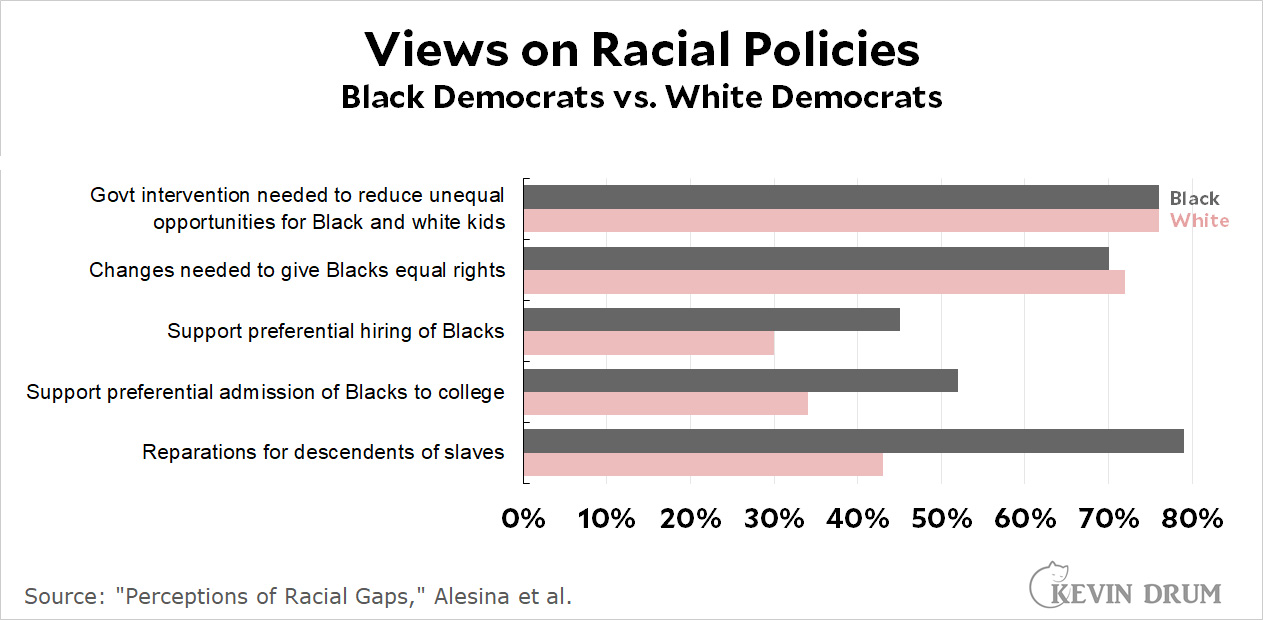
On Friday a team of researchers released the results of a survey about racial views among Black, white, Democratic, and Republican respondents. There's a big gap between Democrats and Republicans, which is hardly surprising, so it's more interesting to rejigger the data and show just the difference between Black Democrats and white Democrats. Here it is:

There aren't a lot of Black-white differences in the first five or six issues, but the differences widen for the last four. White respondents were a lot more likely to believe that white people are less likely to be hired and less likely to be admitted to college thanks to affirmative action. And—oddly?—Black respondents are much more likely to think racism will get worse in the future.

The most interesting divergence however, is in the two discrimination questions. Among Black respondents, 73% believe discrimination is common but only 25% say they've been personally discriminated against. Likewise, about 50% of white respondents think hiring and college admission discrimination against white applicants is common, but only 11% think they've been personally discriminated against.

And now for a look at actual policies:

There's nothing much to see in the top two policies. However, when it comes to concrete preferential treatment, there's a difference of 15-18%. And reparations produce a whopping 36% difference.

Nickel summary: white Democrats generally say the same thing as Black Democrats, but when it comes to the concrete questions of whether white people are discriminated against in hiring and college admissions—and whether they should be—there's a pretty sizeable difference. Whites believe that affirmative action has hurt them and they don't support it. Even among Black respondents, about a third believe that affirmative action hurts white people and only about half support it. Affirmative action just doesn't have a lot of support, even among Democrats.

A wee little timeline:

March 16, 2016: President Obama nominates Merrick Garland to an empty seat on the Supreme Court.

March 17 - November 8, 2016: Senate Republicans blockade Garland, vowing to hold "no hearings, no votes, no action whatsoever" on his nomination.

November 3, 2020: Joe Biden is elected president of the United States.

March 11, 2021: Garland is sworn in as Biden's attorney general.

November 12, 2021: Garland's Justice Department indicts Steve Bannon for contempt of Congress following Bannon's refusal to obey a subpoena to testify before the 1/6 committee.

Revenge is indeed a dish best served cold. I wouldn't be surprised if Bannon isn't the last to be indicted.

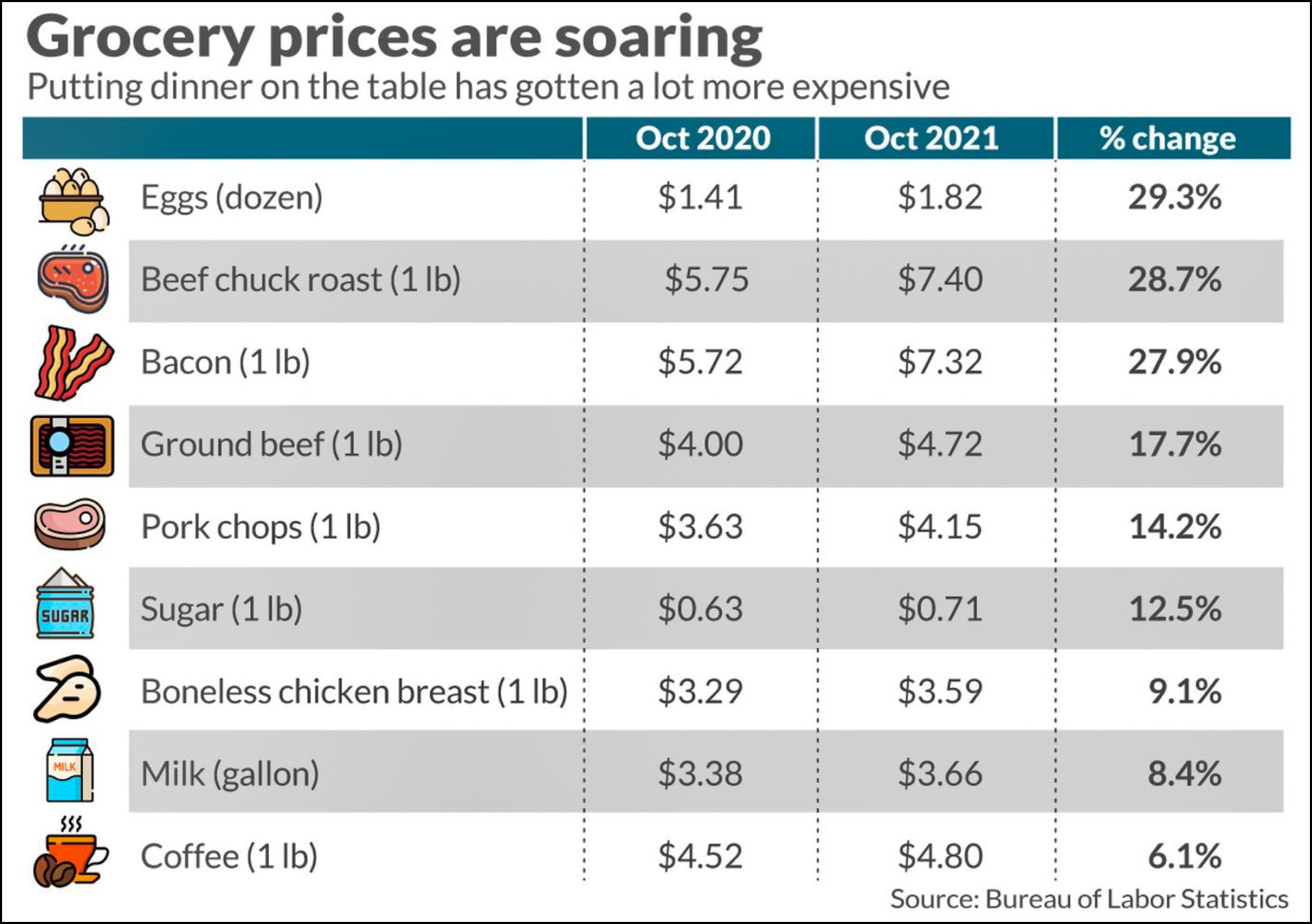
A reader sends me this chart, which was included in an article about "soaring" food prices:

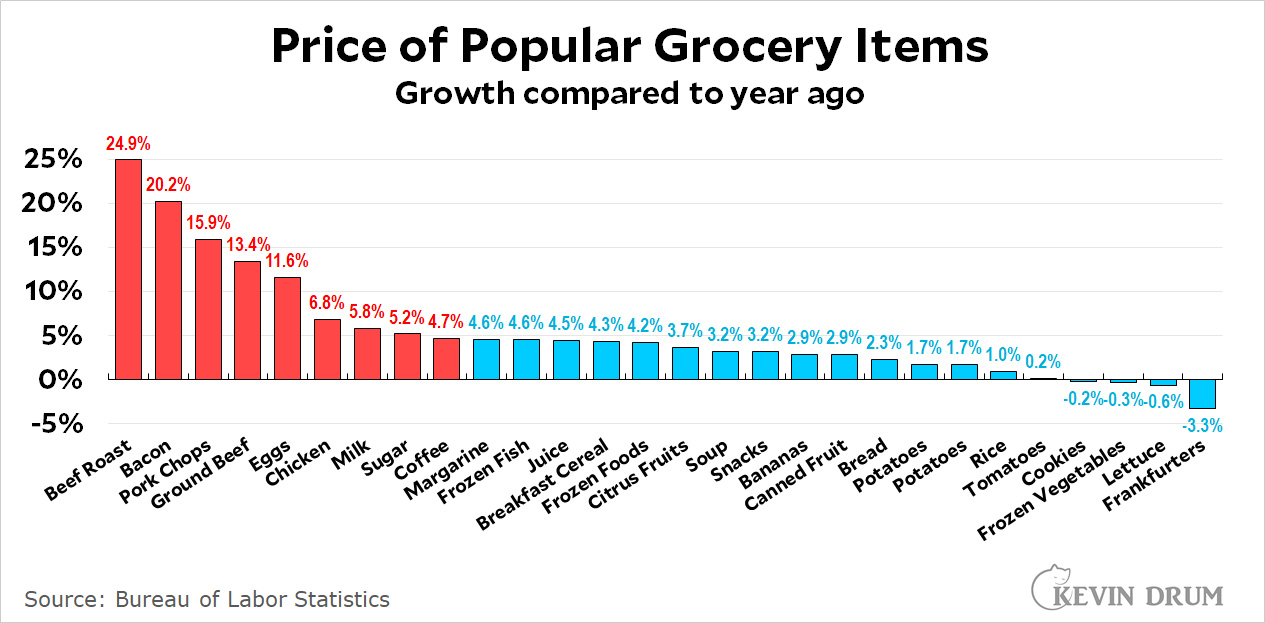
Here's a bigger chart that shows a wider variety of food:

I need to be clear here: I don't object to reporting about high food inflation. At 5.4%, the overall inflation rate of food is high right now. But if you cherry pick your data to show only the items that have gone up the most, then by definition you're playing with loaded dice. It's like presenting a chart showing the prices of BMWs, Porsches, and Cadillacs and pretending that it shows the average price of cars.

In the top chart, if you glance quickly at the middle because that seems like it's probably the average, you'd think overall food prices are up 15% or more. That's wrong. Conversely, if you show your readers the lower chart, they'd probably figure that food prices are about 4-5% higher than last year, which happens to be correct.

Why would a news outlet do this? The top chart is flatly misleading. Is there anyone in the news media interested in doing a contrarian piece showing what's really happening with food prices? Why not?