You may be familiar with something called the Flynn Effect. It's named after James Flynn, a researcher who discovered that IQs had been rising about three points per decade for most of the 20th century.
The evidence for this has been replicated numerous times and is now accepted as pretty rock solid. I've always had a hard time with it, though, since it suggests that, relative to today, the average IQ of people in the 1920s was about 70. This is roughly a 6th grade level, so it means that the Jazz Age was mostly populated by a bunch of 6th graders.
That doesn't sound right, does it? Then again, I suppose F. Scott Fitzgerald didn't hang around with ordinary people very much, so maybe our view of the '20s is distorted.
In any case, there's now a controversy over whether this IQ increase has continued into the 21st century. I'll spare you all the gruesome details about g-loading and fluid vs. crystallized intelligence and just show you the numbers:
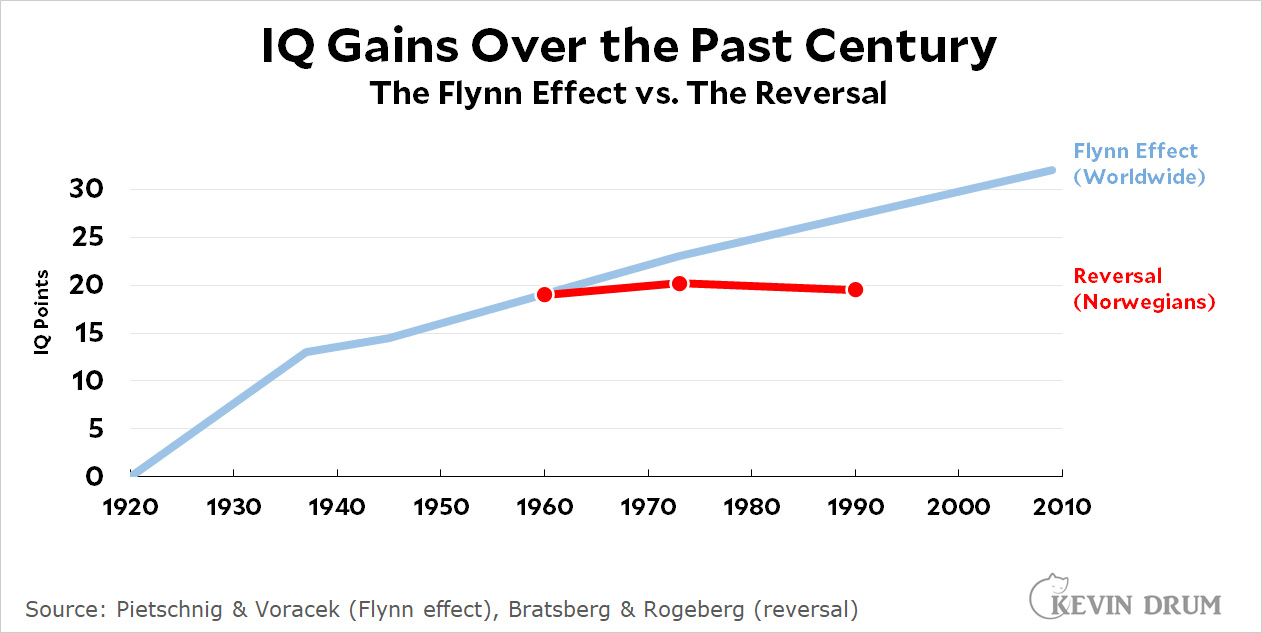 The Flynn Effect, according to some researchers, has slowed down a bit but is still going strong. But a few others, mostly relying on administrative data from conscripts in Scandinavian countries, say that the Flynn Effect slowed down in the 1960s and then reversed. If it's continued along this path, it would mean that Team Flynn estimates an increase of about 14 IQ points since 1960 while Team Reversal estimates a decline of about 3 points.
That's a big difference! And you'd think someone would try to research this. One obvious way is to get a copy of, say, a Stanford-Binet test from 1960 and administer it to a random group of a few hundred people. Would their average score be 100, as it is on a modern IQ test, or would it be around 115, suggesting that we're so smart these days that we score like geniuses on older tests?
This would be neither a difficult nor an expensive study. Why has no one done it?