This post is a shoutout to my buddy Don, who asks "How does this whole Starlink thing work anyway? What are the Ukrainians getting from us?"
No problem. Each Starlink kit comes with a small dish—referred to by fans as dishy or McDishy—which connects via the Ka-Ku band to Starlink's constellation of satellites in low-Earth orbit:
 Dishes can be mounted in lots of different ways but must have a clear view of the sky. Second-generation dishes, like the one shown above, connect via a cable to a Starlink WiFi router:
 The router has two ports. One connects to the dish and the other connects to power:
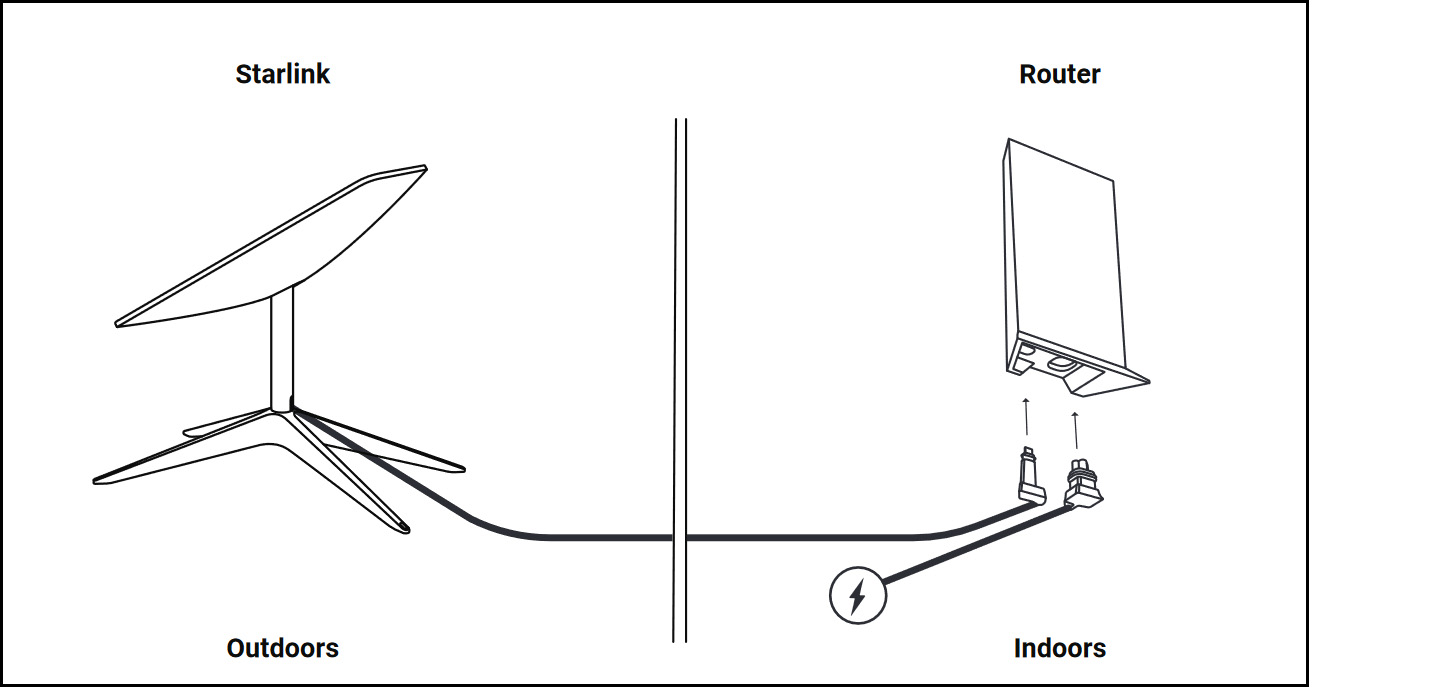 After you've given the dish a few minutes to orient itself, go into your phone's WiFi settings and connect to the Starlink network. If everything has gone right, you're in business.
Each kit costs about $600 unless you want the upgraded business kit, which costs $2,500. Monthly costs are $110 for standard service and $500 for the faster business service. Both include unlimited data usage.
So what is Ukraine getting? The good news is that the Ukrainian army says the small size and portability of Starlink kits is a godsend:
For war-torn Ukraine, Starlink has become an information lifeline....Ukraine’s Digital Transformation Minister Mykhailo Fedorov reported there are more than 10,000 Starlink terminals now operating in Ukraine, according to NBC. Unlike cellphone transmission towers, the satellite dishes used by Ukrainian forces for Starlink reception are small—about 23 inches wide—and readily movable to evade detection and retaliation. A Ukrainian soldier identified as Dima—his last name was withheld—told journalist David Patrikarakos: “Starlink is what changed the war in Ukraine’s favor. Russia went out of its way to blow up all our comms. Now they can’t. Starlink works under Katyusha fire, under artillery fire. It even works in Mariupol.”
The terminals are also resilient and adaptable.....When Russia resorted to electronic countermeasures, Starlink simply pushed out software updates to prevent these, according to Dave Tremper, director of electronic warfare at the Office of the U.S. Secretary of Defense. Temper said the speed at which Starlink countered the attack was “eye-watering.”
The (somewhat) bad news is that all this Starlink equipment is not a purely charitable donation from the company, as Elon Musk kinda sorta seemed to imply. The Washington Post reported about this a few weeks ago:
The United States Agency for International Development (USAID) announced it has purchased more than 1,330 terminals from SpaceX to send to Ukraine, while the company donated nearly 3,670 terminals and the Internet service itself.
....USAID agreed to purchase closer to 1,500 standard Starlink terminals for $1,500 apiece and to pay an additional $800,000 for transportation costs, documents show, adding up to over $3 million in taxpayer dollars paid to SpaceX for the equipment sent to Ukraine.
In a letter to SpaceX last month outlining the deal, the USAID mission director to Ukraine said the terminals...come with three months of “unlimited data.”
....It is [] unclear whether the price the U.S. government is paying for individual Starlink units matches their typical market price. USAID is paying $1,500 for each standard terminal and the accompanying service, documents show. According to the Starlink website, a standard terminal set costs $600, while the monthly service charge costs $110, plus an additional $100 for shipping and handling.
According to The Verge, Starlink recently unveiled a separate premium service that prices the equipment at $2,500 and the monthly Internet charge at $500, but it remains unclear whether that is what Ukraine has received.
So the US has paid $3 million so far, and the units donated by Starlink come with only three months of data. Nobody seems to know if this is for standard kits or business kits.
There's nothing really wrong with this. Just keep in mind that it's more a discounted price than a pure charitable donation.

 Is sewershed 299 the only site that shows evidence of COVID? Or is it the only testing site in Orange County? I'm not sure, but it looks like levels are very low with just a bit of an uptick starting in late April.
 It looks about the same: COVID levels in wastewater are very low in Orange County, but took a tick upward toward the end of April.