Are you wondering why the "accidental lab release" theory of the coronavirus has been getting more attention lately? It's not because there's more evidence in its favor. Just the opposite: It's because the evidence of a zoonotic origin has been getting harder and harder to sustain.
As you may recall, the initial theory for the origin of the coronavirus had to do with transmission via wet markets in Wuhan. That theory was abandoned pretty quickly when it turned out that several of the very first victims had no connection to the wet markets.
The work after that centered on bats, which are huge reservoirs of coronaviruses. However, since there are no bat viruses that are good candidates to be a SARS-CoV-2 precursor, scientists began searching for intermediate hosts. You probably remember this. Palm civits were candidates at first. Raccoon dogs were on the list. Or pangolins. Or minks. Or ferrets.
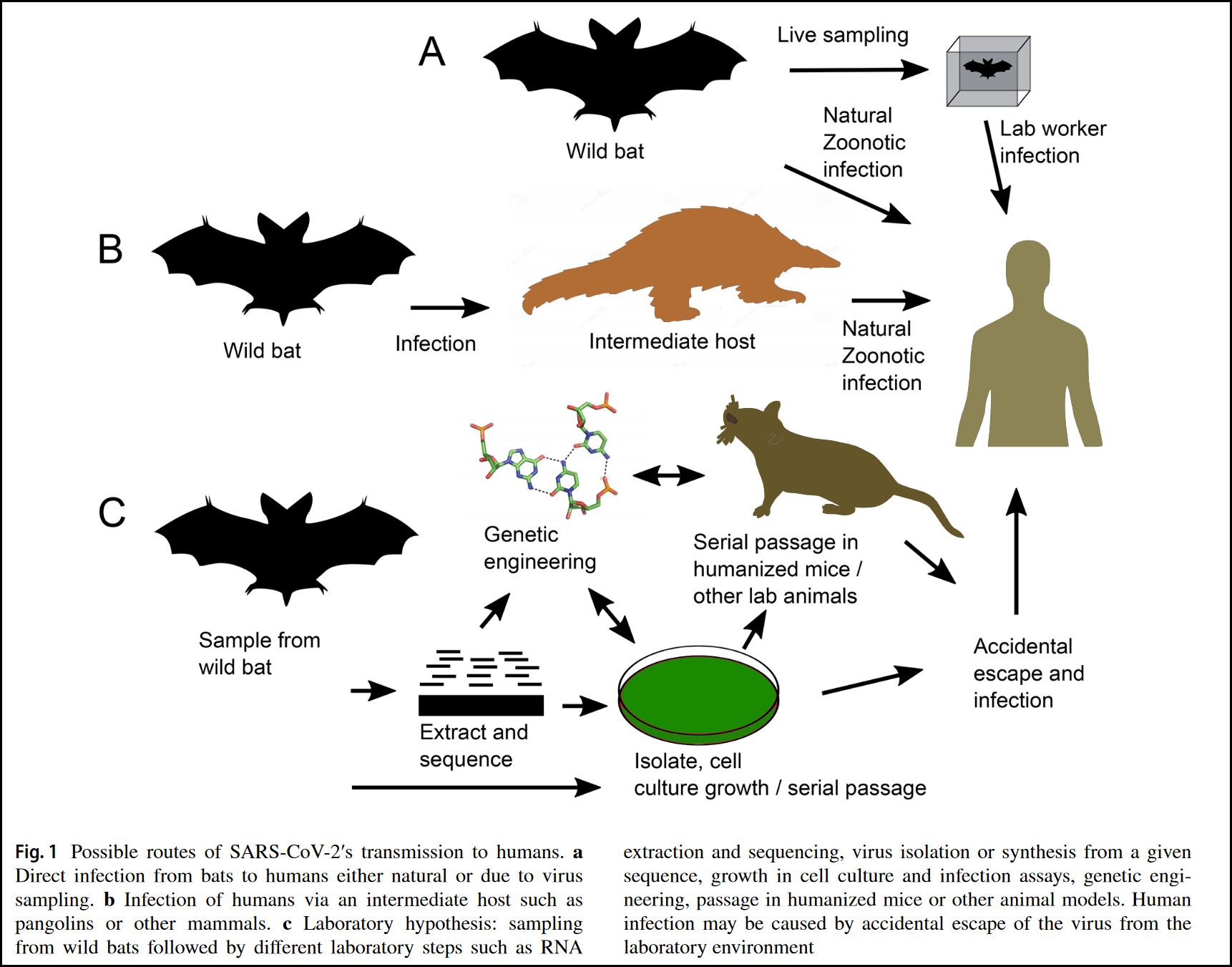
For various reasons, all of these intermediate hosts had problems that made them unlikely candidates. At first this wasn't a big issue: it was early days and the search continued.
But eventually days turned into months and then into more than a year. And still no likely intermediate hosts had been identified. We're now at a point where it's been nearly a year and a half and we still have no good theory of zoonotic origin.
That doesn't mean the lab release theory is correct. It just means that it's natural for it to get more attention as the zoonotic origin theory becomes more and more difficult to find evidence for. One problem, though, is that even if a bat virus did escape accidentally from the Wuhan lab, it would still need an intermediate host to evolve into something transmissable to humans. So the lab theory faces the same problems as the zoonotic theory.
There's much more to the story, of course, including the fact that the SARS-CoV-2 virus is unusually efficient at infecting humans. However, this cuts against both theories. Even given the fast mutation rate of coronaviruses, it's difficult to figure out how it could become so good so fast in the wild. On the other hand, any lab release theory that assumes the virus was good to begin with implies not just that the Chinese were careless, but that they were deliberately engineering a coronavirus with a spike protein that was designed for maximum harm to humans. There's strong genomic evidence against that, and in any case it requires you to believe that the Chinese were both unbelievably careless and were engineering a bioweapon of some kind. That's kind of hard to swallow.
In other words, it's worthwhile keeping an open mind on this. On the one hand, the Chinese have been so aggressively uncooperative that it's hard to believe they don't have something to hide. This favors the lab theory. On the other hand, we shouldn't let the current lack of success on the zoonotic front provoke us into giving up out of frustration and turning to simpler theories featuring well defined enemies that we never liked much in the first place. Science runs into tough roadblocks all the time, and in another year maybe some genius will have a lightbulb moment and we'll finally have a fleshed-out theory of zoonotic origin that makes perfect sense. This calmer mode of thinking favors the zoonotic theory.
This whole thing might remain a mystery forever. Alternatively, maybe some lab worker from Wuhan will escape to the West with concrete evidence that the virus was manmade. Or else someone will finally come up with a convincing zoonotic story. Stay tuned, and in the meantime don't get too attached to either side.
POSTSCRIPT: Just to be absolutely clear here, my point is that expert opinions about the origin of the SARS-CoV-2 virus haven't just changed for no reason. They've changed because the evidence has changed. The only tricky part is that what changed isn't evidence for the lab theory getting better, but evidence for the opposing theory getting worse.