Skip to content

Over at National Review, Dominic Pino says the woes of the IRS are its own damn fault:

The agency answers only 11 percent of incoming calls, takes 45 days to turn around correspondence, and finished the 2021 tax season with a backlog of 35 million returns.

....The IRS is clearly a poorly run organization, and poorly run organizations should not be rewarded with more money....The bureaucrats who run the agency will always tell Congress that they don’t have enough money, and there’s a certain amount of institutional learned helplessness that goes into that. If the agency actually improved its processes and better served taxpayers, its case for funding increases would weaken.

I admire the brass on display here. Whatever institutional problems the IRS might have, the proximate cause of its problems is that conservatives have been hellbent on gutting the agency over the past 25 years:
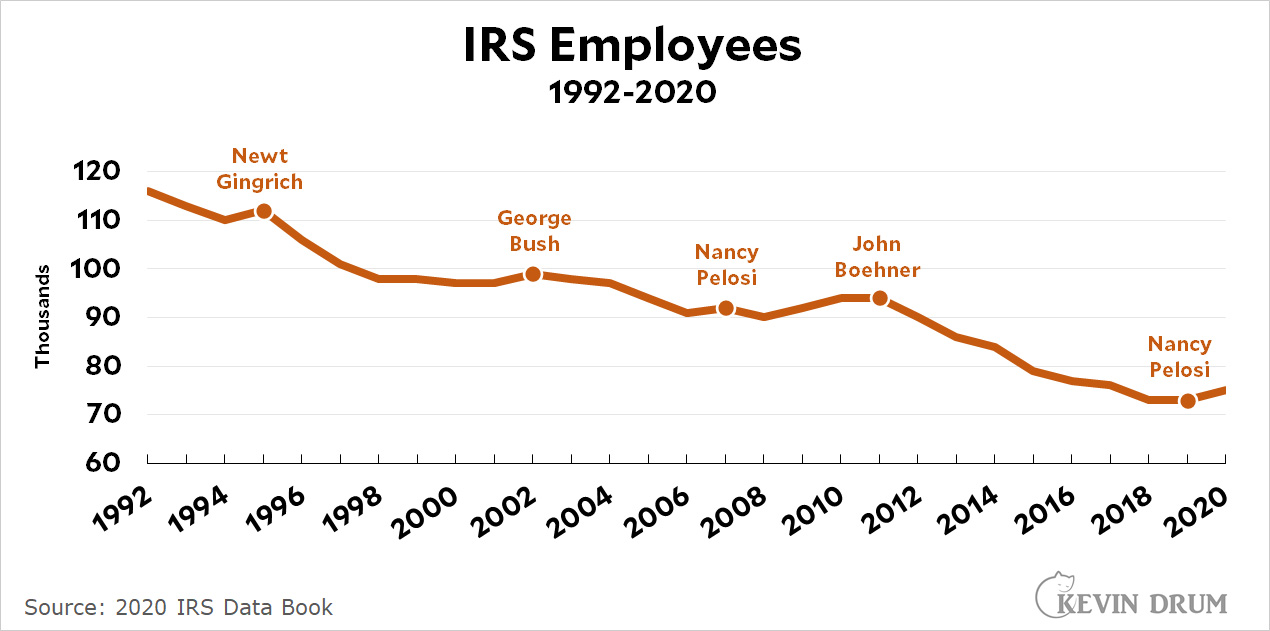
It started in 1995 when Newt Gingrich took control of the House. Within four years he had slashed 14,000 employees from the IRS.

Gingrich was on his way out after four years, but in 1998 Sen. William Roth kept the flame alive by holding a week of hearings in which witnesses were hidden by black curtains and had their voices altered. Everyone was searched before entering the room. Republicans lined up to denounce the IRS as “Gestapo-like” and a law was quickly passed that handcuffed agents and slashed the budget for audits and enforcement, especially against high-income taxpayers.

In 2001 George Bush became president and Republicans were once again free to do as they wished with the IRS. Over the next six years they cut another 5,000 employees, stopping only when they lost control of the House to Nancy Pelosi and control of the presidency to Barack Obama.

In 2011 Republicans took control of the House and slashed another 20,000 employees by bargaining with Obama over things he cared more about.

In 2019 Democrats took control of the House and the hemorrhaging stopped.

Bottom line: over the course of the past three decades, Republicans have cut the IRS workforce by nearly 40,000. Even when you add back the small numbers that Democrats have won, the IRS workforce is still down by over a third since 1992.

But that's not all. It would be simple for the IRS to simply calculate your taxes for you if you have a simple return. This would save tens of millions of taxpayers a huge amount of grief and would take a lot of pressure off of IRS help lines. So why not do it? Roughly speaking, the answer is that Intuit, the maker of TurboTax, has lobbied relentlessly to prevent it. And who supports Intuit? Mostly Republicans. If they supported free IRS tax prep, the vast majority of Democrats would join them.

In other words, Republicans have spent the past three decades committed to the very things that hamstring the IRS most effectively: stripping it of workers and refusing to let it adopt an obvious labor-saving reform. There are two reasons for this:

  • They want people to tear their hair out during tax season. It helps make taxes unpopular.
  • They want to gut the IRS of the resources to audit rich people—and they have. I assume this needs no explanation.
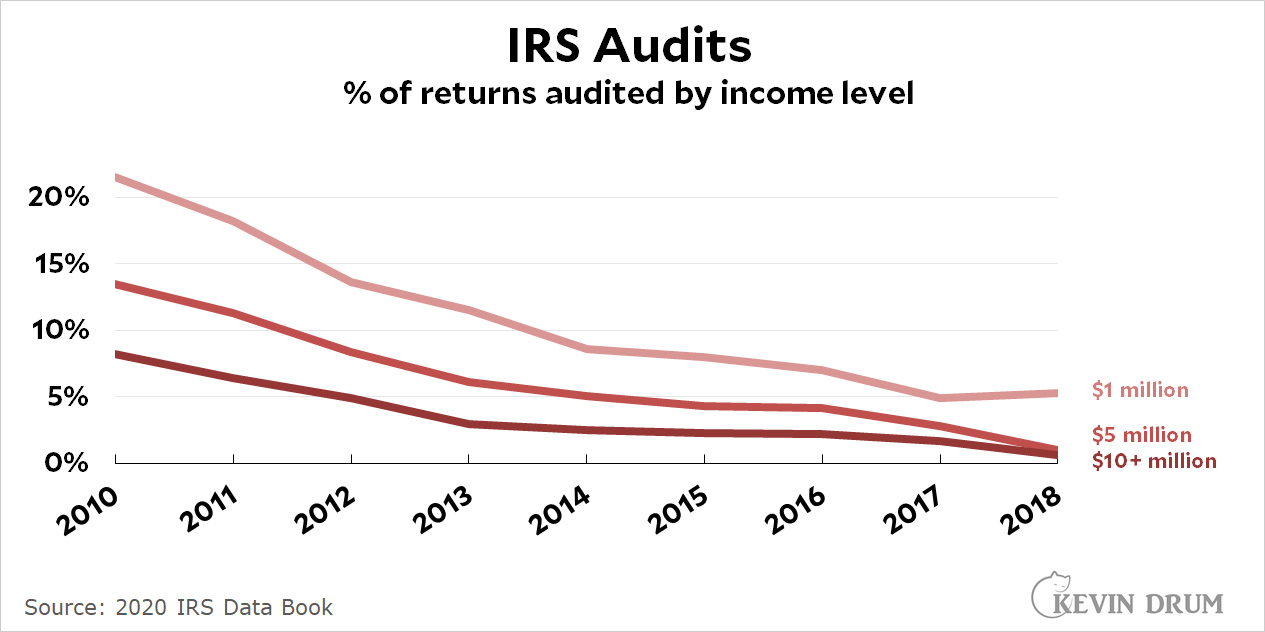
     

Recently, of course, the IRS has been in even worse shape. But this is because of temporary staffing shortages due to COVID-19, not IRS incompetence. Even an NRO writer ought to know that.

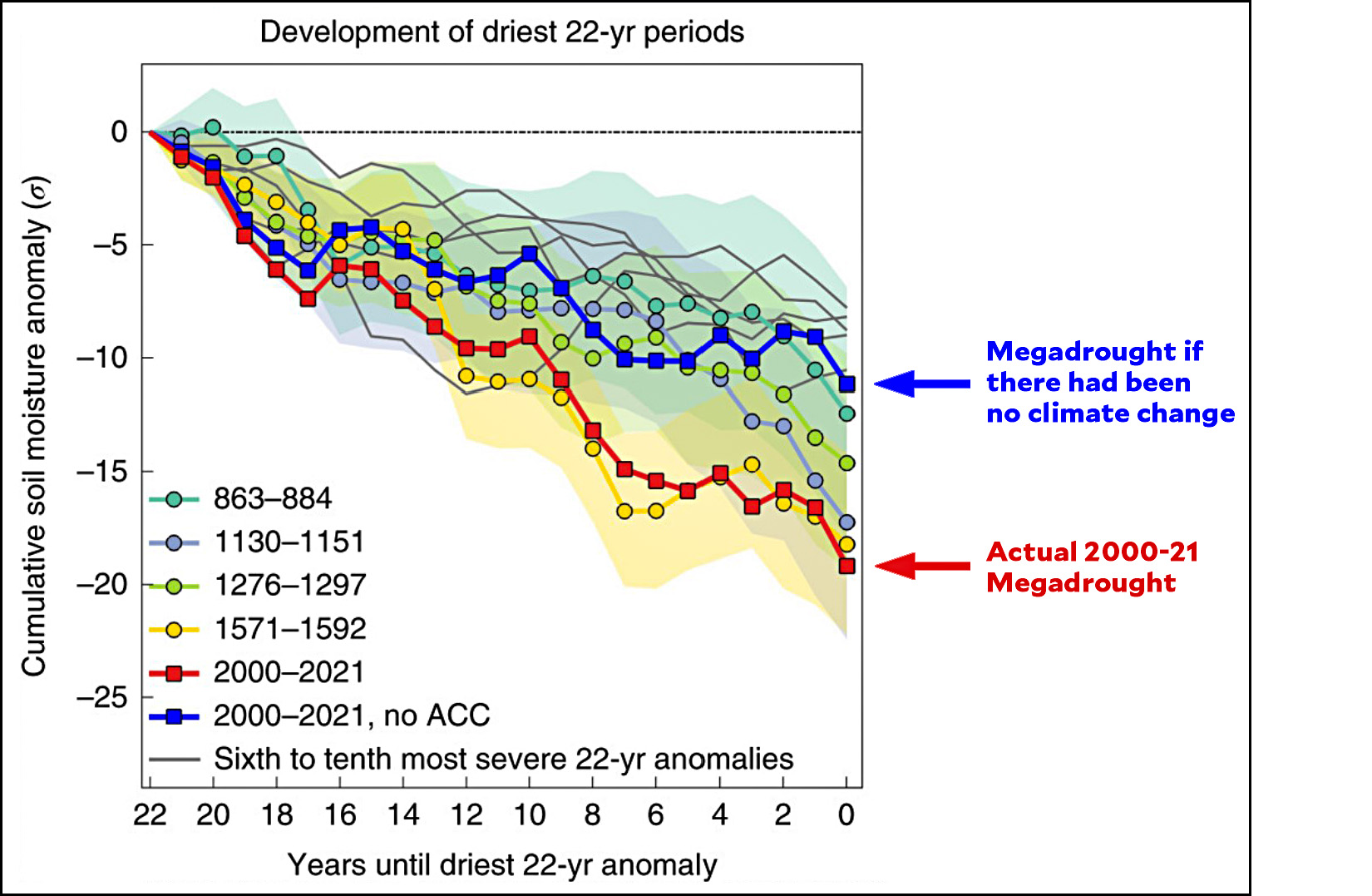
Exciting news, folks. Thanks to an especially dismal 2021, the 2000-21 megadrought in the Southwest is now the worst on record, barely edging out the infamous 1571-92 megadrought:

But we didn't do this all by ourselves. It was a team effort. If not for climate change, our current megadrought would have been unremarkable, barely even cracking the top five. This just shows what we can accomplish by taking a naturally arid region and then adding a few hundred gigatons of CO2 to the atmosphere. Congratulations to everyone involved.

Ezra Klein wants us to think different:

Scientific challenges? You're speaking my language! But I assume we're not talking about things like reconciling quantum mechanics and General Relativity. We want to tackle practical scientific challenges. And we want five of them. Okey doke:

  1. Artificial intelligence. There is, needless to say, boatloads of private money already being spent on this, and money per se is not really the bottleneck. But money makes a difference, and whoever leads in AI will lead the world in 2040. Why not us?
  2. CRISPR. This is sort of a catchall for medical research, which we already spend tons of money on. But we could spend more!
  3. Climate change. We should be spending huge sums on every technology that looks even a little promising as a solution to climate change. Carbon capture, solar, geoengineering, biofuels, nuclear (fission and fusion), land use, adaptation, and more.
  4. Human genomics. Do our genes make us who we are? Do they vary systematically between different groups. Can they turn aging on and off? Which genes affect which human traits?
  5. Human stress. This is sort of a dark horse, but as societies get richer they also get more stressful. And more stress equals worse decisionmaking. We need more research into how to allow people to live more comfortable lives even as society becomes ever more complex and stress-filled.

Some of these, like climate change and AI, would probably show up on anyone's list. But there are others that are more contestable, including some I probably don't even know about. This is especially true in the social sciences, which most people don't think about when they talk about funding "science." But there's a marriage of social science and medical science that needs to happen if we want to accelerate our understanding of what's needed to live fulfilling lives in the face of constant change. Someone just needs to figure out what that marriage looks like and how to study it.

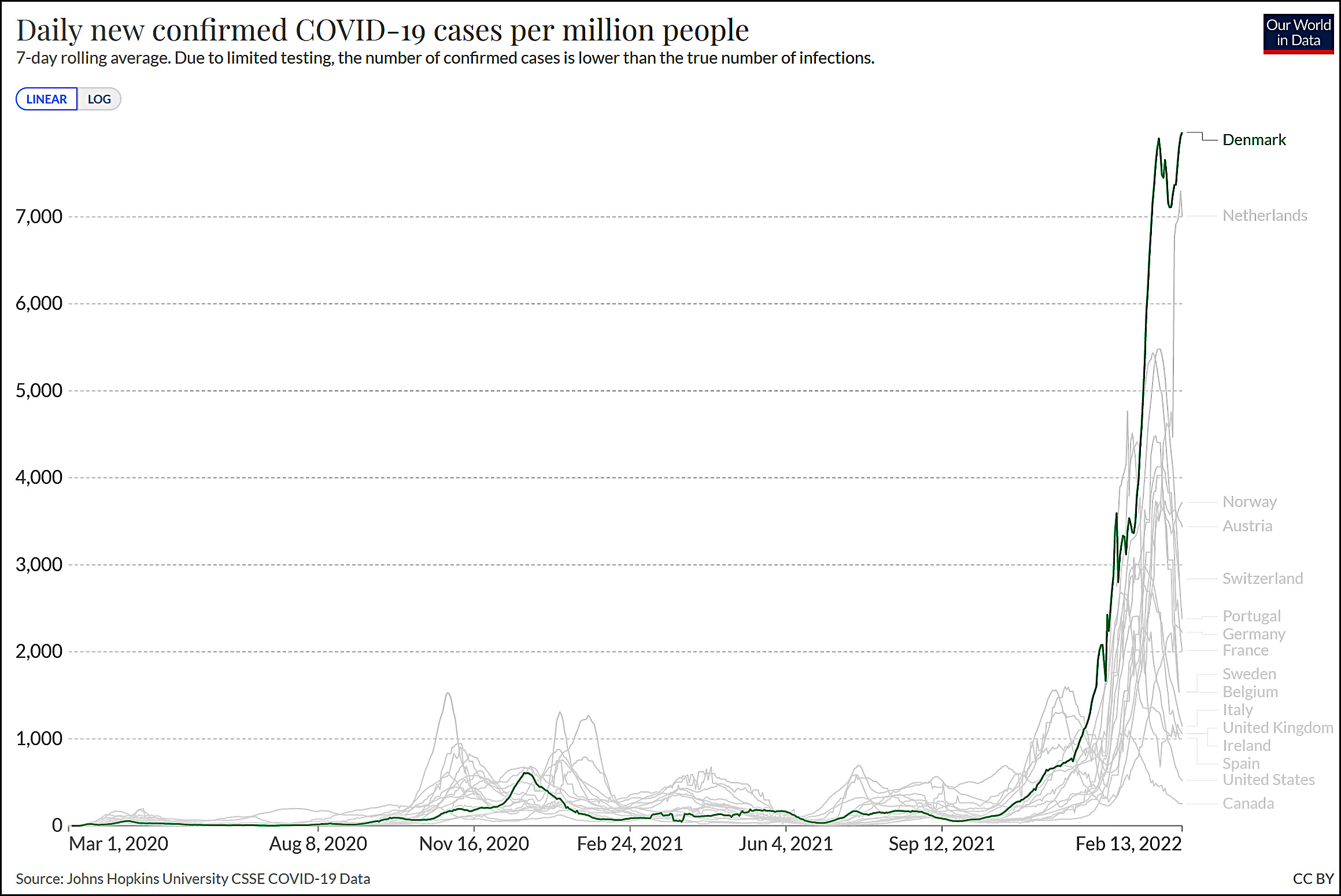
A couple of weeks ago Denmark decided to eliminate all COVID restrictions and open up completely. How's that working out for them?

Shazam! Maybe they acted a little too soon? On the other hand, there's this:

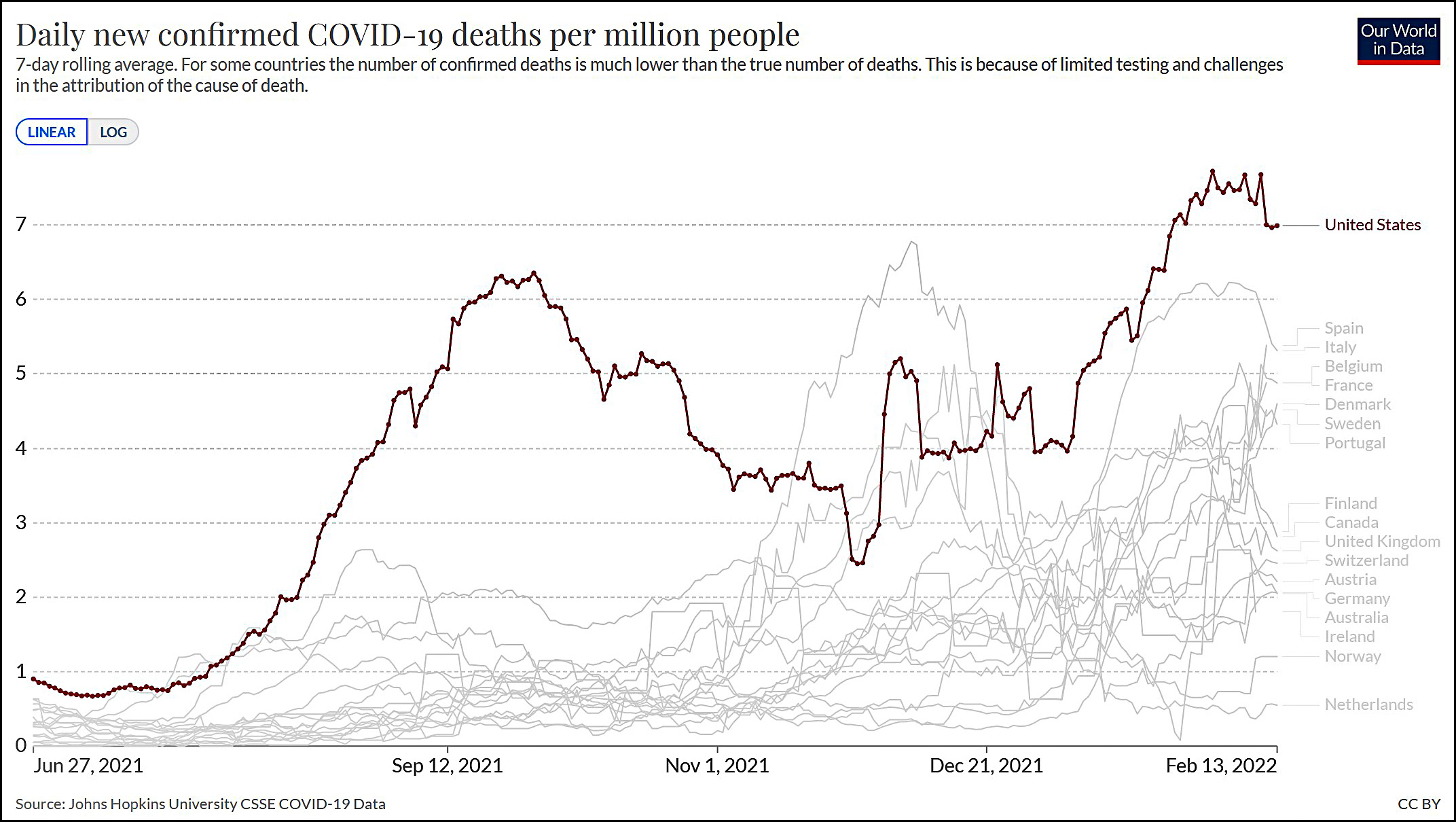
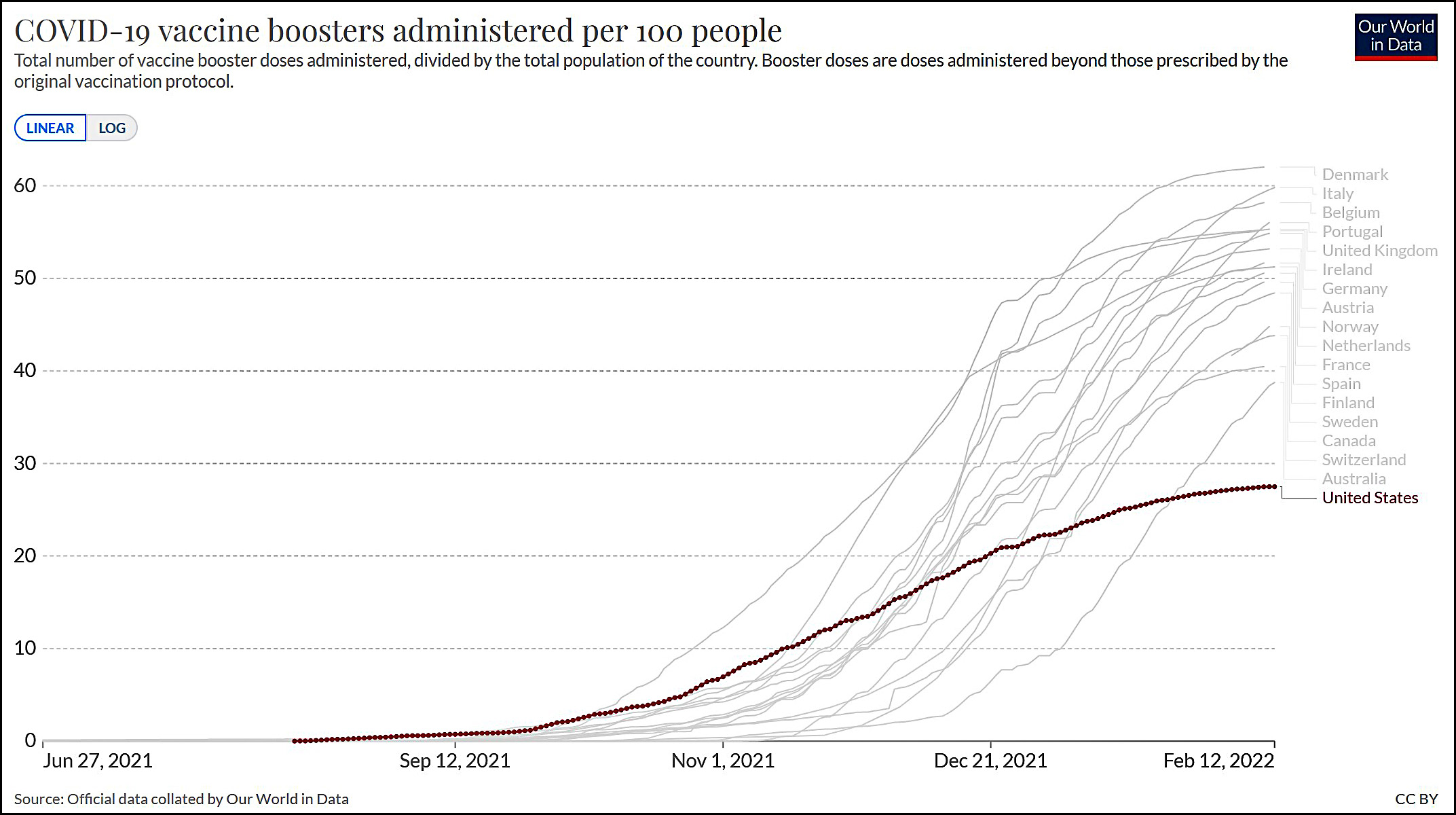
Denmark is in the top half, but the United States has opened a big lead for first place even though our case rate is fairly low. I imagine it's because of this:

The best Valentine's Day gift you can give your beloved is to get them vaccinated. If they're already vaccinated, get them boosted. And if you're both already boosted, find a friend who isn't and badger them into it.

Here's the headline of an editorial in the New York Times:

Please stop this. As the Times admits in its first sentence, this protest rates as little more than a nuisance: "The number of protesters, about 8,000 at their peak, is modest; there have been no serious injuries or altercations, the truckers stopped blaring their horns after residents got a temporary court injunction against them, and most Canadians support neither the truckers nor their cause."

Not everything is a test of democracy. Even if the Trudeau government eventually reacts harshly and stupidly to break up the protests, it still wouldn't be a test of democracy. It would just be a minor protest that was handled badly. That happens in democracies all the time.

Western democracy is in much better shape than the doomsayers claim. It has its problems, but there's no point in pretending that every minor crisis is yet another log on the fire of civilization.

Did you notice Charlie's whiskers in yesterday's catblogging photo? They're two-toned. Some are all white and some are all black, but many of them start out white and then switch to black as they grow out. I don't think I've ever had a cat with two-toned whiskers before.

The medal ceremony for the team ice skating event at the Olympics has been in suspended animation for a week as authorities try to figure out what to do about Kamila Valieva, the Russian teen sensation who tested positive for a banned drug last December.

There are a bunch of minor mysteries here, but the biggest one is this:

  • Experts seem to agree that the drug in question, trimetazidine, would do very little to help an ice skater.
  • On the other hand, trimetazidine is an angina medication. Experts also agree that there's virtually no legitimate reason it would be prescribed to a healthy 15-year-old.

The world is ever more like a matryoshka doll these days. I suppose that's appropriate in this case.

Last night I finally got slightly interested in the Canadian trucker protest and decided to read a little bit about it. I got bored almost immediately because there's really nothing much to know about it, but one interesting thing was learning more about the folks who are the leaders of the protest. Or the founders. Or spokespeople. Or something. Anyway, these names kept popping up:

  • Benjamin Dichter
  • James Bauder
  • Tamara Lich
  • Chris Barber
  • Pat King

This is one weird crowd, and I couldn't tell if they really even work together. In any case, as I browsed through various pieces about the convoy I came across countless descriptions like these:

  • Worried about the "growing Islamization of Canada."
  • Thinks Western Canada should secede.
  • QAnon conspiracy theorist
  • Believes COVID-19 is a scam.
  • Was fined $14,000 in October for violating provincial public health measures.
  • "Wait 'til the real bullets start flying."
  • Evangelical alt-right extremists.
  • Believes COVID virus comes from a Chinese lab and George Soros was involved.
  • Says vaccine mandates are "tyranny at its finest."
  • Has a garage full of Confederate flags.
  • Loves bitcoin.
  • Speaks of an immigration plot that would see the “depopulation of the Caucasian race.”
  • Holocaust denier.

I dunno. Protests against vaccine mandates are all well and good—Canada is a free country, after all—but any protest run by people like this is bound to implode sooner or later. Besides, they all say they're vaccinated. Somehow I don't think vaccine mandates are what they really care about.

Back in ancient times, light meters for cameras were designed to assume that the entire picture averaged 18% gray. Modern cameras have increasingly sophisticated ways of measuring light, but the assumption of an 18% gray average over the entire frame is still built in.

Why mention this? Because it turns out that Charlie is a very photogenic cat. Nearly every picture I take of him is almost perfectly exposed, and I've decided it's because he's an 18% gray cat. Judge for yourself.