It begins:
When ChatGPT came out last November, Olivia Lipkin, a 25-year-old copywriter in San Francisco, didn’t think too much about it....In April, she was let go without explanation, but when she found managers writing about how using ChatGPT was cheaper than paying a writer, the reason for her layoff seemed clear.
....For some workers, this impact is already here. Those that write marketing and social media content are in the first wave of people being replaced with tools like chatbots, which are seemingly able to produce plausible alternatives to their work.
This is not what people expected when AI first became a topic of conversation years ago. Everyone figured the first victims of job loss would be blue-collar workers doing repetitive tasks: data entry clerks, customer service reps, taxi drivers, retail workers, and so forth. Then in 2017 Google published a paper about how to make Large Language Models work better and within a few years the most common form of AI was suddenly white collar and non-repetitive.
Automation has been taking jobs for years, of course. In that sense there's nothing unique about Lipkin's experience. Most likely she'll get another job, this time at a shop that needs writing skills above the bare minimum that ChatGPT can currently provide.
But there's still a difference. In the past, automation was a two-edged sword. Power looms took away weaving jobs, but there were new, better paying jobs tending and maintaining the machines. The transformation was slow and painful, but eventually everybody was re-employed and making more money than ever before.
Today there's nothing like that on the horizon. When ChatGPT gets a little better it will put copywriters out of work, full stop. Some of them will find entirely different work for a while, but none of them will be writers again. Nor will there be "writing machines" for them to maintain. The machines are just software in the cloud. They will maintain themselves with only sporadic help from a small cadre of programmers who neither need nor want help from former writers.
And so most writers will be out of work with no plausible alternative. At first it will just be entry-level writers, but very quickly the software will improve and journeyman writers will also be replaced. Then it will be the very best writers. Even poets and novelists will eventually be replaced.
And they'll have nowhere to go.

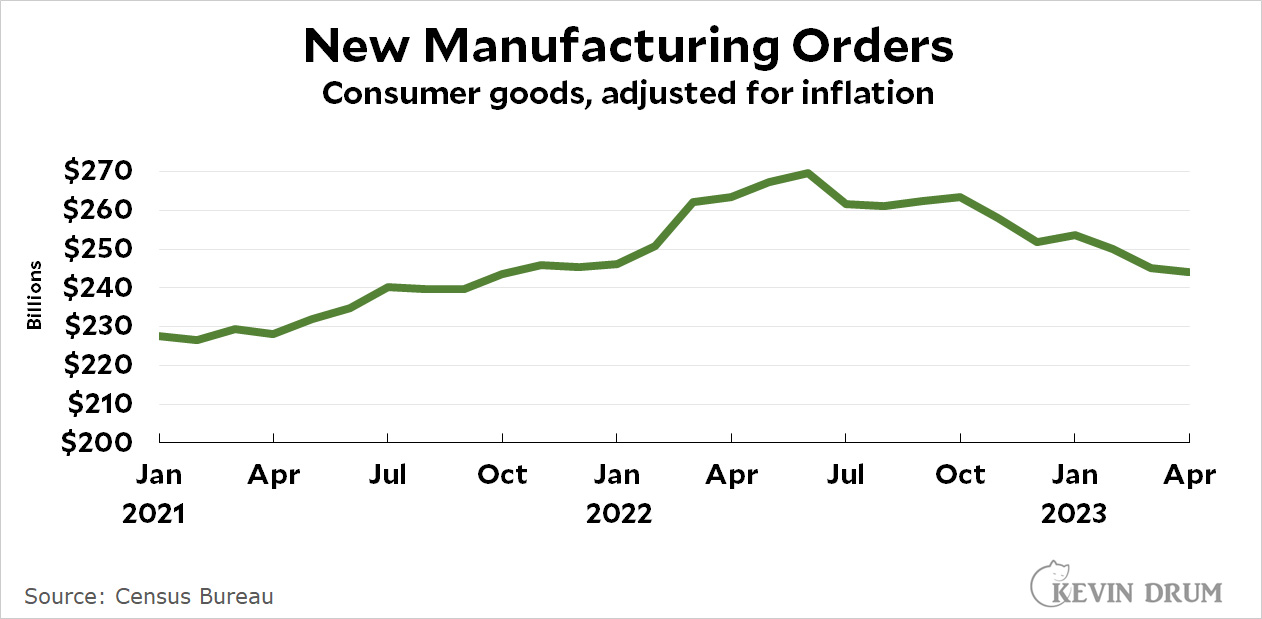 Since June of 2022, new orders for consumer goods have declined nearly 10%. New orders for all manufactured goods have declined 5%.