In my post yesterday about the past 20 years of horrific Israeli behavior I noted that "There are reasons things have turned out this way, many of them the responsibility of Arab nations and the Palestinians themselves."
Unsurprisingly, many people asked just exactly what part of the historical record could explain or justify Israeli conduct. It's a fair enough question, because although this history is both contentious and well-known, it's also peculiarly unknown to a lot of people these days.
So here's a nickel summary. First off, this is the original 1947 UN map showing the partition of the old British Mandate in Palestine into two new states, one Jewish and one Arab. There are several things to notice:
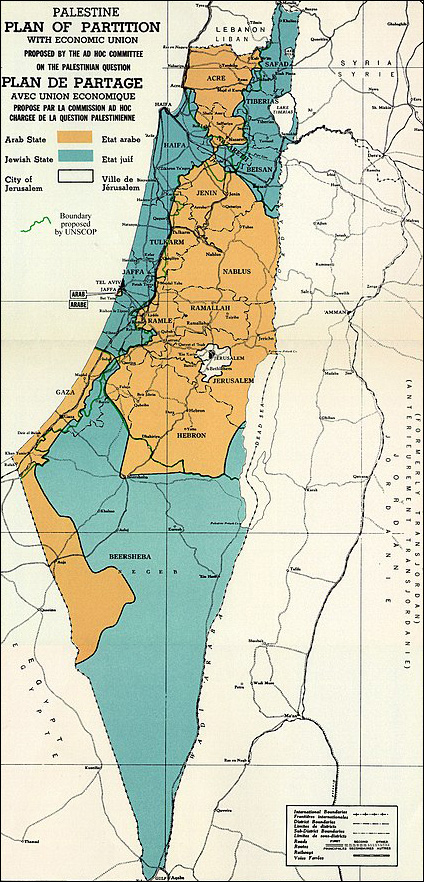 Gaza is much larger than it is today and almost touches the West Bank.
- Jerusalem is solidly within the West Bank and is designated as an international enclave.
- The city of Jaffa on the Mediterranean coast is an Arab enclave.
- Arab lands extend north to the border with Lebanon.
- All of these areas were to be connected by extraterritorial roads, guaranteeing free passage within each state and free passage of all to Jerusalem.
So what happened? Zionist leaders weren't thrilled with the partition but reluctantly accepted it. Arab leaders rejected it completely. Partly this was on the grounds that Israel had been given the best land, but mostly it was because they flatly refused to accept the establishment of a Jewish state. They declared war on Israel as soon as the partition was announced, with the stated intent of destroying it.
They lost, and by the time the war ended a lot of territory had changed hands. Israel took Jaffa, the northern Arab region, most of Gaza, and much of the West Bank—and forcibly expelled nearly a million Palestinians from Israeli territory in the process. Jordan seized the rest of the West Bank. Egypt took the remaining piece of Gaza. The extraterritorial roads, needless to say, were consigned to the dustbin of history.
From that point on the Arab states enforced a total air and land blockade against Israel while Egypt blocked its use of the Suez Canal. In 1956, Egypt's president, Gamal Abdel Nasser, blockaded the Gulf of Aqaba, preventing Israel from developing an alternate route to the Red Sea and Asia. At the same time he nationalized the Suez Canal, prompting an invasion from Britain, France, and Israel. They pulled back due to international pressure and Nasser reopened Aqaba.
During the rest of the 50's Palestinian fedayeen trained in Eqypt mounted repeated attacks across the border into Israel. In 1964 Nasser created the Palestine Liberation Organization. In 1967 he blockaded Aqaba again and planned an imminent war against Israel, joined by other Arab states.
They lost. During the war Israel seized the West Bank, Gaza, and the Golan Heights on the border with Syria. Israel then began building settlements on the West Bank in order to protect itself from further attacks.
In 1973 the Arab States attacked again. This was a close run thing, but again, they lost. The 1973 war shook Israel badly, and after it ended they ramped up the settlement program.
In 1988 Palestinians launched the First Intifada, a civil uprising against Israelis. This happened against a background, over the previous two decades, of hijackings, terrorist attacks, missiles launched into Israeli territory, PLO attacks across the Lebanese border, and the establishment of Hezbollah after the Lebanon War.
The Palestinians lost that intifada. Then, at the Camp David Summit in 2000, peace terms between Israel and the Palestinians seemed to be finally in sight, but the PLO pulled out and the talks collapsed. Shortly afterward, the Second Intifada started, marked by gunfights, suicide bombings, stone-throwing, and rocket attacks. The suicide bombings in particular produced an understandable panic among the Israeli population.
Nonetheless the Palestinians lost. In 2005 Israel withdrew from Gaza but Hamas won elections to run the territory. They declared their unconditional desire to destroy Israel, which was met by an Israeli/Egyptian blockade of Gaza. Since then Hamas has kept up a steady but intermittent barrage of missiles fired into Israel. In 2023 they launched a brutal cross-border attack against Israel.
To summarize:
1948: Arabs launch a war of destruction against Israel.
1956: Egypt blockades the Gulf of Aqaba and nationalizes the Suez Canal, touching off a war.
1967: Arab states plan a war of destruction against Israel but are stopped before it can begin.
1973: Arab states launch yet another war of destruction against Israel.
1982: PLO attacks from Lebanon incite a border war with Israel.
1988: Palestinians launch the First Intifada.
2000: Palestinians launch the Second Intifada.
2007: Hamas takes over Gaza and promises the destruction of Israel.
2023: Hamas launches a brutal attack on Israeli civilians, torturing and killing over a thousand people while taking 200 hostage.
History is contingent. It's not right to say that Palestinians today "deserve" ill treatment because of something that happened in 1948. But at repeated points since then, Arab wars have provoked reactions that eventually metastasized into what we have today. Each of these reactions was a response to an attack in recent memory, and only over time have the beginnings fallen away into mist.
Given this history—even if you take a different view of who started what—it's all but inevitable that Israel would take harsher and harsher measures to protect itself. This doesn't justify the past two decades of Israeli callousness and cruelty, especially against Palestinians in the West Bank, but it does make it understandable.