Ezra Klein reminds me today of a report from the Niskanen Center that got some attention a week ago. Here is its core claim:
We are in an era of spiraling costs for core social goods — health care, housing, education, child care — which has made proposals to socialize those costs enormously compelling for many on the progressive left.
This is something that seems so obvious the authors barely even felt like they needed to back it up. But costs aren't spiraling for these things. In fact, costs in these four categories range from basically flat to "it's complicated." Here they are one by one.
Childcare
The Bureau of Labor Statistics has always tracked childcare inflation as a separate category—though for some reason this seems to be a closely guarded secret or something since you hardly ever see it. Here it is using 2000 as a starting point:
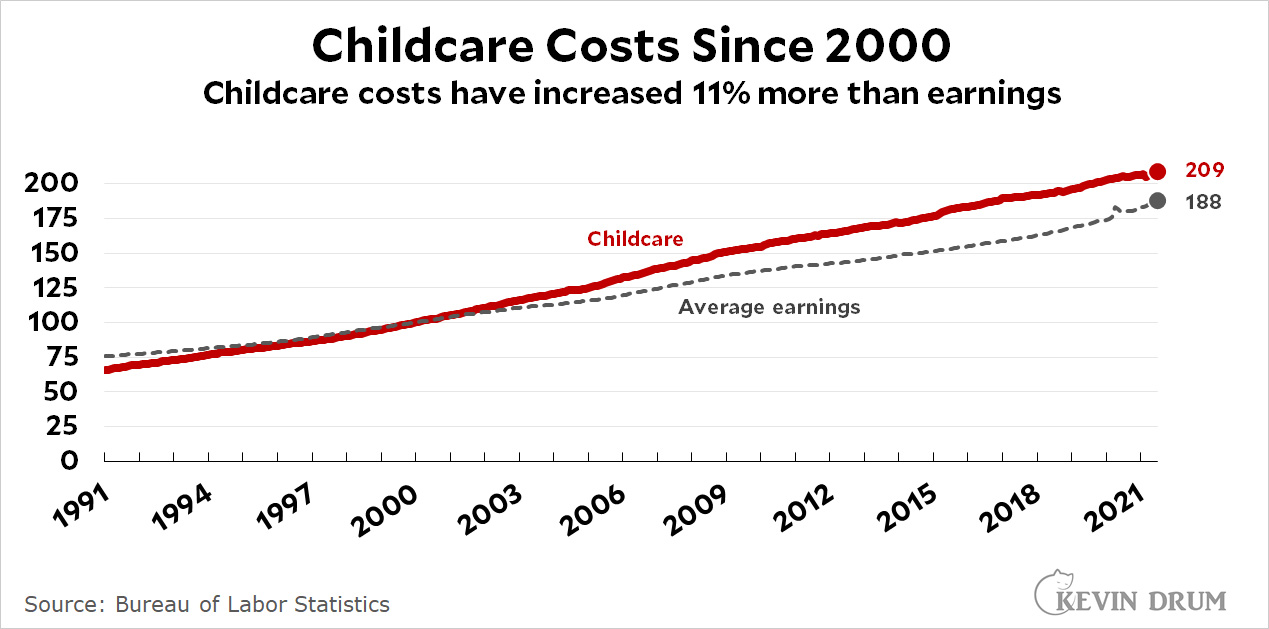
Childcare costs have risen about 11% more than average earnings. That is an increase, but it's hardly "spiraling."
Housing
We've been though this before, but here it is again:
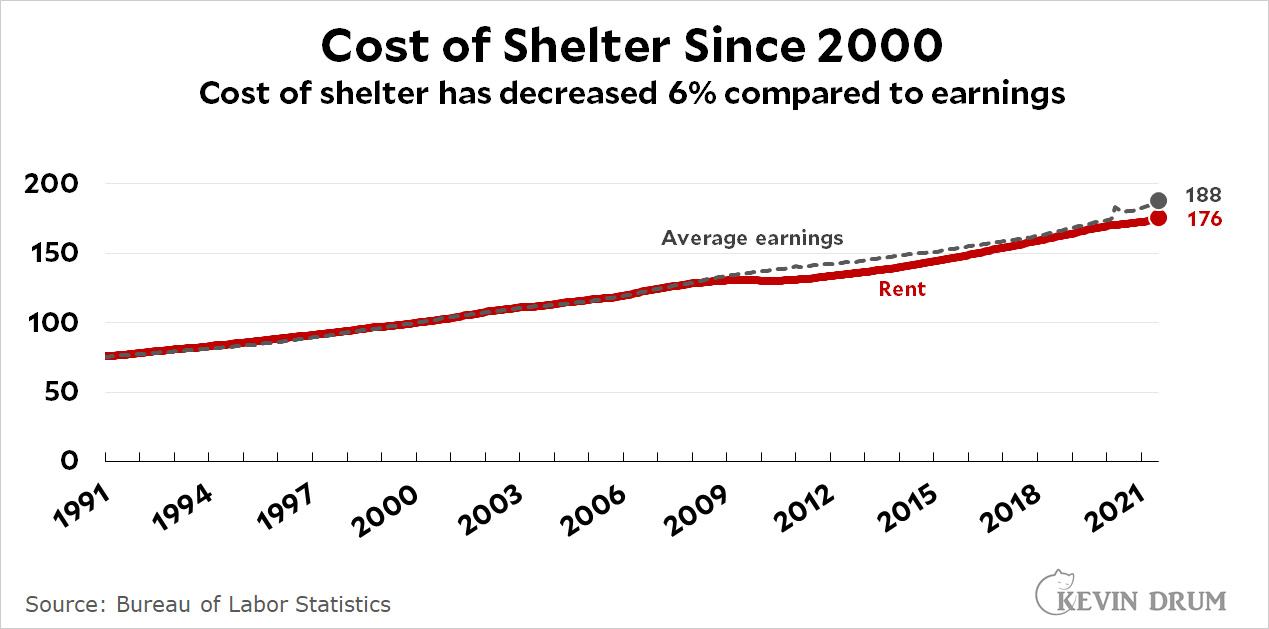
The cost of housing has gone up less than average earnings. If you were to account for lower interest rates, you'd find that mortgage payments have risen even less.
As always, however, there are exceptions. There are always trendy markets that skyrocket for a while before giving way to the newest trendy market. For example, here is Denver:
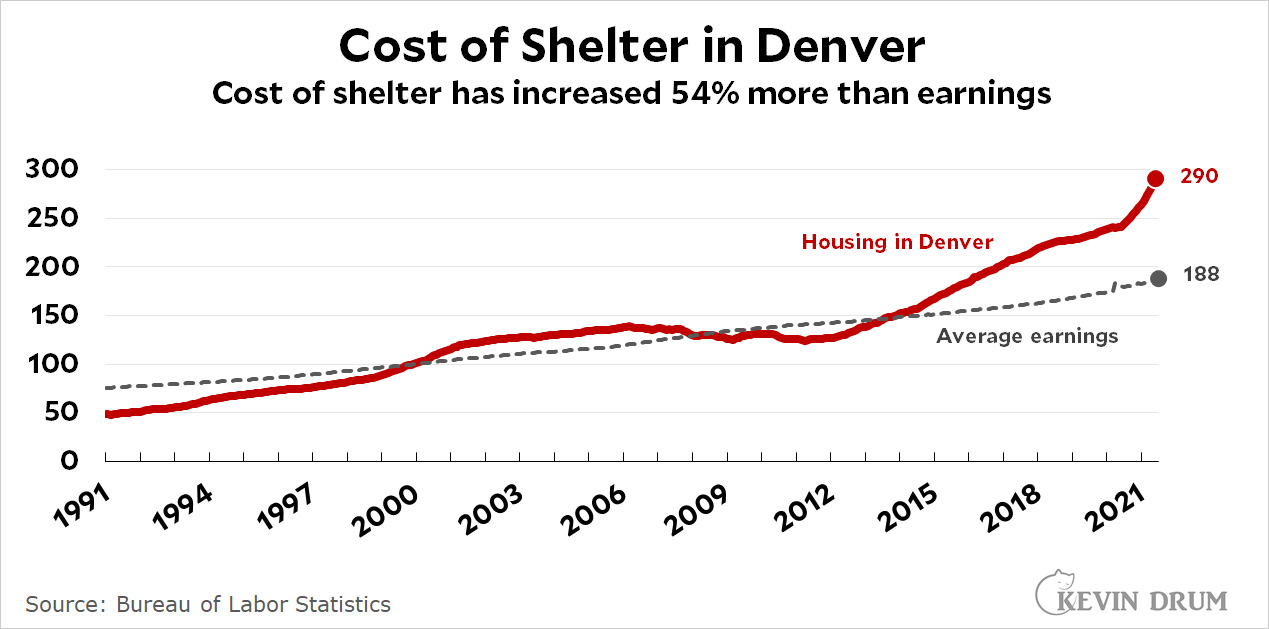
On average, the cost of housing has been pretty stable over the past 20 years. But it's a bell curve, and there are always going to be cities on both the high and low side.
Healthcare
Now we're getting into "it's complicated" territory. The basic story of healthcare costs is that they skyrocketed in the 80s and 90s, but have flattened out over the past couple of decades:
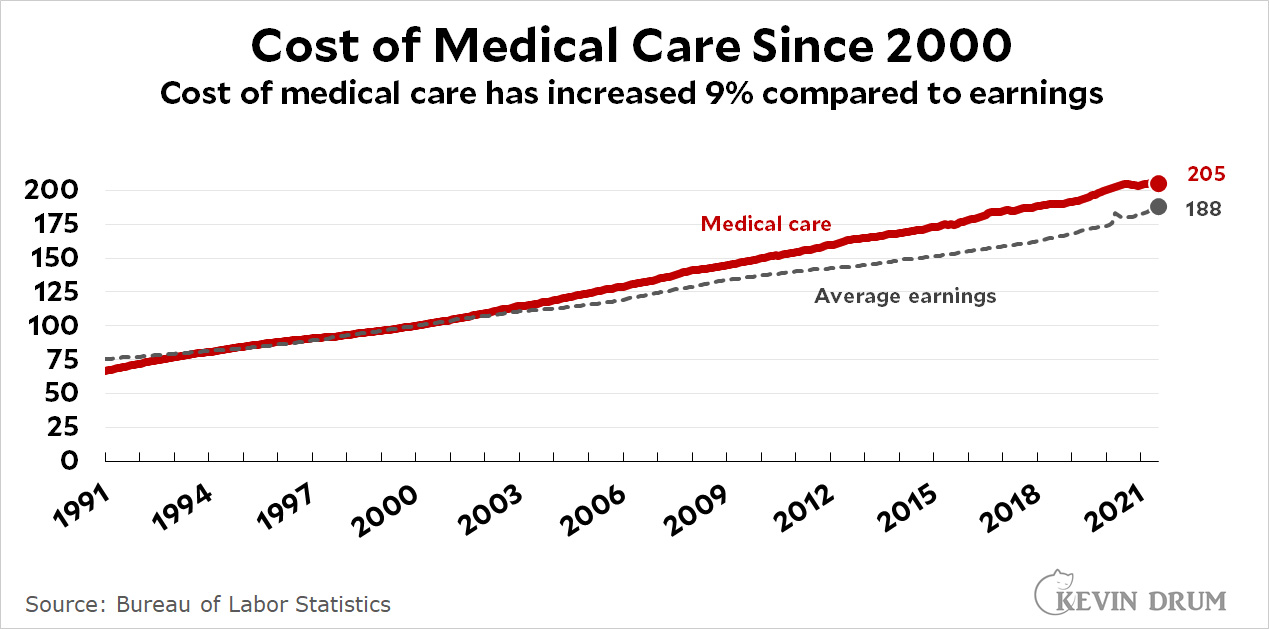
This is a very well known trend among people who actually follow healthcare costs. Medical inflation is still a bit higher than overall inflation, but not by a lot. It turns out that the 80s and 90s were an aberration, and we've since returned to the lower healthcare cost growth of earlier years.
But that's not the whole story. Here are actual consumer expenditures on healthcare:
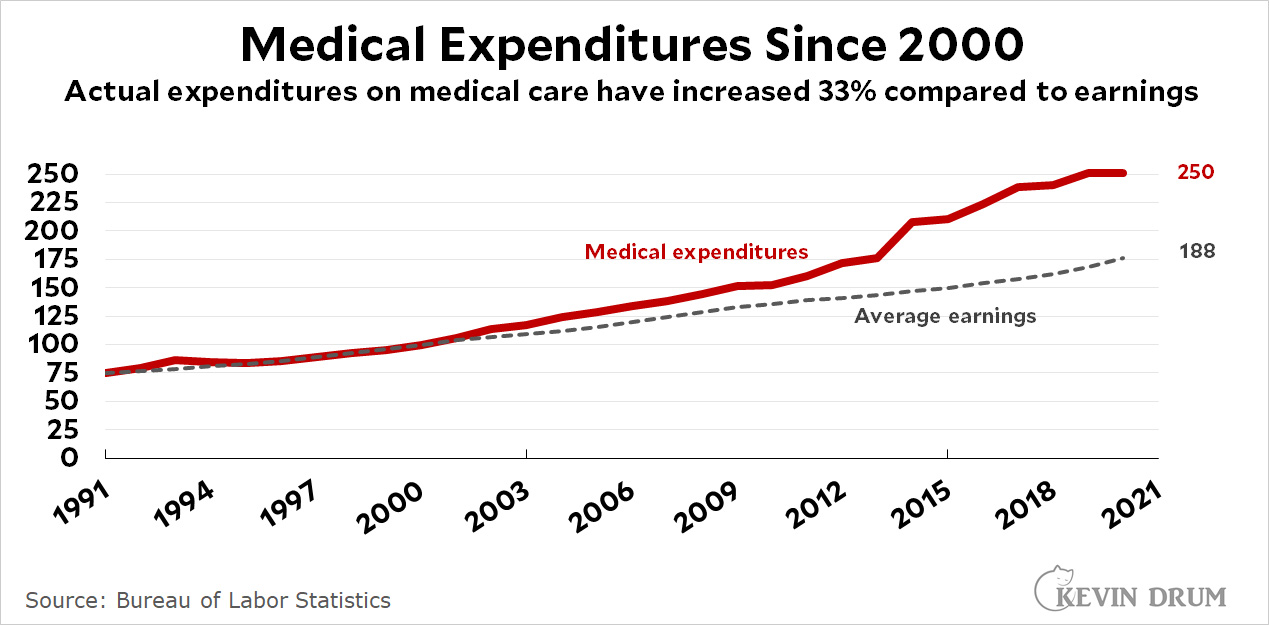
What's going on here? If medical inflation is restrained, why are we paying way more for healthcare than we used to?
The answer is that consumers are paying an increasing share of healthcare costs. Employer healthcare programs are charging bigger and bigger premiums for policies that have larger deductibles and higher out-of-pocket maximums.
There's no question that this trend is driving public sentiment toward subsidized and/or national healthcare. However, it's important to understand the underlying cause. It's not that medical care costs are spiraling, and if that's your target you're missing what's really going on.
Higher Education
Finally we get to something where costs really are spiraling:
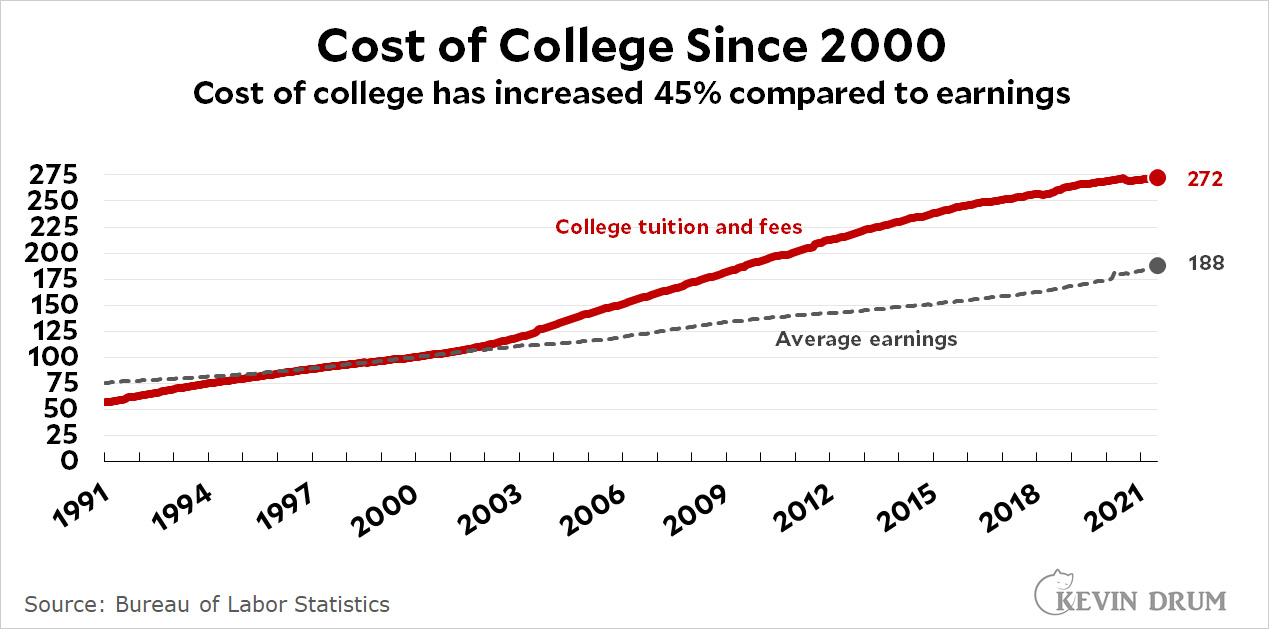
Even here, though, "it's complicated" rears its head. For starters, universities are the original masters of price discrimination: in the same way that the person sitting next to you on a plane may have paid double—or half—what you paid, averages mean nothing in higher education. Everyone pays a different price.
In particular, the net cost of tuition and fees for most public universities is basically zero for anyone with a working class income or less, and fairly modest for those with middle-class incomes.
On the other hand, this doesn't include housing, which is high for some but zero for kids who live at home and attend a commuter college.
On the other other hand, costs have spiraled for those with higher family incomes, and that's contributed to the explosion of student debt.
On the other other other hand, the most outrageous stories of student debt come from for-profit trade schools and graduate students (mostly law and MBA students). Student debt is truly a problem even for ordinary 4-year undergrads, but it's mostly a problem for those with decent family incomes and fairly good career expectations.
These are all details, and they're important, but of the four things mentioned by the Niskanen report this is the one that truly does fit their premise. Higher education costs really are spiraling, and that really does push public sentiment in the direction of ever higher subsidies. That's not a sustainable dynamic in the long run.
That's that. But why do I bother with stuff like this? It's because I look around and I see endless evidence of conventional wisdom that never gets questioned even though it's fundamentally wrong. It seems like I and others spend a lot of time pointing out things like this but it just never sinks in.
Don't take any of this as gospel. I may have some things wrong myself. However, I'm pretty sure I have the big picture mostly right, though it never seems to make much of a dent in public discourse.
Want more examples? A lot more? There's always this.