Today Mother Jones re-upped an interview from 2021 with Dorothy Brown, a law professor at Emory University who argues that the US tax code is rigged against Black people. The example she gives has to do with the so-called "marriage penalty," which in some cases makes taxes higher for married couples than if they had stayed unmarried and paid separate individual taxes:
When Congress passed the joint return, they set the stage for the marriage bonus/penalty to exist. Single-wage-earner couples, who are most likely to be white, get a tax cut when they marry, and equal-earning couples, who are most likely to be Black, pay the marriage penalty. The key is which couples are likely to be single-wage-earner households and which are likely to be co-equal earners. Black Americans need two earners to make ends meet because the labor market doesn’t compensate Black Americans the way it does white Americans.
This is not the whole story. Brown is right that among married couples, Black families are more likely to have two earners than white families, by 91% to 68%. This makes tax penalties larger and more likely for Black families. According to the Tax Policy Center:
Among those with penalties, relative to white couples, Black couples paid less in dollars ($1,804 versus $2,091) but paid more as a share of income (1.8 percent versus 1.4 percent).
This is not a huge difference. Moreover, it doesn't take into account the fact that Black women marry at much lower rates than white women. If you look at all families, it's Black families that are less likely to have two earners:
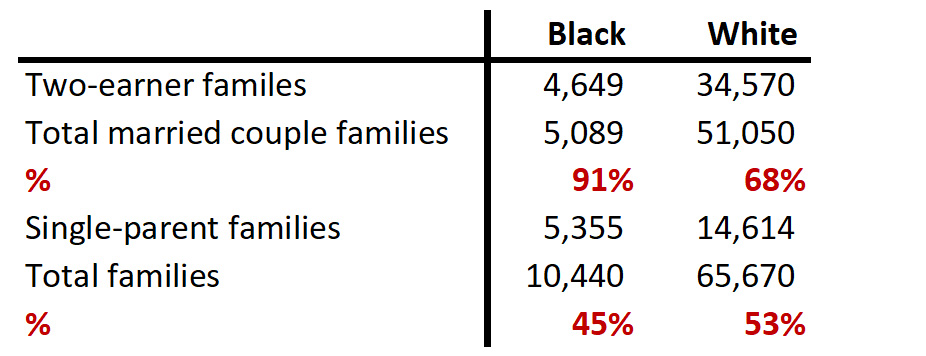 It's true that there's a slightly bigger penalty for getting married among Black couples compared to white couples, but if you look at all families it's Black taxpayers who come out ahead. Overall, there's not much evidence here of a racial bias in the tax code.
POSTSCRIPT: This is an example of doing a deep dive into some aspect of life and discovering a disparate impact on Black and white people. But while this might be a reason to change things, it doesn't necessarily show evidence of any racial animus. It took 50 years for anyone to notice this, and it's unlikely in the extreme that anyone in Congress in 1969 had the slightest idea that the creation of a new tax schedule would have any racial impact at all.